Tag Archives: layoffs

Is 2026 Going to be the Worst Year for IT Layoffs?

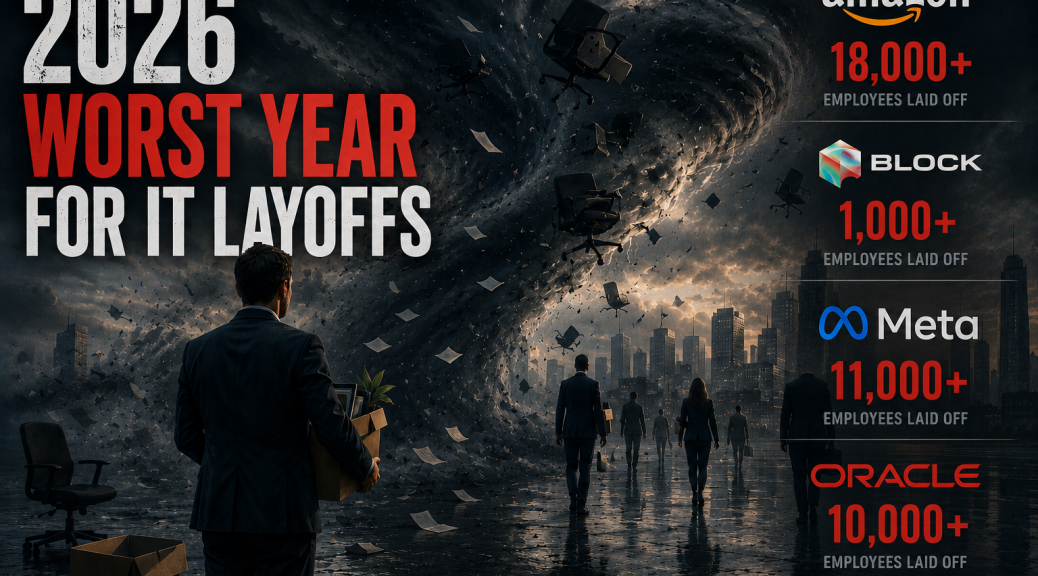
So far in 2026, the biggest IT/tech layoffs have been driven by AI spending, restructuring, and cost cuts, with published trackers putting the total anywhere from roughly 45,000 to nearly 94,000 cuts depending on scope and date [1][2][3]. The single largest named cut is Amazon’s 16,000 corporate layoffs in January, while Oracle, Meta, Atlassian, Block, Pinterest, and a growing list of others have also announced significant reductions [1][4][5][6].

Biggest known layoffs

  • Amazon: 16,000 jobs cut in 2026 so far, the largest single contributor to year-to-date tech layoffs [1][7].
  • Oracle: reports range from “thousands” to as many as 30,000 jobs, with widespread cuts beginning at the end of March [8][4][9].
  • Meta: multiple rounds in 2026, including about 700 jobs in March and earlier Reality Labs cuts of around 1,000 roles [10][5].
  • Atlassian: about 1,600 jobs, or 10% of its workforce, announced in March [6].
  • Block: 4,000 jobs, framed as a shift toward AI and automation [11].
  • Pinterest: roughly 675 jobs, about 15% of staff, tied to AI and restructuring [11][12].

Other notable cuts

  • GoPro announced 145 layoffs in April as part of restructuring and cost reduction [6].
  • EBay, WiseTech Global, Livspace, ANGI Homeservices, and MercadoLibre were also listed in early-2026 AI-related layoff roundups [11].
  • Reports also mention cuts at Disney, Snap, Epic Games, Riot Games, Salesforce, Autodesk, and others across the first quarter [2][13][14].

What the numbers say

  • One tracker-based roundup put early-2026 tech layoffs at 45,363 globally by early March [1].
  • Another put the figure at 78,557 by early April, while TrueUp-based reporting cited about 91,739 impacted workers at 229 layoff events [3][15].
  • A March report said about 9,238 cuts were directly linked to AI adoption and automation, roughly one-fifth of the total then [11].
  • The broad pattern across reports is that the U.S. accounts for most of the job losses and AI is now a major stated reason rather than just a background trend [1][3].

Important caveat

These totals vary because different trackers count different things: announced vs confirmed cuts, tech-only vs broader IT-adjacent roles, and single layoffs vs multiple rounds at the same company [1][2][16]. That means the safest takeaway is not one exact number, but that 2026 has already seen a very large wave of tech layoffs, led by Amazon and Oracle, with AI investment a central driver [1][4][16].

What is actually happening in 2025–2026

  • Tech layoffs re-accelerated through 2025, with over 100,000 tech workers cut and more than 200 tech companies reducing headcount globally.[economictimes]​
  • Many of these 2025 cuts came from large players (Amazon, Intel, TCS, Google, Meta) shifting priorities, especially towards AI and away from older or lower‑margin lines.[tomshardware]​
  • Early 2026 has already seen fresh rounds from firms like Meta (Reality Labs), Citigroup, and BlackRock, suggesting the 2025 pattern is carrying into this year.[business-standard]​

Why leaders expect more cuts in 2026

  • Surveys of executives show a clear bias towards staying lean: roughly two‑thirds of CEOs say they plan to either cut or hold headcount flat in 2026 rather than grow it.[saastr]​
  • One 2025 survey of 1,000 US business leaders found half had already pulled back on hiring, nearly 40% had done layoffs in 2025, and a majority expected further layoffs to be likely in 2026.[hrdive]​
  • Another survey of hiring managers reported that more than half expect layoffs in 2026 and see AI as a top driver of those cuts, especially for white‑collar roles.[informationweek]​

AI, “invisible unemployment,” and who is most exposed

  • A growing chunk of the pain is “invisible”: roles quietly eliminated via attrition, aggressive performance management, relocation/RTO pressure, and not backfilling departures, so the headline layoff numbers understate the chill.[saastr]​
  • Economists and industry observers describe 2026 as a “Great Freeze”: fewer new openings, more restructuring, and companies using AI plus process changes to do the same work with fewer people.[linkedin]​
  • High‑salary staff without strong AI or automation skills, recently hired employees, and some entry‑level roles are viewed by executives as the highest‑risk groups for future cuts.[hrdive]​

How this likely feels in tech and AI infra

  • For people in tech, 2026 is likely to feel like a grinding reset: fewer net new roles, more churn between companies, and continued pressure on anything tied purely to speculative AI or overbuilt infra.[info.siteselectiongroup]​
  • At the same time, companies are heavily investing in a smaller core of people who can build, operate, and productize AI and automation, including infra and observability talent, rather than cutting across the board.[finalroundai]​

Practical implications for you

  • Treat 2026 as a year to be defensive:
    • Make sure your current role is visibly tied to cost savings, reliability, or revenue, not just “innovation theatre”.[perplexity]​
    • Double down on AI‑adjacent skills (MLOps, GPU/AI infra, automation with AI copilots) so you’re in the “kept and retrained” cohort rather than the expendable one.[tomshardware]​
  • If you’re in AI/data‑center/infra, the risk is more about over‑concentration in a fragile employer or product line than the whole category disappearing; diversified or sovereign‑backed infra tends to ride out the cycle better.[perplexity]​

A-Z of 2026 Layoffs

A is for Amazon

B is for Block

https://edition.cnn.com/2026/02/26/business/block-layoffs-ai-jack-dorsey

M is for Meta

https://www.wsj.com/tech/meta-layoffs-reality-labs-2026-347008b0

https://ww.fashionnetwork.com/news/Meta-targets-may-20-for-first-wave-of-layoffs-additional-cuts-later-in-2026,1824714.html

https://cryptonews.net/news/metaverse/32726808/

O is for Oracle

https://medium.com/codex/the-stargate-sacrifice-why-oracle-is-cutting-30-000-jobs-to-bankroll-a-156-billion-bet-on-openai-4400b02e3f21

https://opentools.ai/news/oracles-bay-area-shake-up-layoffs-hit-oci-and-aiml-teams

https://www.peoplematters.in/news/strategic-hr/oracle-plans-to-cut-over-250-jobs-in-bay-area-in-latest-layoff-round-48115

https://www.cio.com/article/4125103/oracle-may-slash-up-to-30000-jobs-to-fund-ai-data-center-expansion-as-us-banks-retreat.html

The Nature of IT RIFs (reduction in force aka layoffs aka mass redundancies)

If you work for any IT company and see Slack users all of a sudden disappearing – then your company is performing a RIF. Out of the blue or with very short notice – a colleague or two’s Slack account is closed and you are left wondering why.

This trend has been around for a while now and sprung sites such as https://layoffs.fyi/ documenting the unprecedented amount of layoffs in the IT industry. Other sites document layoffs in other industries (e.g. UK education and civil service) too, and paints a gloomy picture of the state of unemployment and an extreme tough jobs market.

My current employer is make a round of RIF this moment in time! Hence this article about RIFs. I was affected by a RIF a year ago with a different corporation, so I am putting in motion things to do from the lessons I learnt from last time. I hope this will help anyone affected this time…

Trust No One

When you are being told that there is a round of RIF and “we are not affected” or “we are safe” by your manager or director – do not trust them. When this announcement is made interpret this as “you need to make plans and execute them ASAP in preparation that you will be affected”. Until the RIF round is “official” over, then consider this “unknown” period is your “at-risk” period.

By UK employment rules (the minimum that corporations will follow) your employer will have to give you an “at-risk” period (different from above!) When they give you this notice, you are able to stop work and look for other roles – internally OR externally).

My previous employer when they gave me this “at-risk” period, had already frozen hiring and no new “req”s were granted, making it impossible to get an internal role if you wanted to stay with your employer. In this situation you are effectively certain of being made redundant and will have to leave their employment…

You need to put things into place if you are going to survive the redundancy.

The Nature of IT RIFs

Two is not a pattern to draw definite conclusions on but it seems to me that when a corporation announces a record profit-making quarter, they follow this up by a record spend which forces them to make a RIF. This is the way…

The nature of IT recruitment and redundancies seem to have established a boom and bust pattern. Corporations overspend and over-recruit to achieve a commercial objective or goal (usually adding as much value to the corps as possible) and when this funding-period is over, they then perform a RIF to be able to start the next project. This is an evil cycle for the all employees, not just those who are let go.

When a RIF occurs, there’s little rhyme or reason why specific individual is affected. The main directive or goal of a RIF is to reduce costs so the corps can make up the huge spend or fund the new project – nowadays it is certain to be AI. The lowest hanging fruits will be picked first and then maybe the projects that are costing most but have delivered little and then just randomly in areas that (to the bosses) are not important. Of course, to the individual, we are all important so we ask the question why me? Why my team? Why my organisation?

There is no reason – even if your manager or director gives you a reason – this will not be it!

Accept and Move On

Successful people turn disadvantages to advantages – they accept the situation, deal with it fast – learn from the situation – and move on! They do not “sulk” or “get down” or “get stuck” – they learn, try again, try something different until they succeed. This is what anyone affected by RIF must do. When I say “accept and move on” yes, I mean accept the severance package and start on your CV/Resume and start job hunting… or if you are due a good package, buy that Porsche you’ve always wanted and drive it… into a traffic jam…

One of the help that might be available to someone who is “at-risk” is free consultation with a career coach. I must admit, I was very skeptical about this free facility at first, but once I ventured out to look at the job market, I find myself turning around and was open to help, tips, advice and motivation of any kind to get a head start.

The job market has changed a lot and has also gotten tougher and tougher with each round of redundancies. You need al the advice and coaching you can get. The successful things you did to attain the job/role that you’ve juts been made redundant from will NOT work this time! You need new job hunting skills, tools and be adaptable to the current state of the market.

Those who have not hunted for new roles or moved jobs in the past 5 or 10 years will have to learn and act fast! I see that even talent advisors and experience recruiters struggle to find new roles for themselves let alone for others…

What To Do?

This is my list – it needs to be adapted for your personal needs/situation – it is just to give you something to start with:

  1. Update/rewrite your CV/Resume
    • Your CV/resume will be current so update
    • Your CV/resume will not be in a modern format/layout
    • Your CV/resume will need to be tailored to the role
    • Your CV/resume will need to be in a format for auto-form-filling easier
    • Your CV/resume will need to be in a format for AI to process and not reject you without passing it on to a human!
  2. Create a generic cover letter
    • Your roles will be very similar in requirements, so a generic letter will save time
    • Leave areas for specifics, but don’t forget to change those specifics
  3. Sign up to LinkedIn and other job boards
    • These sites will have job hunting tips and advice so take advantage
    • These sites allow you to network so take advantage
    • These sites might have training courses or practise facilities
  4. Reach-out to contact and ex-colleagues
    • There maybe suitable vacancies with their employer
    • Ask them to spread the message that you are looking for a new role
  5. Create a spreadsheet of job applications
    • You will soon lose track of what company, the recruiter, the role, etc that you’ve applied for an why – keep a spreadsheet of all relevant info
  6. Create a routine of job searching/application and rest
    • You will need to be disciplined so a route that works with rest breaks to relieve the stress will keep you going until you are successful
  7. Practise interviews. conversations, and coding tests, etc.
    • You will need to be sharp and effective in your interview, practise and deploy all the tricks and methods for effective interview e.g. using S.T.A.R. method and the like.
    • Practise in a Zoom session and record yourself, playback to evaluate how you perform and what you should do and not do, say and not say

Good Luck!

Do not give up! And do not stop once you’ve achieved a new role! Work as though you are under threat of being made redundant – there is no such thing as a safe job any more – always actively develop and progress to the next role…

I am writing this in a situation when I am actually in my “at-risk” period… But as I’ve started this process well before the RIF news, I think I am ahead in the job queue (although not necessary near the very start!)