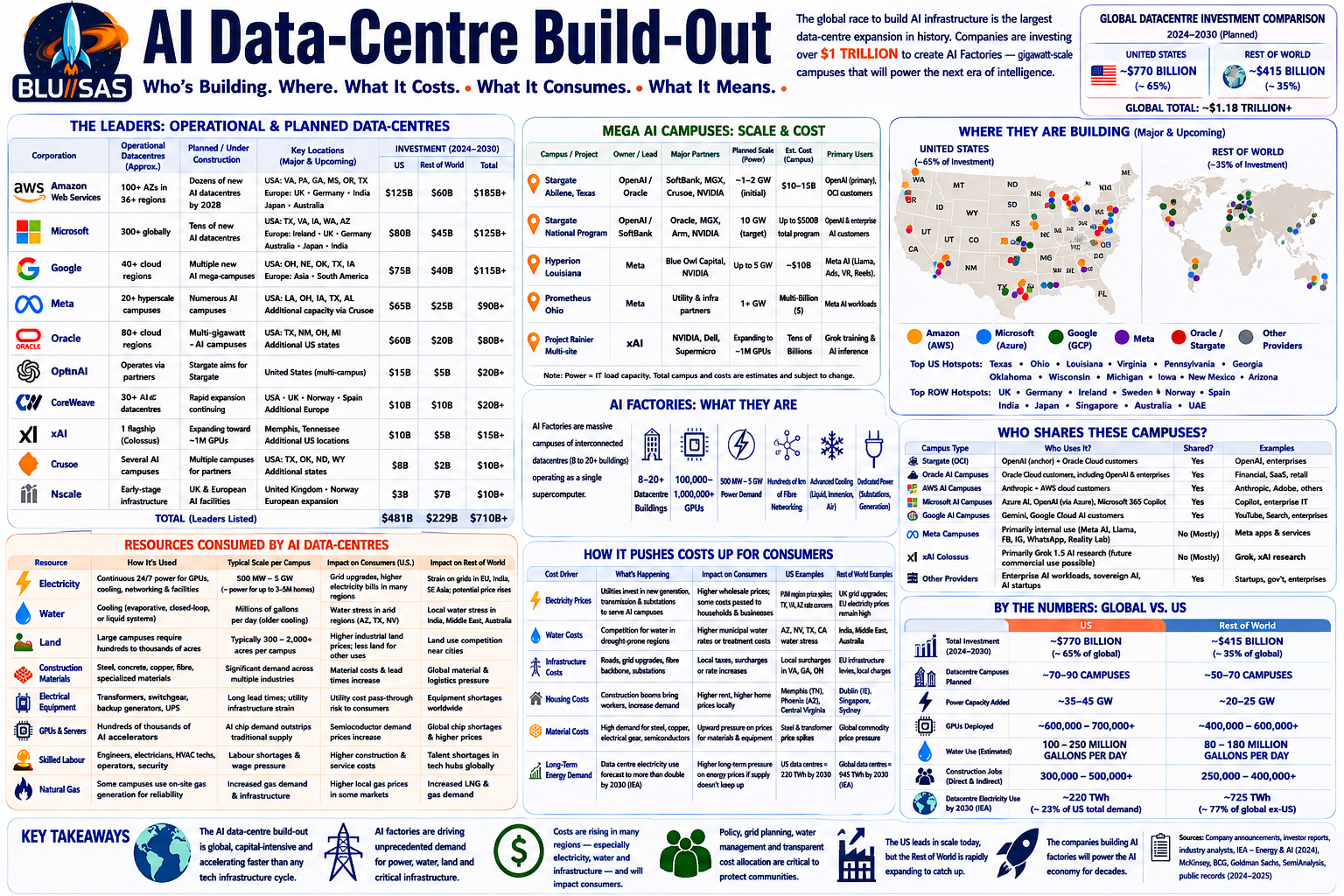
The AI infrastructure race is being led by a relatively small number of corporations, but together they represent well over US$1 trillion of planned investment over the remainder of this decade. Many figures below are approximate because companies often announce campuses or regions rather than exact building counts, and projects evolve rapidly.
Corporation
Operational data centres (approx.)
AI data centres planned / under construction
Main locations
Amazon Web Services
100+ availability zones across 36+ regions
Dozens of new AI campuses through 2028 (including Project Rainier)
USA (Virginia, Pennsylvania, Georgia, Mississippi, Oregon), Europe, UK, Germany, India, Japan, Australia
Microsoft
300+ data centres globally
Tens of new AI campuses; ~$80B AI infrastructure investment
USA, Sweden, Finland, UK, Germany, Australia, Japan, Texas, Wisconsin
Google
40+ cloud regions and many hyperscale campuses
Multiple new AI mega-campuses
Ohio, Nebraska, Oklahoma, Texas, Iowa, Europe, Asia
Meta
20+ hyperscale campuses
Numerous AI campuses under expansion
Louisiana, Ohio, Iowa, Texas, Alabama, with additional capacity from Crusoe
Oracle
80+ cloud regions
Multi-gigawatt AI campuses via Stargate plus Oracle Cloud expansion
Texas, New Mexico, Ohio, Michigan and other US states
OpenAI
Operates via partners rather than owning a global DC fleet
Stargate aims for roughly 20 major AI campuses
Texas, New Mexico, Ohio, Wisconsin, Michigan and additional US sites
SoftBank
No major hyperscale cloud estate
Co-investor in Stargate
United States (multiple campuses)
CoreWeave
~30+ AI data centres
Continuing rapid expansion
USA, UK, Norway, Spain and additional European sites
xAI
1 flagship AI supercluster (Colossus) plus expansions
Expanding toward one million GPUs
Memphis, Tennessee and additional US locations
Crusoe
Several AI campuses under operation
Multiple campuses for OpenAI, Meta and Microsoft
Texas, Oklahoma and other US states
Nscale
Early-stage AI infrastructure
UK and European sovereign AI facilities planned
United Kingdom, Norway and Europe (build-out still in early stages)
Where the biggest build-out is happening
The current hotspots are:
Texas – by far the largest concentration, with Stargate, Oracle, Microsoft, Google and xAI all investing heavily.
Ohio – Google, Meta and Oracle are all expanding there.
Louisiana – Meta’s enormous AI campus.
Virginia – still the world’s largest concentration of conventional cloud data centres.
Pennsylvania, Georgia and Oklahoma – major AWS and Google investments.
Wisconsin, Michigan and New Mexico – emerging AI infrastructure hubs.
The scale is unprecedented
The six largest AI infrastructure builders (Amazon, Microsoft, Google, Meta, Oracle and the Stargate consortium) have collectively committed around US$690–700 billion in AI-related capital expenditure, with 74 new AI-focused projects breaking ground in the US during 2026 alone. Longer-term projections suggest total AI infrastructure investment could exceed US$5 trillion globally by 2030.
One notable trend is that these companies are no longer building isolated data centres. They are constructing AI campuses consisting of anywhere from 8 to more than 20 individual data-centre buildings, all linked by ultra-high-speed networking so they function as a single giant AI supercomputer. A single campus can consume 500 MW to over 1 GW of power, equivalent to the electricity demand of a medium-sized city.
The largest AI campuses consume enormous quantities of resources. Some impacts are already measurable, while others remain uncertain and depend on how utilities allocate costs. It’s important to distinguish local effects (which can be substantial) from national effects (which are often much smaller).
Resource
How AI campuses use it
Impact on consumers
Electricity
Hundreds of MW to several GW continuously
Higher utility investment, possible higher electricity bills in constrained regions, increased need for new power stations
Water
Cooling systems can consume millions of gallons per day, although newer designs increasingly use closed-loop or air cooling
Competition for water in drought-prone areas; pressure on municipal supplies
Land
Campuses often occupy hundreds to thousands of acres
Industrial land values rise; reduced land available for other development
Construction materials
Steel, concrete, copper, fibre-optic cable
Higher demand can contribute to material price increases, though AI is only one of several drivers
Electrical equipment
Transformers, switchgear, substations
Longer lead times for utilities and industrial customers
Electrical engineers, construction workers, data-centre technicians
Wage competition and labour shortages in some regions
Natural gas
Some campuses are building dedicated gas-fired generation
Increased demand for gas infrastructure and fuel in certain markets
Electricity prices
Electricity is the area where households are most likely to notice an effect.
Large AI campuses require utilities to invest in:
New transmission lines
New substations
Additional generation
Grid upgrades
Who pays depends on regulation.
In some regions, regulators are trying to ensure that AI companies pay most of these costs. In others, some infrastructure costs are spread across all customers, which can increase household bills.
For example:
Region
Reported effect
PJM (eastern U.S.)
Wholesale electricity prices rose sharply as demand from AI data centres increased, prompting calls for tech companies to fund more of the required infrastructure.
Arizona
Utilities warn that electricity infrastructure may need to roughly double within a few years because of AI growth.
Virginia
Data centres already account for a very large share of electricity demand in some parts of the state.
It’s also worth noting that recent academic work found that, historically (2015–2024), data centres slightly reduced average U.S. electricity prices by helping spread fixed grid costs over more customers. The authors caution that this may not hold if future supply constraints become severe.
Water
Water is highly location-dependent.
Older evaporative cooling systems can use several million gallons of water per day. Newer AI facilities increasingly employ:
Closed-loop liquid cooling
Direct-to-chip liquid cooling
Air cooling where practical
These approaches can significantly reduce freshwater consumption, but water remains a concern in arid regions.
Housing
AI campuses can affect local housing markets by:
Bringing thousands of construction workers
Creating highly paid engineering jobs
Increasing demand for rental accommodation
The effect is usually local rather than national.
Employment
Benefits include:
Construction employment
Electrical contracting
Operations and maintenance jobs
Security
Network engineering
Mechanical engineering
However, once operational, AI campuses employ far fewer people than factories of similar size.
Have prices increased?
Evidence is mixed:
Item
Observed trend
Electricity
Some U.S. regions have seen higher wholesale prices and concerns about retail bills where AI demand is concentrated.
Water
Mostly local impacts in water-stressed regions rather than broad consumer price rises.
Housing
Local increases around major developments are common, though driven by multiple factors.
Construction materials
Increased demand contributes to pressure, but AI is only one of many drivers.
Consumer goods
There is currently little evidence that AI data centres have directly increased the prices of everyday retail goods.
Overall, the greatest measurable impact today is on electricity infrastructure. The International Energy Agency projects that global data-centre electricity consumption will more than double to about 945 TWh by 2030, driven largely by AI. Whether households ultimately pay more depends on regulatory decisions about who funds the new power plants, transmission lines and substations needed to support these AI campuses.
Changing Jobs and Roles
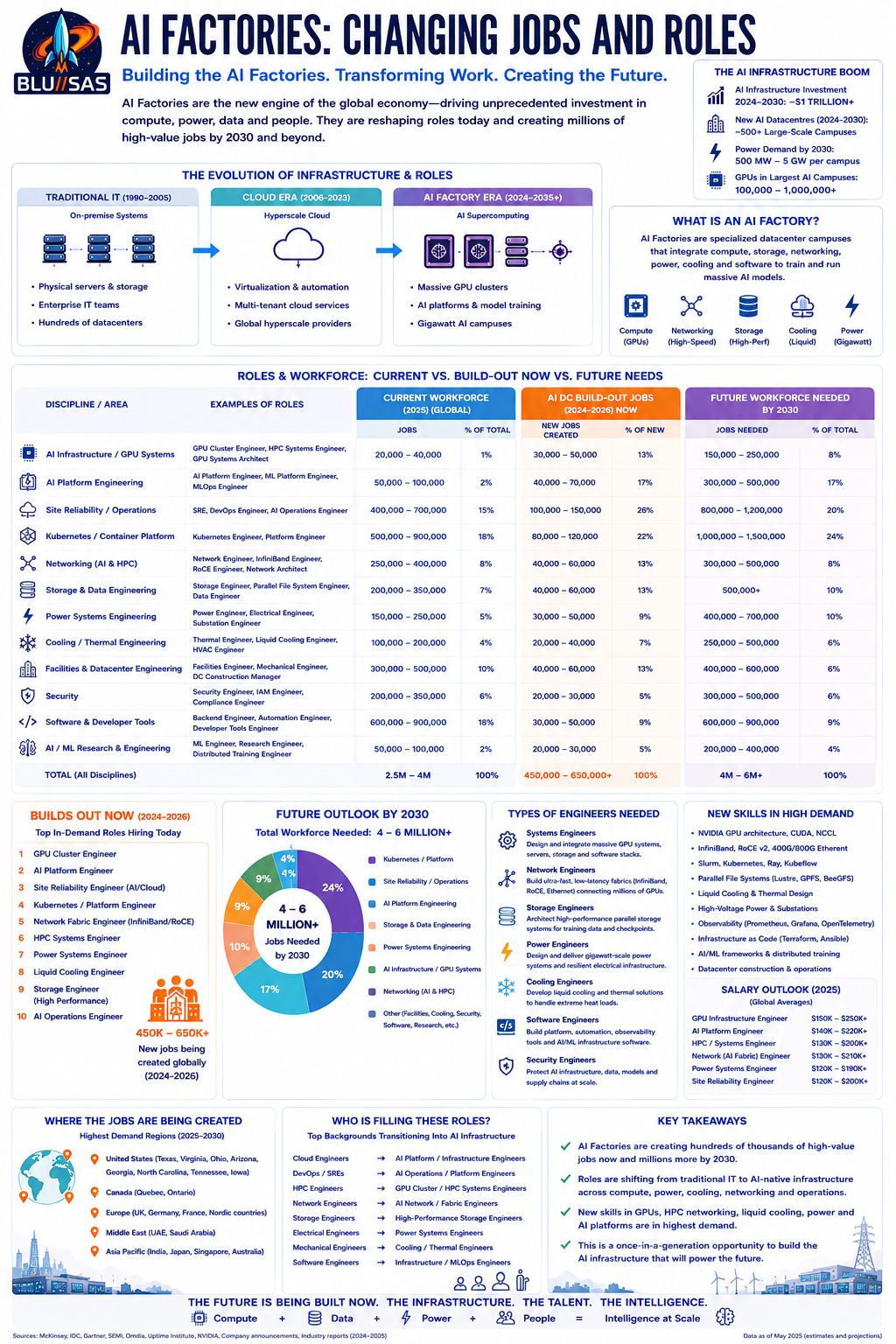
The AI infrastructure boom is creating the largest shift in infrastructure engineering since the rise of public cloud around 2006–2015. Traditional cloud providers needed engineers to build reliable, scalable services for virtual machines, storage and networking. AI Factories require all of that plus expertise in GPUs, ultra-high-speed networking, power engineering, liquid cooling and AI software platforms.
Evolution of Infrastructure Engineering
Era
Primary Goal
Main Infrastructure
Typical Employer
Enterprise IT (1990–2010)
Business applications
Servers, SAN, LAN
Banks, government, enterprises
Cloud (2006–2024)
Multi-tenant cloud services
Hyperscale datacenters
AWS, Azure, Google Cloud
AI Factory (2024–2035+)
Massive AI computation
GPU supercomputers, AI campuses
OpenAI, Meta, xAI, Oracle, CoreWeave, Nscale, AWS
Traditional Cloud Provider Jobs
Cloud providers traditionally organised engineering into around a dozen major disciplines.
Applications
Containers
Virtual Machines
Hypervisor
Servers
Storage
Networking
Power
AI Factory:
AI Models
Distributed Training
Kubernetes / Slurm
CUDA / ROCm
100,000+ GPUs
InfiniBand / RoCE
Parallel Storage
Liquid Cooling
Gigawatt Power
Traditional Cloud Skills
Linux
VMware
Kubernetes
OpenStack
AWS
Azure
Terraform
Ansible
Prometheus
Grafana
Python
Go
Storage
Networking
New AI Factory Skills
Additional skills now becoming highly valuable include:
NVIDIA GPU architecture
AMD Instinct
CUDA
NCCL
GPUDirect RDMA
InfiniBand
RoCE v2
Slurm
Ray
Kubeflow
MLFlow
Triton Inference Server
Parallel file systems (Lustre, IBM Storage Scale/GPFS, BeeGFS)
High-performance Ethernet (400/800 GbE)
Direct-to-chip liquid cooling
Rack-scale power engineering
Jobs Growing Fastest
Role
Growth Outlook
GPU Infrastructure Engineer
Extremely High
AI Platform Engineer
Extremely High
HPC Systems Engineer
Extremely High
Kubernetes Platform Engineer
Very High
Storage Engineer
Very High
Site Reliability Engineer
Very High
Network Fabric Engineer
Extremely High
Power Systems Engineer
Extremely High
Mechanical Cooling Engineer
Extremely High
AI Operations Engineer
Extremely High
Approximate Current Workforce (2025–2026)
The exact numbers are difficult to measure because many roles overlap, but industry estimates suggest:
Profession
Estimated Global Workforce
Cloud Engineers
2–3 million
DevOps Engineers
1.5–2 million
Site Reliability Engineers
400,000–700,000
Kubernetes Engineers
500,000–900,000
Datacenter Engineers
300,000–500,000
Storage Engineers
200,000–350,000
HPC Engineers
80,000–150,000
GPU Infrastructure Specialists
20,000–40,000
AI Infrastructure Engineers
50,000–100,000
Estimated Workforce Needed by 2030
As AI campuses proliferate worldwide, demand is expected to increase significantly.
Profession
Estimated Demand by 2030
AI Infrastructure Engineers
300,000–500,000
GPU Cluster Engineers
150,000–250,000
HPC Engineers
250,000–400,000
SREs (AI/Cloud)
800,000–1.2 million
Kubernetes Platform Engineers
1–1.5 million
Network Fabric Engineers
300,000–500,000
Storage Engineers
500,000+
Power Engineers
400,000–700,000
Cooling Engineers
250,000–500,000
These are indicative estimates derived from announced AI infrastructure expansion plans and broader industry workforce analyses rather than official forecasts.
Where the Talent Is Coming From
Most AI Factory engineers are not newly trained graduates. Companies are recruiting experienced professionals from adjacent disciplines:
Previous Role
Transition To
Cloud Engineer
AI Platform Engineer
Kubernetes Engineer
AI Infrastructure Engineer
SRE
AI Operations Engineer
HPC Engineer
GPU Cluster Engineer
Linux Engineer
GPU Systems Engineer
Network Engineer
InfiniBand/RoCE Fabric Engineer
Storage Engineer
AI Storage Architect
OpenStack Engineer
AI Cloud Platform Engineer
Ceph Engineer
High-performance Storage Engineer
DevOps Engineer
ML Platform Engineer
Why This Matters
The next decade is likely to see a shift similar to the transition from enterprise IT to cloud computing. During the 2010s, the most sought-after roles were Cloud Engineers, DevOps Engineers and SREs. Through the late 2020s and into the 2030s, many of the highest-demand infrastructure roles are expected to centre on AI Factories: designing, building and operating gigawatt-scale GPU campuses, high-performance storage systems, ultra-low-latency networks and AI platforms.
For someone with expertise in Linux, Kubernetes, observability, automation, storage and cloud infrastructure, the progression into AI infrastructure engineering is relatively direct. Adding knowledge of GPU platforms, HPC networking (InfiniBand/RoCE), parallel storage (such as Lustre or GPFS), Slurm, CUDA and liquid-cooled datacenter design positions engineers for many of the roles expected to see the strongest demand over the coming decade.
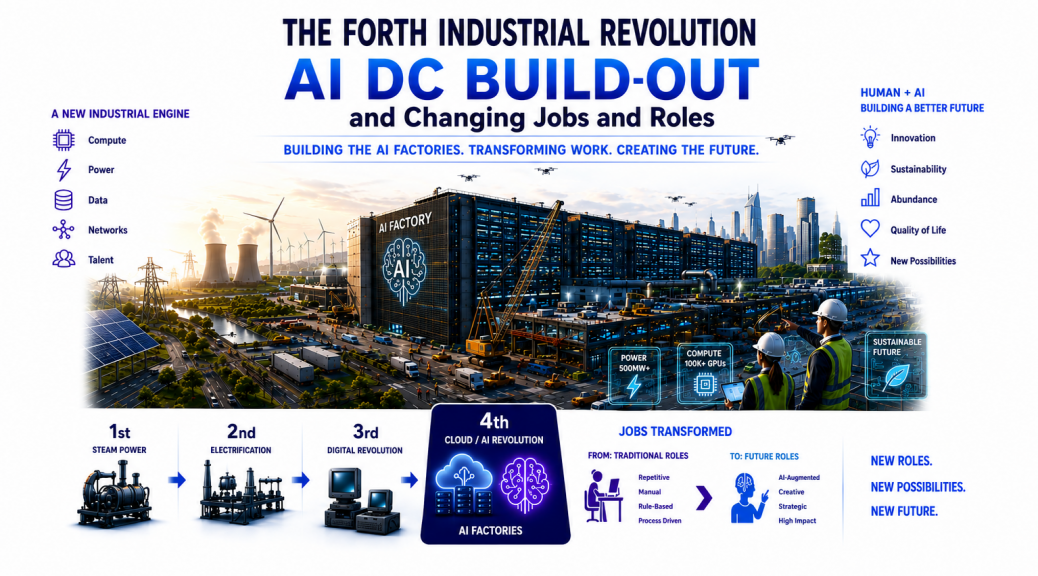
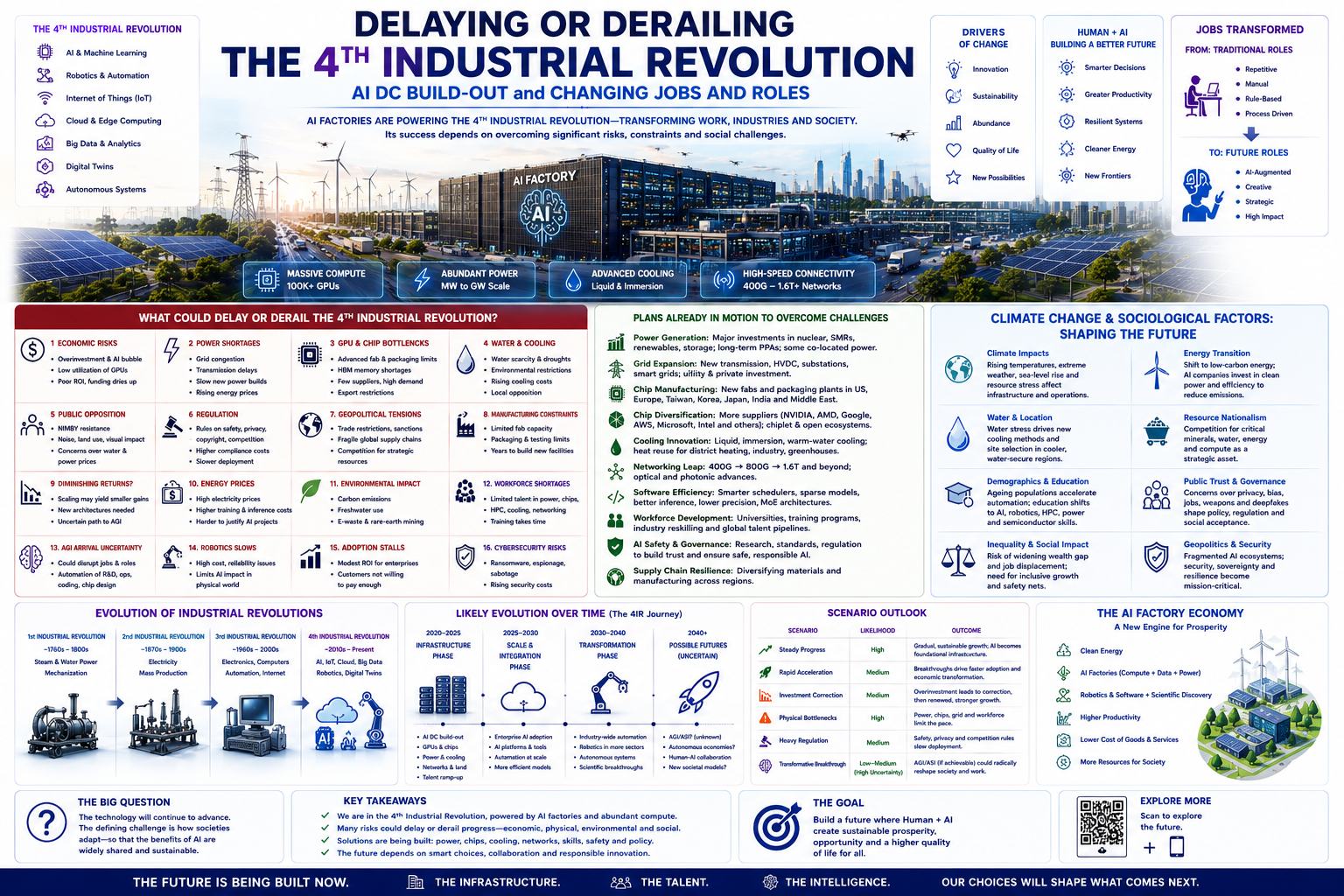
Part of the 4th Industrial Revolution
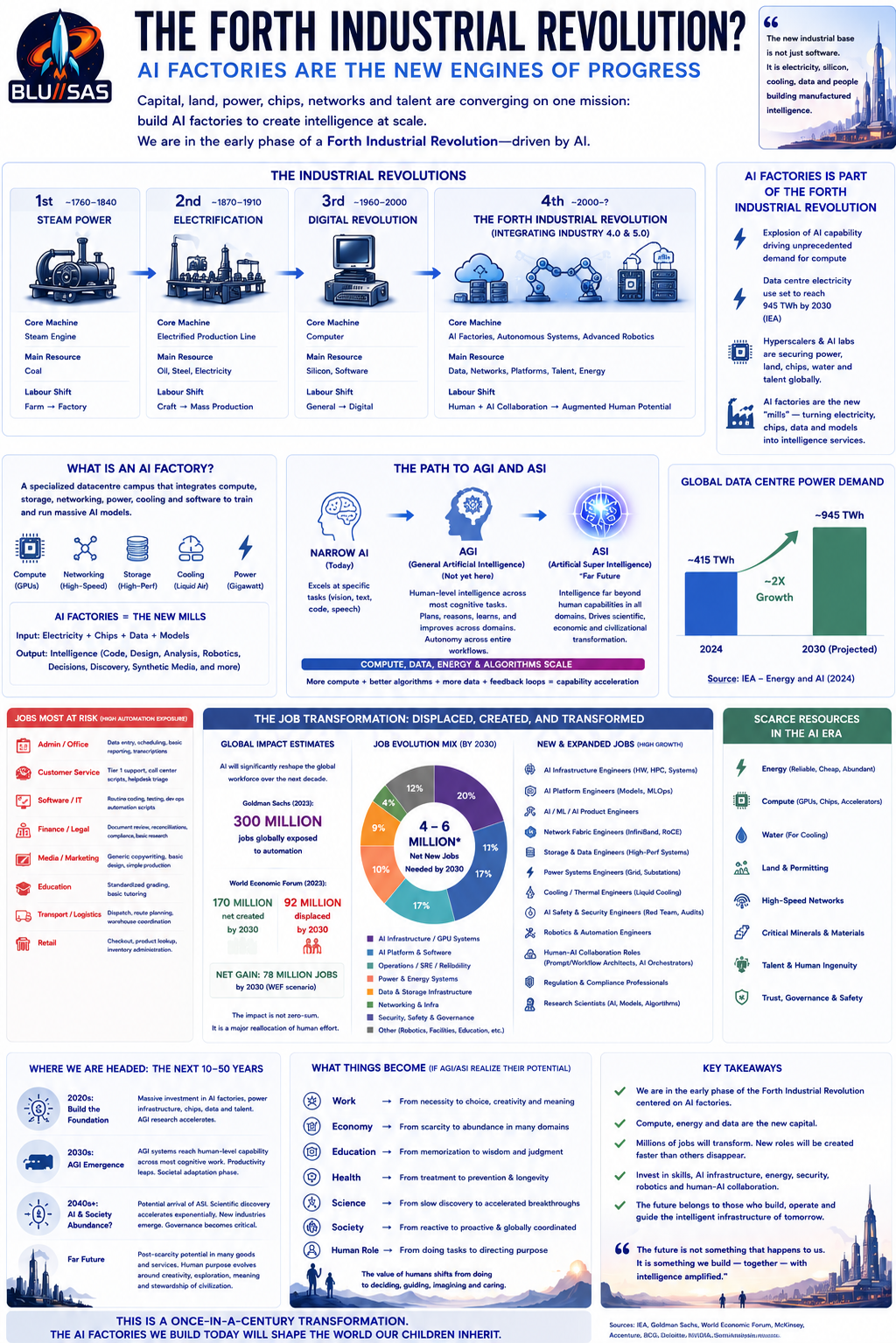
Yes — this is plausibly the tail-end phase of the Forth Industrial Revolution, but with one caveat: we do not yet know whether AGI/ASI will arrive, or when. What is clear is that capital, land, power, water, chips, networks and engineering labour are being redirected toward AI factories.
The simplest framing:
Industrial phase
Core machine
Main resource
Main labour shift
1st
Steam engine
Coal
Farm → factory
2nd
Electrified production line
Oil, steel, electricity
Craft → mass production
3rd
Computer
Silicon, software
Clerical → digital
4th
Cloud + automation
Data, networks, platforms
IT → cloud/SRE/DevOps
5th
AI factory
Compute, power, GPUs, data
Human labour → AI-augmented/AI-directed labour
The AI factory is the new “mill.” Instead of spinning cotton or stamping cars, it converts electricity + chips + data + models into intelligence services: code, design, analysis, customer support, robotics control, synthetic media, drug discovery and eventually autonomous decision systems.
The resource pull is already visible. The IEA projects global data-centre electricity consumption could roughly double to about 945 TWh by 2030, growing far faster than general electricity demand. That is why hyperscalers, AI labs and neoclouds are racing to secure power, grid connections, GPUs, cooling, land and engineering staff.
On jobs, the likely pattern is not “all jobs disappear.” It is task compression: fewer people needed for routine cognitive work, more people needed for infrastructure, supervision, security, robotics, energy, regulation and high-complexity design. Goldman Sachs has estimated that AI could expose the equivalent of 300 million full-time jobs globally to automation, while the World Economic Forum projects by 2030 about 170 million roles created and 92 million displaced, for a net gain of 78 million under its surveyed-employer scenario.
AI compliance officer, algorithmic accountability auditor
Human-AI work
Agent orchestrator, prompt/workflow architect, AI operations manager
Synthetic worlds
Simulation designer, digital twin engineer, synthetic-data engineer
If AGI arrives, the shift accelerates. If ASI arrives, the shift becomes civilisational: the scarce resources may become energy, compute rights, physical materials, robotics capacity, trusted governance and human legitimacy, rather than ordinary labour.
So yes: the AI build-out looks like the physical foundation of a Fifth Industrial Revolution — not just software, but a new industrial base built around manufactured intelligence.
Climate change and broader sociological factors are arguably the largest long-term uncertainties for the Fifth Industrial Revolution. Unlike technical bottlenecks, they can alter not just the pace of AI adoption but also where, how, and for whom AI infrastructure is built.
I don’t think climate change will stop the AI revolution, but it could fundamentally reshape it. History suggests industrial revolutions adapt to resource constraints rather than ending because of them.
Climate change
1. Energy transition
Today’s AI factories consume enormous amounts of electricity.
If climate policies tighten globally, AI companies may no longer be able to rely on inexpensive fossil-fuel generation.
This is already pushing investment towards:
Nuclear power
Small Modular Reactors (SMRs)
Geothermal
Offshore wind
Utility-scale solar
Long-duration batteries
Grid-scale storage
By the 2040s, a successful AI company may be judged as much by its carbon intensity per AI token as by its model quality.
2. Water shortages
Many AI campuses currently use water-intensive cooling.
Increasing droughts could force AI factories to relocate.
Future AI campuses are likely to favour:
Scotland
Norway
Sweden
Finland
Iceland
Canada
Pacific Northwest
Patagonia
Cool climates reduce cooling costs while providing more reliable water supplies.
3. Sea-level rise
Many current datacentres sit near coasts because they benefit from:
Fibre landing stations
Major cities
Existing infrastructure
Over decades, flood risks may encourage more inland development.
4. Extreme weather
Increasingly frequent:
Heatwaves
Wildfires
Hurricanes
Flooding
all increase operational risks.
Future campuses may need:
Greater redundancy
Fire-resistant designs
Multiple grid connections
Larger battery systems
Independent power generation
Resource nationalism
Countries increasingly recognise compute as a strategic asset.
Competition may intensify over:
Lithium
Copper
Rare earth elements
Uranium
Semiconductor-grade silicon
Freshwater
Electricity
The next century may see competition over compute capacity much as the twentieth century saw competition over oil.
Demographics
Many developed nations face ageing populations.
This may actually accelerate AI adoption.
Examples include:
Japan
South Korea
Germany
Italy
If fewer working-age people are available, automation becomes economically attractive.
Education
Universities are already adapting.
Future curricula may emphasise:
AI engineering
Robotics
HPC
Power engineering
Semiconductor engineering
AI governance
Routine programming skills alone may become less valuable than systems integration, critical thinking and domain expertise.
Public trust
AI adoption depends heavily on social acceptance.
Concerns include:
Surveillance
Privacy
Bias
Deepfakes
Autonomous weapons
Job displacement
Public backlash could lead to stricter regulation or slower deployment in some sectors.
Wealth inequality
One of the most significant risks is that AI could concentrate wealth among those who own:
AI models
Compute infrastructure
Semiconductor intellectual property
Energy assets
Data
If productivity gains are not widely shared, inequality could increase.
Possible policy responses include:
Expanded education and retraining
Wage insurance
Stronger competition policy
Tax reforms
New social safety nets
Different countries are likely to pursue different approaches.
Employment transition
Industrial revolutions historically eliminate some jobs while creating others.
The challenge is timing.
If AI removes work faster than new roles appear, societies may experience:
Higher unemployment
Political instability
Reduced consumer spending
Pressure for labour-market reforms
Managing this transition is likely to be one of the defining policy challenges of the coming decades.
Geopolitics
Compute is becoming a strategic resource.
This may encourage blocs centred around:
North America
Europe
China
India
Middle East
Each could develop increasingly independent AI ecosystems, supply chains and regulations.
Alternative futures
Scenario
AI build-out
Society
Green AI Revolution
AI powered largely by low-carbon energy; highly efficient hardware
AI helps accelerate decarbonisation and scientific progress
AI Arms Race
National security drives rapid expansion despite environmental costs
Fragmented AI ecosystems and geopolitical competition
AI Bubble
Infrastructure investment slows after poor returns
AI remains important but grows more gradually
Climate Adaptation AI
AI prioritises climate modelling, energy optimisation and resilient infrastructure
AI becomes a key tool for adapting to climate change
Post-Scarcity Transition(speculative)
Abundant clean energy and highly capable AI dramatically reduce production costs
Work shifts towards creativity, care, governance and exploration
The “AI Factory Economy”
A useful way to think about the long term is that AI factories may become a new class of critical infrastructure, similar to:
Power stations
Railways
Ports
Telecommunications
The Internet
The economy could evolve around interconnected systems:
Clean Energy
      │
      ▼
AI Factories
      │
      ▼
Robotics + Software + Scientific Discovery
      │
      ▼
Higher Productivity
      │
      ▼
Lower Cost of Goods and Services
      │
      ▼
More Resources Available for Society
That is an optimistic pathway. A less favourable outcome is also possible if productivity gains are unevenly distributed, infrastructure cannot keep pace, or environmental constraints become more severe.
The most important sociological question
The defining issue may not be whether AI becomes powerful enough—it almost certainly will continue to improve significantly. The larger question is who benefits from the productivity gains.
Previous industrial revolutions eventually raised average living standards, but they also brought decades of disruption, labour conflict and institutional change. The Fifth Industrial Revolution, if it unfolds as many expect, is likely to follow a similar pattern: technological progress may be rapid, but the economic and social institutions needed to distribute its benefits will evolve more slowly.
In other words, the success of the Fifth Industrial Revolution may depend less on building bigger AI factories and more on how societies adapt their education systems, labour markets, energy infrastructure and governance to make effective use of the capabilities those AI factories create.
“Neocloud” (sometimes written neo cloud) is a term for a new generation of cloud providers that specialize in AI computing rather than offering the full range of traditional cloud services. They focus heavily on providing high-performance GPUs for AI training and inference.
How neoclouds differ from traditional cloud providers
Traditional cloud (AWS, Azure, Google Cloud)
Neocloud
Broad range of services (databases, storage, networking, analytics, etc.)
Primarily focused on AI and GPU computing
Designed for many types of workloads
Optimized specifically for AI/ML workloads
Large hyperscale platforms
Often smaller, AI-focused companies
GPU capacity can be limited or expensive
Aim to provide faster access to GPUs and lower costs
Why neoclouds became popular
The explosion of generative AI created huge demand for GPUs such as NVIDIA H100 and Blackwell chips. Many organizations struggled to obtain enough AI compute from traditional cloud providers, creating an opportunity for specialized GPU cloud companies.
Examples of neocloud providers
Some well-known neocloud companies include:
CoreWeave
Lambda
Crusoe
Nebius
Together AI
These companies provide GPU-as-a-Service (GPUaaS) and AI-focused infrastructure.
Simple analogy
Think of traditional cloud providers as a large supermarket that sells everything, while a neocloud is a specialty store focused almost entirely on AI computing power. It may offer fewer services overall, but it is optimized for AI workloads and often provides better access to GPUs.
Nscale a European Neocloud?
Today, a more representative list of major neoclouds would include:
Company
Region
Notes
Nscale
UK / Europe
Full-stack AI infrastructure, sovereign AI cloud, GPU cloud, data centre developer.
CoreWeave
US
Often regarded as the archetypal neocloud.
Nebius
Europe
AI cloud and GPU infrastructure provider.
Lambda
US
GPU cloud focused on AI training and inference.
Crusoe
US
AI data centres and GPU cloud infrastructure.
Together AI
US
AI platform plus infrastructure.
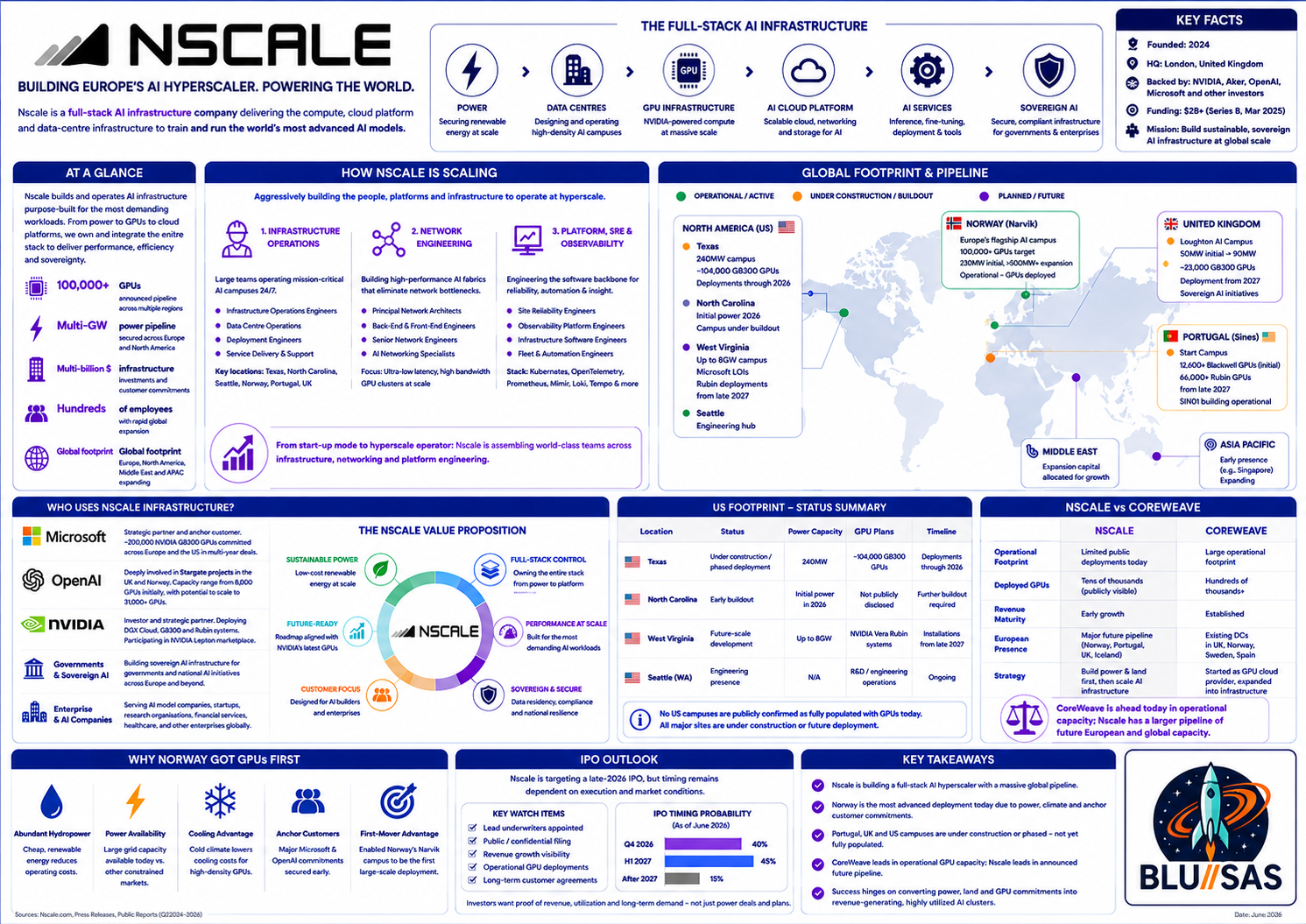
Nscale’s positioning is actually slightly different from some of the others because it is trying to be vertically integrated:
Building or owning AI data centres.
Procuring GPU fleets at massive scale.
Operating AI cloud services.
Offering sovereign AI infrastructure for governments and enterprises.
Running full-stack AI platforms rather than just renting GPUs.
Some analysts now classify Nscale as an AI hyperscaler rather than merely a neocloud because of the scale it is targeting. ABI Research ranked Nscale as the overall leader among 14 neocloud providers in its 2026 assessment.
What’s interesting is that the neocloud landscape appears to be splitting into three tiers:
AI hyperscalers – own data centres, networking, power, GPUs, and cloud platform.
Nscale is deliberately pursuing category 3. The company describes itself as a vertically integrated AI cloud and has announced very large-scale deployments in Europe and the US.
If you compare Nscale, CoreWeave, and Crusoe specifically, I’d place them like this:
Area
Nscale
CoreWeave
Crusoe
Sovereign European AI
Strongest
Limited
Limited
GPU Cloud
Strong
Very Strong
Strong
Data Centre Ownership
Extensive strategy
Growing
Extensive
AI Hyperscaler Ambition
Very High
High
High
European Presence
Strongest
Moderate
Moderate
Microsoft Partnerships
Significant
Significant
Significant
From a European perspective, Nscale is probably the closest thing Europe currently has to a home-grown AI hyperscaler.
No. If we’re talking about Europe specifically, I would actually argue the opposite:
CoreWeave is currently ahead in deployed AI infrastructure, while Nscale is ahead in announced future European capacity.
Those are very different things.
CoreWeave’s position in Europe
CoreWeave already has:
European headquarters in London.
Two operational UK data centres.
Expansion into Norway, Sweden, and Spain.
Billions already committed and deployed into European infrastructure.
A mature GPU cloud platform that is already serving customers globally.
By 2025, CoreWeave had announced European expansion into Norway, Sweden, and Spain alongside its existing UK footprint.
More importantly, CoreWeave entered Europe after already becoming a large-scale AI cloud provider in the US. They brought:
Operational expertise
Existing customers
Existing software platform
Existing GPU fleet
That is a major advantage.
Where Nscale is stronger
Nscale’s strength is the future build pipeline.
Publicly announced projects include:
Stargate Norway
Sines (Portugal)
UK AI campus developments
Iceland expansion plans
Some of these projects are absolutely enormous on paper. The Norway Stargate project alone targets 100,000 NVIDIA GPUs.
Portugal is also positioned as one of Nscale’s flagship European hubs, with 12,600+ Blackwell GPUs initially and much larger Rubin deployments planned later.
The key distinction
If you compare today’s operational reality:
Metric
CoreWeave
Nscale
Operational GPU cloud
Ahead
Behind
Existing customer workloads
Ahead
Behind
Software/cloud platform maturity
Ahead
Behind
European operational experience
Ahead
Behind
Publicly visible deployed GPU capacity
Ahead
Behind
If you compare future announced European capacity:
Metric
CoreWeave
Nscale
Norway buildout
Large
Very large
Portugal
Limited public presence
Major flagship site
Sovereign AI initiatives
Some
Strong focus
OpenAI-linked projects
Limited
Significant
Future European MW pipeline
Large
Potentially larger
A useful analogy
Today, CoreWeave is closer to:
“We already run a large AI cloud and are expanding into Europe.”
Nscale is closer to:
“We are building some of Europe’s largest AI campuses and will become a major AI cloud.”
Those are different stages of maturity.
The question investors are asking
The debate isn’t really:
“Can Nscale catch CoreWeave?”
The debate is:
“Can Nscale turn announced power, land, and GPU commitments into revenue-producing clusters before demand or financing conditions change?”
CoreWeave has already demonstrated it can operate large GPU fleets and monetize them. Nscale is in the process of proving that at the same scale.
One interesting point: some recent reporting has questioned the extent to which both companies’ European investment announcements translate into immediately operational facilities, noting that some “new data centre” claims are actually deployments into existing colocation facilities rather than brand-new campuses. That criticism has been directed at both Nscale and CoreWeave.
So as of mid-2026:
Operationally: CoreWeave is ahead in Europe.
Announced future European capacity: Nscale may have the larger headline pipeline.
Execution risk: Nscale has more to prove because a larger proportion of its European footprint is still future-dated.
Is Nscale’s IPO still on target for late 2026?
As of June 2026, there is no publicly filed prospectus, no announced exchange, and no confirmed IPO date for Nscale.
The strongest public indication that an IPO is still being pursued comes from industry reports stating that Nscale was planning a fall/late-2026 IPO and was pursuing additional US data-centre acquisitions ahead of that listing.
However, there are several reasons to be cautious about assuming it is “on target”:
Reasons it could still happen in late 2026
The AI infrastructure sector remains one of the hottest areas in public markets.
Investors have rewarded AI infrastructure companies such as CoreWeave since its public debut.
Nscale has announced very large infrastructure commitments involving Microsoft and multiple multi-hundred-megawatt campuses, which is the type of growth story public investors currently like.
Reasons it could slip into 2027
The challenge is that public-market investors increasingly want proof of:
Revenue growth
Actual GPU deployments
Utilization rates
Long-term customer contracts
Cash-flow visibility
rather than just power agreements and future construction plans.
Unlike CoreWeave, which entered public markets after operating large GPU fleets for years, much of Nscale’s most ambitious capacity remains future-dated. That creates execution risk that investors will scrutinize heavily.
What I would watch for
If Nscale is genuinely targeting a late-2026 IPO, I would expect to see during the next few months:
Appointment of lead underwriters (Goldman Sachs, Morgan Stanley, JPMorgan, etc.).
Public filing activity or confidential filing reports.
More detailed revenue disclosures.
Announcements of operational GPU deployments, not just planned deployments.
Additional long-term customer agreements.
My assessment
If I had to assign probabilities today:
Outcome
Probability
IPO in Q4 2026
~40%
IPO slips into H1 2027
~45%
IPO delayed beyond 2027
~15%
That’s not based on any insider information—just on where Nscale appears to be in its infrastructure rollout compared with where most AI infrastructure companies are when they ring the bell.
The most important signal is not the IPO date itself. It’s whether Nscale can demonstrate that its Norway, Texas, Portugal, and future UK capacity are being converted into revenue-generating GPU clusters with high utilization. If that evidence emerges during 2026, a late-2026 IPO becomes much more plausible.
CoreWeave
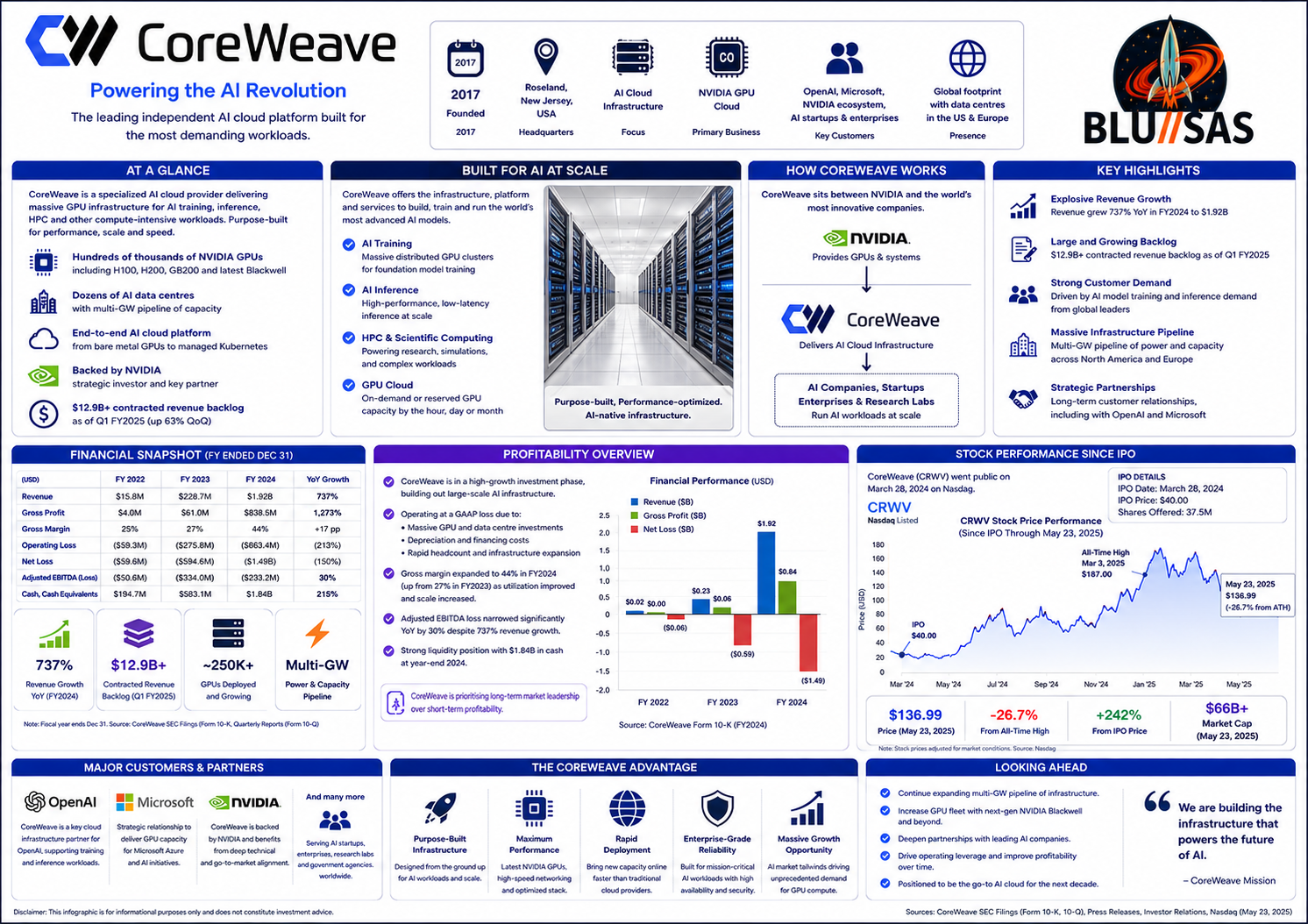
CoreWeave is an AI cloud provider that specializes in delivering large-scale GPU infrastructure for AI training, inference, HPC, rendering, and scientific computing.
The company started life as a GPU-focused cloud provider and has evolved into one of the largest independent AI infrastructure companies in the world.
Unlike AWS, Azure, and Google Cloud, which offer AI as part of a broader cloud portfolio, CoreWeave is almost entirely focused on GPU-accelerated workloads.
Category
Details
Founded
2017
Headquarters
Roseland, New Jersey, USA
Focus
AI Cloud Infrastructure
Primary Business
GPU-as-a-Service
Main Customers
OpenAI, Microsoft, NVIDIA ecosystem, AI startups
Major Hardware
NVIDIA H100, H200, GB200, Blackwell
Competitors
AWS, Azure, Google Cloud, Crusoe, Lambda, Nscale
How CoreWeave Started
The company originally operated in cryptocurrency mining.
Management realized early that:
GPUs used for mining
GPUs used for AI training
GPUs used for rendering
all required similar infrastructure.
When the AI boom began following the success of ChatGPT, CoreWeave pivoted aggressively into AI compute.
This turned out to be one of the best-timed pivots in the technology industry.
CoreWeave’s Business Model
Think of CoreWeave as:
NVIDIA
   ↓
CoreWeave
   ↓
AI Companies
Instead of:
NVIDIA
   ↓
Microsoft Azure
AWS
Google Cloud
   ↓
AI Companies
CoreWeave sits between NVIDIA and AI customers.
What Services Does CoreWeave Offer?
1. AI Training Clusters
Used for:
Large Language Models (LLMs)
Foundation Models
Multimodal Models
Scientific AI
Examples:
GPT-style models
Image generation models
Robotics models
Typical infrastructure:
Thousands of GPUs
InfiniBand networking
Petabytes of storage
2. AI Inference
After a model is trained:
Training
   ↓
Model
   ↓
Inference
Inference is what happens when:
You ask ChatGPT a question
Generate an image
Run a chatbot
CoreWeave provides infrastructure for this at scale.
3. HPC
High Performance Computing workloads:
Weather modelling
Genomics
Drug discovery
CFD
Physics simulations
This is an area where CoreWeave competes with traditional HPC centres.
4. GPU Cloud
Instead of buying:
H100s
H200s
Blackwell systems
Customers rent them by:
Hour
Day
Month
Why NVIDIA Likes CoreWeave
NVIDIA has invested in CoreWeave because CoreWeave helps NVIDIA:
By 2026, CoreWeave is operating or building infrastructure measured in:
Hundreds of thousands of GPUs
Multiple gigawatts of power
Dozens of AI data centres
This puts them among the largest AI-focused cloud providers globally.
Why Microsoft Matters
One of CoreWeave’s biggest customers has been Microsoft.
Microsoft has used CoreWeave capacity to supplement Azure AI infrastructure when Azure could not provision GPUs quickly enough.
This relationship helped accelerate CoreWeave’s growth enormously.
CoreWeave vs Nscale
Area
CoreWeave
Nscale
Founded
2017
2024
Stage
Mature AI cloud
Emerging AI hyperscaler
GPUs Deployed Today
Very Large
More Limited
Revenue
Much Higher
Earlier Growth
Operational Experience
Extensive
Building
US Presence
Major
Growing
Europe Presence
Growing
Large Future Pipeline
Data Centres
Operating Today
Many Future Builds
AI Cloud Platform
Mature
Developing
What Would Interest an SRE?
For someone coming from:
Kubernetes
Observability
OpenTelemetry
Prometheus
Mimir
Loki
Tempo
HPC
CoreWeave is fascinating because it combines:
Infrastructure Scale
Thousands of servers per cluster.
AI Networking
InfiniBand
RoCE
GPUDirect RDMA
Storage
High-throughput parallel storage
Object storage
Checkpointing
Reliability
When a training run consumes:
10,000 GPUs
×
7 days
a single infrastructure failure can cost millions of dollars.
This creates unique SRE challenges around:
Cluster reliability
GPU scheduling
Capacity management
Fleet automation
Telemetry at hyperscale
AI workload observability
Why CoreWeave is Important
CoreWeave is one of the first companies to prove that a specialist AI cloud provider can compete with traditional hyperscalers.
The company effectively created a new category:
Traditional Cloud
AWS
Azure
GCP

vs

AI Cloud
CoreWeave
Crusoe
Lambda
Nscale
That category is now one of the fastest-growing areas of infrastructure technology and is driving much of the current AI infrastructure build-out worldwide.
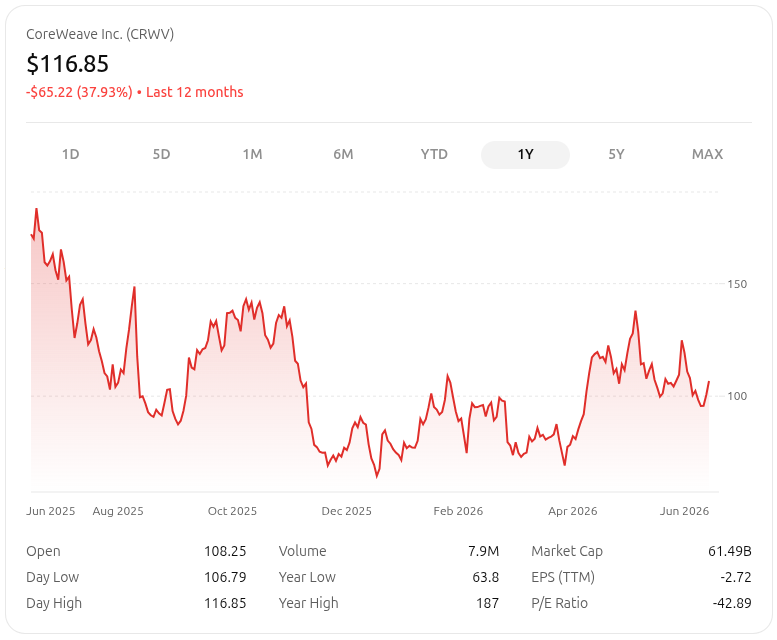
CoreWeave’s stock has had one of the most volatile post-IPO journeys in the AI infrastructure sector.
Share Price Since IPO
CoreWeave completed its Nasdaq IPO in March 2025 under the ticker CRWV. The IPO was downsized before launch, raising about $1.5 billion rather than the larger amount initially targeted.
The broad trajectory has been:
Period
Approximate Story
Mar 2025 IPO
Weak initial reception and downsized offering
Apr–Jun 2025
Strong AI enthusiasm drove shares sharply higher
Jun 2025
Reached all-time highs around $187/share
H2 2025
Significant correction as investors focused on debt, losses, and data-centre execution
Early 2026
Recovery driven by AI demand, Anthropic, Meta, OpenAI and enterprise growth
Jun 2026
Trading around $107/share
Recent trading puts the company at a market capitalization of roughly $56 billion.
The Good News Financially
Revenue Growth Is Extraordinary
CoreWeave is one of the fastest-growing infrastructure companies in the market.
Examples include:
Revenue more than doubled year-over-year in multiple recent quarters.
Enterprise adoption is expanding beyond AI labs into financial services and large enterprises.
Revenue backlog reached approximately $99.4 billion as of Q1 2026.
That backlog is enormous and provides strong visibility into future revenue.
Recent earnings showed revenue beating expectations while margins and profitability remained under pressure.
Customer Concentration
Historically, a large portion of revenue has come from a relatively small number of customers.
If:
OpenAI
Microsoft
Meta
Anthropic
decide to build more capacity themselves, future growth could be affected.
This is one reason investors closely watch customer mix and backlog growth.
Why Investors Still Like It
The bullish thesis is straightforward:
AI demand continues growing.
GPU supply remains constrained.
Training and inference workloads keep increasing.
CoreWeave owns and operates the infrastructure needed to satisfy that demand.
In that scenario, today’s debt becomes manageable because revenue grows faster than financing costs.
Compared with Nscale
If I compare the two today:
Area
CoreWeave
Nscale
Public Company
Yes
Not yet
Market Cap
~$56B
Private
Revenue
Multi-billion
Much smaller
Operational GPU Capacity
Very large
Limited publicly visible
Revenue Backlog
~$99B
Not publicly disclosed at same level
Debt
Very high
Much lower today
Execution Risk
Moderate
High
Infrastructure Maturity
Established
Emerging
CoreWeave’s biggest challenge is financial leverage.
Nscale’s biggest challenge is execution.
CoreWeave has already proven it can build and operate AI infrastructure at scale. The question investors are asking is whether it can generate enough cash flow to justify the enormous capital expenditure and debt required to stay ahead in the AI compute race.
Crusoe
Crusoe is arguably the third major AI infrastructure challenger behind CoreWeave and the large hyperscalers, and alongside Nscale and Radiant in the race to build AI factories.
What makes Crusoe unique is that it evolved from an energy company into an AI infrastructure company.
Its progression has been roughly:
Flared Gas Capture
        ↓
Power Generation
        ↓
Bitcoin Mining
        ↓
GPU Infrastructure
        ↓
AI Cloud
        ↓
AI Factories
Today the company describes itself as an “AI Factory Company” rather than a traditional cloud provider.
Current Position
Valuation
Crusoe raised:
$600M Series D (2024)
$1.375B Series E (2025)
at a valuation exceeding $10 billion.
There are also industry reports suggesting private-market discussions at significantly higher valuations during 2026, though these are not official company figures.
Funding Strength
Crusoe has now raised approximately:
$3.8B+ equity funding
Additional billions in project finance and credit facilities
including a $750M Brookfield-backed credit facility.
Compared with many startups, Crusoe has become exceptionally well capitalized.
The Abilene AI Campus
The company’s flagship project is:
Abilene, Texas
This has become one of the largest AI infrastructure projects in the world.
Public reports describe:
1.2 GW campus
Up to ~400,000 NVIDIA GB200-class GPUs planned
$15B+ joint venture funding
Major Oracle/OpenAI involvement
Multiple operational buildings already online
This campus is one of the key foundations of the Stargate ecosystem.
Relationship With OpenAI, Oracle & Microsoft
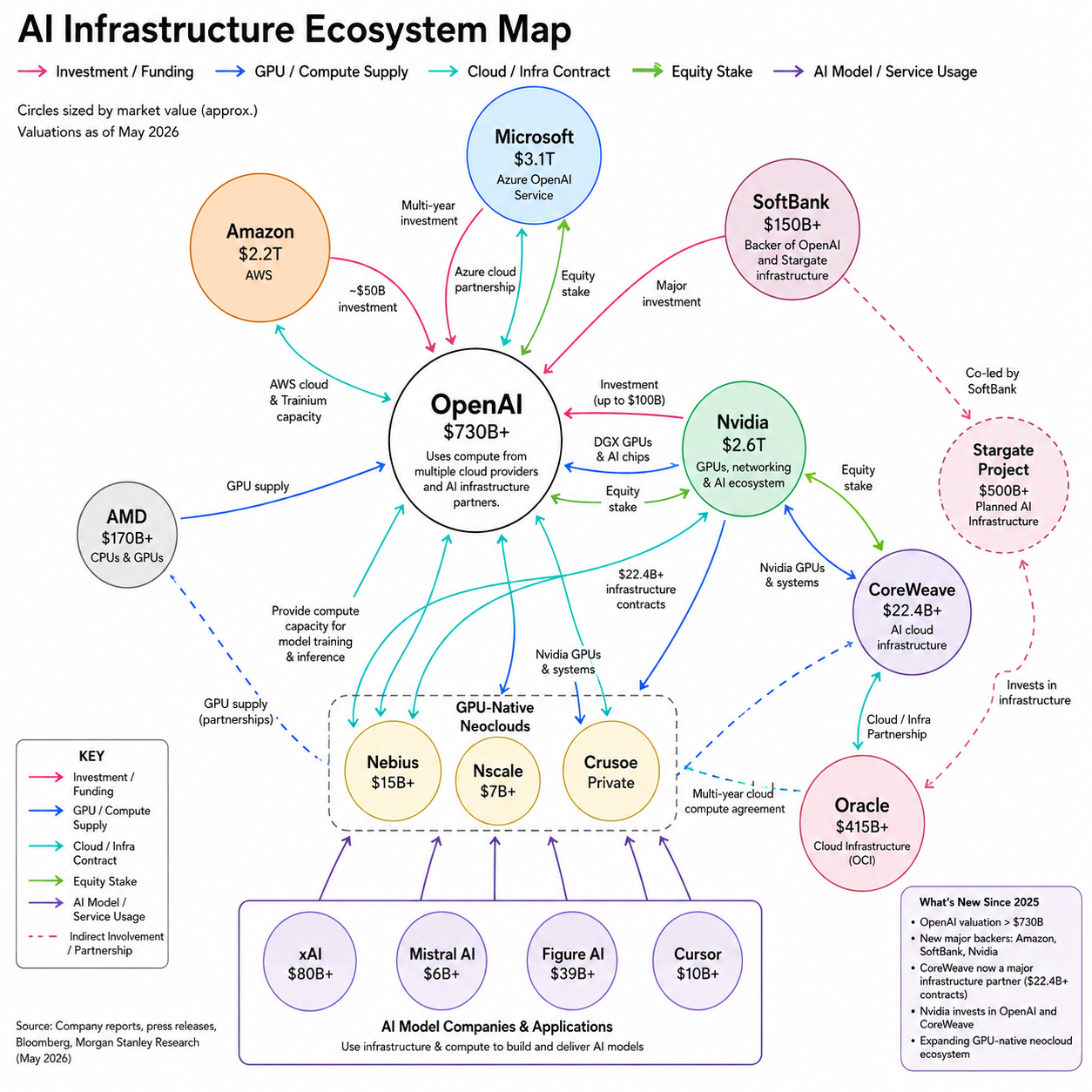
Crusoe sits at the center of a fascinating triangle:
OpenAI
   │
Oracle
   │
Crusoe
   │
Microsoft
Recent developments have been mixed:
Positive
Oracle states:
Abilene remains on schedule
Two buildings are operational
Additional Stargate capacity remains under development
Complicated
Several planned expansions have changed tenants or scope.
Reports indicate:
OpenAI and Oracle stepped back from some expansion plans.
Microsoft subsequently agreed to lease part of the adjacent capacity.
Meta has reportedly evaluated some available capacity.
This isn’t necessarily bad news—it may actually demonstrate that demand is broad enough that multiple hyperscalers are competing for capacity.
Revenue Performance
Industry estimates suggest:
Year
Revenue
2024
~$276M
2025
~$998M
2026
Potentially >$2B
These are not audited public-company figures but are widely cited estimates reflecting the company’s rapid growth trajectory.
If accurate, Crusoe would be among the fastest-growing infrastructure companies globally.
Why Investors Like Crusoe
1. Speed
Crusoe has developed a reputation for building AI infrastructure extremely quickly.
Some investors explicitly cite build speed as a competitive advantage versus traditional data-center developers.
2. Vertical Integration
Unlike many competitors, Crusoe controls:
Power
   ↓
Generation
   ↓
Infrastructure
   ↓
Data Centres
   ↓
GPU Cloud
This resembles Radiant’s strategy and increasingly resembles Nscale’s.
3. AI Factory Focus
The company is moving beyond:
GPU Rental
toward:
Complete AI Factories
which is where the largest contracts are emerging.
Current Challenges
1. Customer Concentration
Much of Crusoe’s growth is tied to:
OpenAI
Oracle
Microsoft
This creates concentration risk.
If one customer changes strategy, large projects can be affected.
2. Capital Intensity
Like CoreWeave, Crusoe requires enormous capital expenditures.
Building:
Multi-GW campuses
Power infrastructure
GPU fleets
requires tens of billions of dollars.
3. Project Volatility
Recent examples include:
Wyoming project pause
Changing Stargate scope
Customer reallocations between OpenAI, Oracle, Microsoft and others
This demonstrates that even the hottest AI infrastructure projects are not immune to execution risk.
How Crusoe Compares
Category
CoreWeave
Crusoe
Nscale
Radiant
Public Company
Yes
No
No
No
Valuation
~$56B market cap
$10B+ private
Private
Private
AI Cloud Platform
Mature
Growing rapidly
Emerging
Ori platform
Operational AI Infrastructure
Very large
Large
Smaller today
Early
AI Factory Focus
Strong
Very strong
Very strong
Very strong
Energy Integration
Moderate
Strong
Strong
Exceptional
IPO Candidate
Already public
Likely future IPO
Potential IPO
Long-term possibility
What I Think of Crusoe
Among the “new hyperscalers”:
CoreWeave is currently the operational leader.
Crusoe is probably the most advanced private AI infrastructure company.
Nscale has one of the largest future pipelines.
Radiant may have the strongest long-term capital structure because of Brookfield.
Crusoe’s biggest strength is that it has already proven it can deliver and operate very large AI campuses while still retaining startup-level speed. Its biggest challenge is moving from a few gigantic flagship projects into a diversified, repeatable AI infrastructure business that is less dependent on any single customer or project.
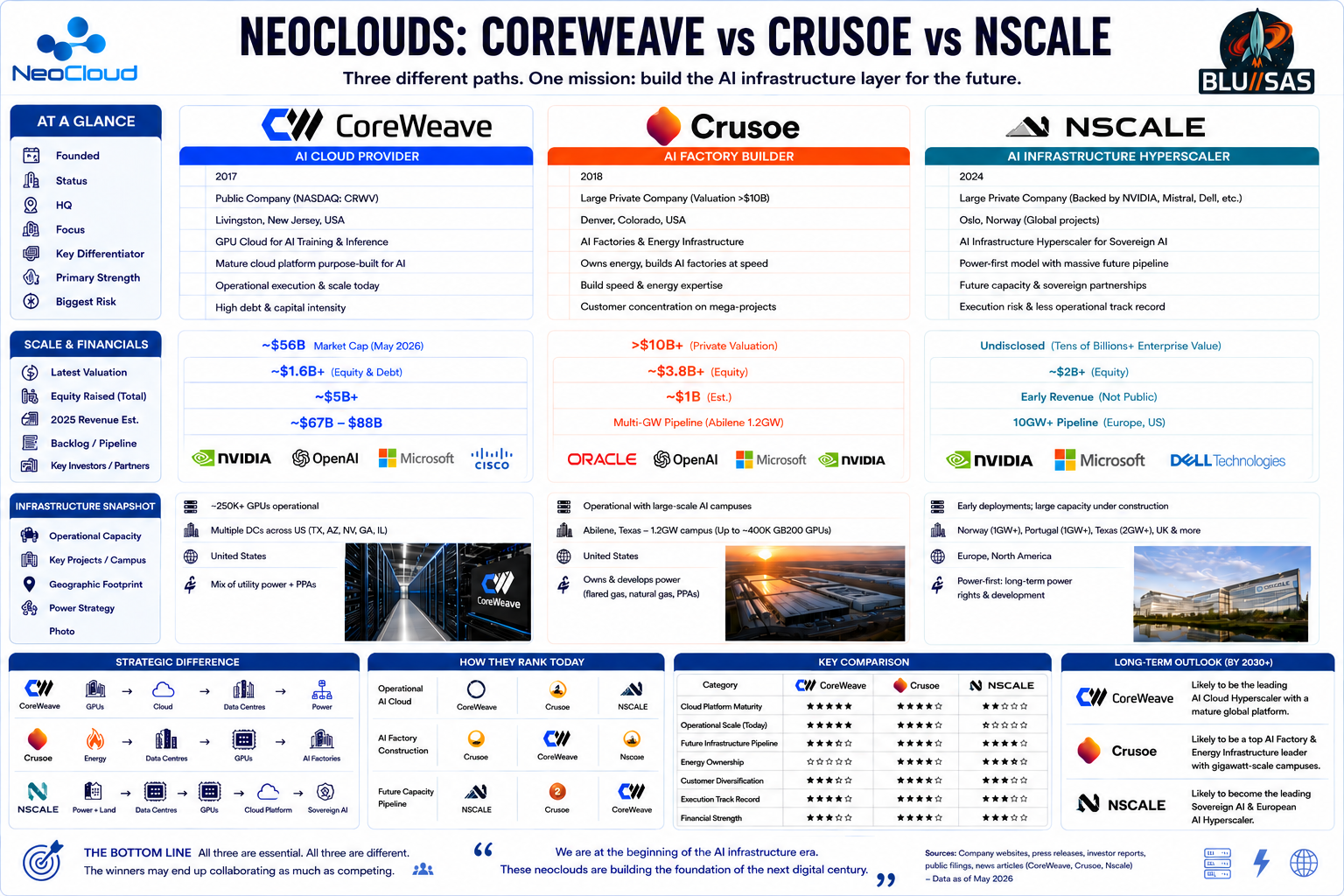
CoreWeave vs Crusoe vs Nscale
These are arguably the three most important “Neoclouds” today.
All three are trying to become the AI-era equivalent of hyperscalers, but they are taking very different paths.
Executive Summary
Company
CoreWeave
Crusoe
Nscale
Founded
2017
2018
2024
Status
Public company
Large private company
Large private company
Core Identity
AI cloud provider
AI factory builder
AI infrastructure hyperscaler
Geographic Strength
US
US
Europe
Operational Maturity
Highest
High
Emerging
AI Cloud Platform
Most mature
Growing
Developing
Energy Ownership
Limited
Strong
Strong
Future Capacity Pipeline
Large
Very Large
Enormous
Biggest Risk
Debt
Customer concentration
Execution
Biggest Strength
Operational excellence
Infrastructure delivery
Power + future capacity
CoreWeave is currently winning on execution. Crusoe is winning on AI factory construction. Nscale is winning on future infrastructure ambition.
1. CoreWeave
What CoreWeave Is
CoreWeave is fundamentally an AI-native cloud provider.
Think:
AWS for GPUs
except purpose-built for:
AI training
AI inference
LLMs
HPC
Its cloud platform is already mature and heavily used by large AI companies. CoreWeave operates dozens of data centres, hundreds of thousands of GPUs, and has become one of NVIDIA’s most important cloud partners.
CoreWeave reported more than $5B revenue and a backlog approaching $67B-$88B depending on reporting period.
Weaknesses
Huge debt load
Heavy capex requirements
Customer concentration
Public market scrutiny
2. Crusoe
What Crusoe Is
Crusoe is best described as:
Energy Company
        +
AI Factory Builder
        +
GPU Cloud
It started by monetizing stranded energy and evolved into building some of the largest AI campuses in the world.
The Abilene campus in Texas has become one of the flagship AI infrastructure projects globally and is tied to Oracle and OpenAI’s broader Stargate ecosystem.
Strengths
Extremely fast construction capability
Strong energy expertise
Large-scale AI factory delivery
Deep OpenAI/Oracle ecosystem integration
Weaknesses
Smaller cloud platform than CoreWeave
Less diversified customer base
Still heavily tied to a few mega-projects
What Crusoe Wants To Become
Crusoe appears to be evolving toward:
AI Factory Company
rather than simply a GPU cloud.
3. Nscale
What Nscale Is
Nscale is pursuing the most ambitious infrastructure vision.
Their strategy is:
Power
   ↓
Land
   ↓
Data Centres
   ↓
GPUs
   ↓
Cloud Platform
They are effectively trying to build a European AI hyperscaler from scratch.
Strengths
Massive future pipeline
Strong sovereign AI positioning
European leadership position
Large power commitments
Strong Microsoft/OpenAI/NVIDIA relationships
Weaknesses
Much of capacity remains future-dated
Less operational experience
Less mature cloud platform
Execution risk
Public reporting has highlighted that several headline projects remain in buildout or planning phases rather than being fully operational today.
The Strategic Difference
CoreWeave
Started with:
GPUs
Then added:
Cloud
→ Data Centres
→ Power
Crusoe
Started with:
Energy
Then added:
Data Centres
→ GPUs
→ AI Factories
Nscale
Started with:
Power + Infrastructure
Then added:
GPUs
→ Cloud
→ Sovereign AI
Which Company Is Furthest Ahead Today?
Operational AI Cloud
Winner:
🥇 CoreWeave
Reason:
Largest operational fleet
Most mature software platform
Largest customer base
AI Factory Construction
Winner:
🥇 Crusoe
Reason:
Abilene
Stargate involvement
Proven delivery capability
Future Capacity Pipeline
Winner:
🥇 Nscale
Reason:
Norway
Portugal
Texas
UK projects
Sovereign AI initiatives
Which Is Closest To Becoming a New Hyperscaler?
Today
CoreWeave
   ↑
   |
Crusoe
   |
Nscale
By 2030 (Potential)
CoreWeave
Crusoe
Nscale
All three could be major AI infrastructure providers, but they will likely specialize differently:
Company
Likely Long-Term Identity
CoreWeave
AI Cloud Hyperscaler
Crusoe
AI Factory & Energy Infrastructure Leader
Nscale
Sovereign AI & European AI Hyperscaler
From an SRE / Cloud Infrastructure Perspective
If you wanted to work on the most technically mature environment today:
CoreWeave
If you wanted to build some of the world’s largest AI campuses:
Crusoe
If you wanted to help create a new AI hyperscaler from the ground up:
Nscale
That is the clearest distinction between the three companies as of mid-2026.
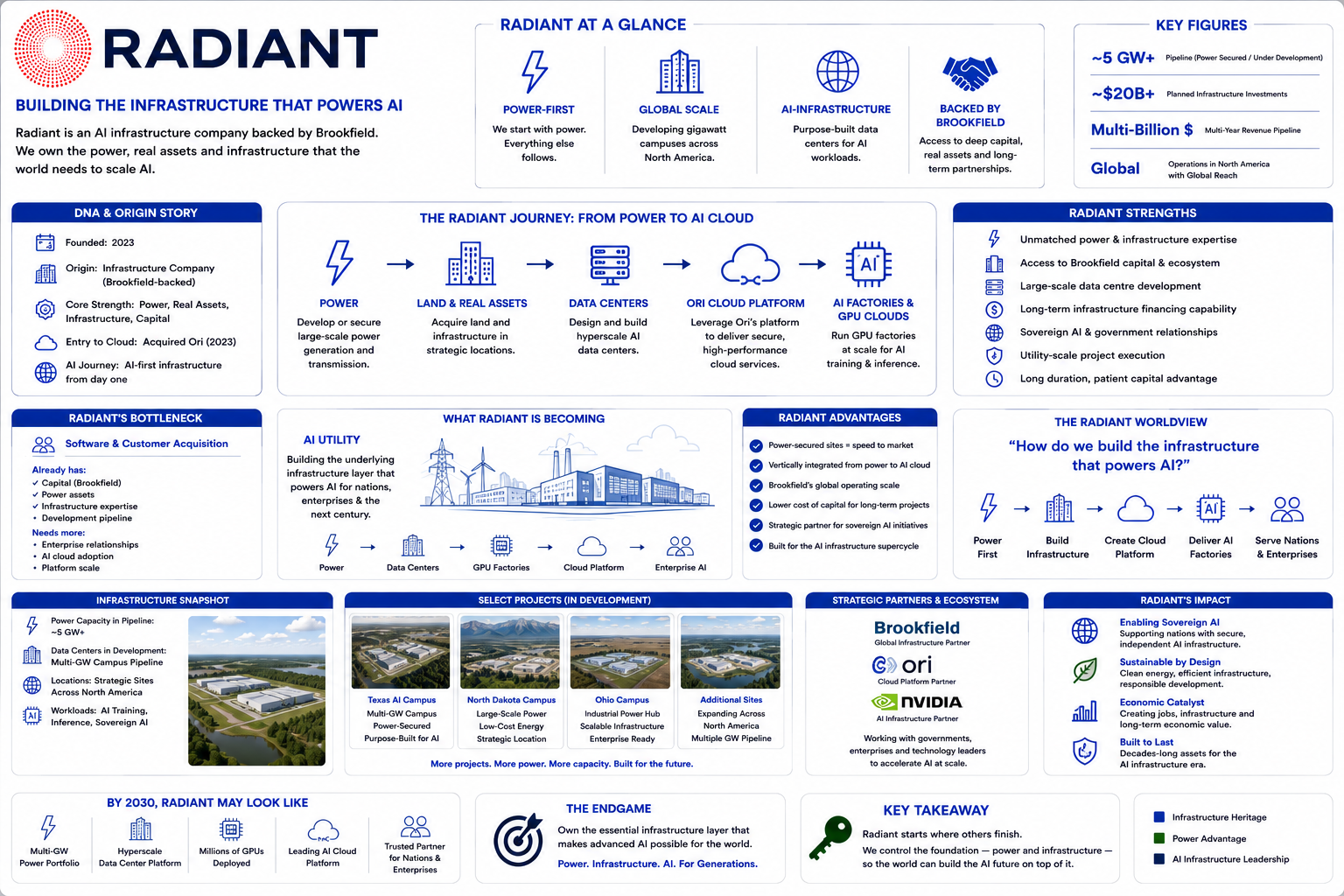
Who is Radiant?
Radiant/Ori is one of the more interesting challengers because they are not trying to copy CoreWeave or Nscale exactly.
Instead, they are attempting to combine:
Brookfield’s enormous infrastructure and energy assets
Ori’s AI cloud software platform
NVIDIA’s AI factory ecosystem
Sovereign AI demand from governments and large enterprises
into a vertically integrated AI infrastructure company.
What is Ori?
Before the merger, Ori Industries was a UK AI cloud company founded in 2019.
Ori built:
Distributed GPU cloud infrastructure
AI model training platforms
AI deployment services
Multi-location AI compute services
The company operated AI infrastructure across more than 20 global locations and developed software to orchestrate AI workloads across GPU infrastructure.
Think of Ori as:
What CoreWeave built:
GPU Cloud Platform

What Ori built:
Distributed AI Infrastructure Platform
Ori’s technology is arguably the key intellectual property in the merger.
What is Radiant?
Radiant is Brookfield’s AI infrastructure company.
Brookfield is one of the world’s largest infrastructure investors with hundreds of billions under management spanning:
Power generation
Transmission
Renewable energy
Real estate
Data centres
Infrastructure projects
Radiant was created to become Brookfield’s AI compute platform.
Why Brookfield Matters
This is where Radiant becomes potentially disruptive.
Most AI clouds have a structure like:
Raise Venture Capital
        ↓
Buy GPUs
        ↓
Rent Datacentre Space
        ↓
Sell Compute
CoreWeave largely grew this way.
Nscale is evolving toward:
Power
  ↓
Datacentres
  ↓
GPUs
  ↓
Cloud Platform
Radiant starts with:
Brookfield Capital
       +
Brookfield Power
       +
Brookfield Land
       +
Brookfield Datacentres
       +
Ori Software
That means they potentially have access to cheaper capital than most AI startups.
Their Stated Strategy
Radiant has publicly described itself as a vertically integrated AI infrastructure platform.
Target customers include:
Sovereign governments
Hyperscalers
Tier-1 telecom operators
Large enterprises
Rather than simply renting GPUs to startups.
Their focus appears to be:
AI Factories
Large installations of:
NVIDIA GPUs
AI networking
AI storage
AI orchestration software
built for nations and large corporations.
The NVIDIA Connection
Radiant is built around NVIDIA’s AI factory vision.
Public statements indicate:
NVIDIA contributed capital to Brookfield’s AI fund.
NVIDIA will supply GPUs.
Radiant will deploy NVIDIA DSX AI factories.
This places them squarely in the same ecosystem as:
CoreWeave
Crusoe
Lambda
Nscale
but with a heavier focus on sovereign infrastructure.
How They Intend to Join the Hyperscaler Club
The strategy appears to be:
Phase 1: Acquire Software
Acquire Ori.
Result:
GPU Cloud Software
AI Orchestration
AI Platform Expertise
✓ Completed.
Phase 2: Leverage Brookfield Infrastructure
Use Brookfield’s:
powered land
data centres
energy assets
instead of building everything from scratch.
This is a major advantage versus startups.
Phase 3: Build Sovereign AI Factories
Target:
governments
national AI initiatives
regulated industries
This aligns well with Europe’s push toward sovereign AI and AI factories.
Phase 4: Scale Like a Utility
This is probably the most important difference.
Several executives have stated they want AI infrastructure financed like:
Power Stations
Utilities
Rail Networks
Airports
rather than venture-backed cloud startups.
That could significantly lower financing costs compared with many GPU cloud providers.
How Do They Compare?
Company
CoreWeave
Nscale
Radiant
Founded
2017
2024
2026
Public
Yes
No
No
Core Strength
Operating GPU clouds
Building AI campuses
Infrastructure + software
Main Backer
Public markets
Investors/NVIDIA
Brookfield
Focus
AI cloud
AI hyperscaler
AI utility model
Sovereign AI
Moderate
Strong
Very Strong
Capital Access
Good
Good
Potentially Exceptional
Operational GPU Scale Today
Highest
Lower
Very Early
What Could Make Radiant Dangerous?
If you look at this as an SRE or infrastructure engineer, the biggest threat to competitors is not technology.
It is cost of capital.
CoreWeave’s biggest weakness is debt.
Nscale’s biggest challenge is execution.
Radiant’s pitch is:
“We already own the power, land, infrastructure financing, and data-centre expertise. We just needed the AI cloud software.”
That is precisely what the Ori acquisition gives them.
If Brookfield genuinely deploys the AI Infrastructure Fund at the scale discussed publicly (up to $10B fund commitments and potentially much larger through co-investment structures), Radiant could become one of the few companies capable of competing with CoreWeave, Nscale, Crusoe, and the hyperscalers in the sovereign AI factory market.
For someone with a background in Kubernetes, OpenStack, HPC, AI infrastructure, observability, Ceph, Slurm, and GPU platforms, Radiant is arguably one of the most interesting companies to watch over the next 2–3 years because they are trying to build the “AI utility company” rather than just another GPU cloud.
Is Radiant Ramping Up Recruitment?
If I were advising Radiant’s leadership after the Brookfield + Ori merger, I would not primarily hire more software developers or more data-centre staff initially.
The biggest challenge is integrating:
Energy Infrastructure
      +
Data Centres
      +
GPU Factories
      +
Cloud Platform
      +
Sovereign AI
These are the people that actually make expensive GPUs productive.
3. Staff Network Engineers
Need 20–40.
The AI industry is becoming:
Network Limited
rather than
GPU Limited
Experience:
InfiniBand
RoCE
EVPN/VXLAN
Arista
NVIDIA Spectrum
Mellanox
Sources:
Meta
Microsoft
NVIDIA
Oracle OCI
Azure
4. Site Reliability Engineers
Need 30–60.
Not generic web SREs.
Need:
Kubernetes
Linux
GPU clusters
Storage
Automation
Focus:
Reliability
Capacity
Performance
Automation
5. Observability Platform Engineers
Need 10–20.
This is where many AI companies are currently weak.
Technology:
OpenTelemetry
Prometheus
Mimir
Loki
Tempo
ClickHouse
Kafka
Mission:
Observe
Everything
including:
GPUs
Power
Cooling
Storage
Training jobs
Networks
This is one of the areas where someone with your background would be valuable.
Tier 2 — Build During Year One
6. OpenStack Engineers
Many sovereign customers still want:
Private Cloud
rather than:
Public GPU Cloud
Need:
Nova
Neutron
Cinder
Ironic
Especially for government customers.
7. Storage Engineers
Need 15–30.
Experience:
Ceph
Lustre
BeeGFS
Weka
VAST
AI clusters consume storage at enormous scale.
8. Infrastructure Software Engineers
Need 20–50.
Build:
Fleet management
Provisioning
Capacity systems
Internal developer platforms
Languages:
Go
Python
Rust
9. Platform Security Engineers
Need 10–20.
Focus:
Supply chain security
GPU isolation
Sovereign compliance
Zero trust
Tier 3 — The Secret Weapon
These are the hires that separate a cloud provider from an AI hyperscaler.
10. HPC Engineers
Need 20–40.
Backgrounds:
National labs
Universities
Supercomputing centres
Skills:
Slurm
MPI
InfiniBand
Parallel filesystems
These people understand:
10,000 GPU training jobs
better than most cloud engineers.
11. Power Systems Engineers
This is where Brookfield can dominate.
Need:
Utility engineers
Grid engineers
High-voltage engineers
Most AI companies have very few.
Brookfield already has many.
Radiant should integrate them directly.
12. Cooling Engineers
Future AI factories may be:
100MW+
500MW+
1GW+
Cooling becomes strategic.
Need expertise in:
Liquid cooling
Direct-to-chip
Immersion
The Leadership Layer
Radiant’s biggest risk is organizational silos.
Avoid:
Brookfield Team
          |
          |
       Ori Team
Instead build:
AI Infrastructure
     |
     +-- Energy
     +-- Datacentres
     +-- GPU Platform
     +-- SRE
     +-- Observability
     +-- Security
If I Had £100M Hiring Budget
I’d prioritize:
Role
Approx Headcount
GPU Platform Engineers
40
SREs
40
Network Engineers
30
Infrastructure Software Engineers
30
Storage Engineers
20
Observability Engineers
15
HPC Engineers
20
Security Engineers
15
AI Infrastructure Architects
10
Power/Cooling Specialists
20
Total: ~240 specialist engineers.
The Three Most Valuable Hires
If Radiant could only hire three categories tomorrow:
Principal GPU Platform Engineers
Principal AI Networking Engineers
Principal Observability/SRE Engineers
Those three groups determine whether a 100,000-GPU AI factory operates at:
95% utilization
or
60% utilization
The difference is potentially hundreds of millions of dollars per year in infrastructure efficiency. For a company trying to become an AI utility, those engineering disciplines are arguably more important than almost any other technical hiring category.
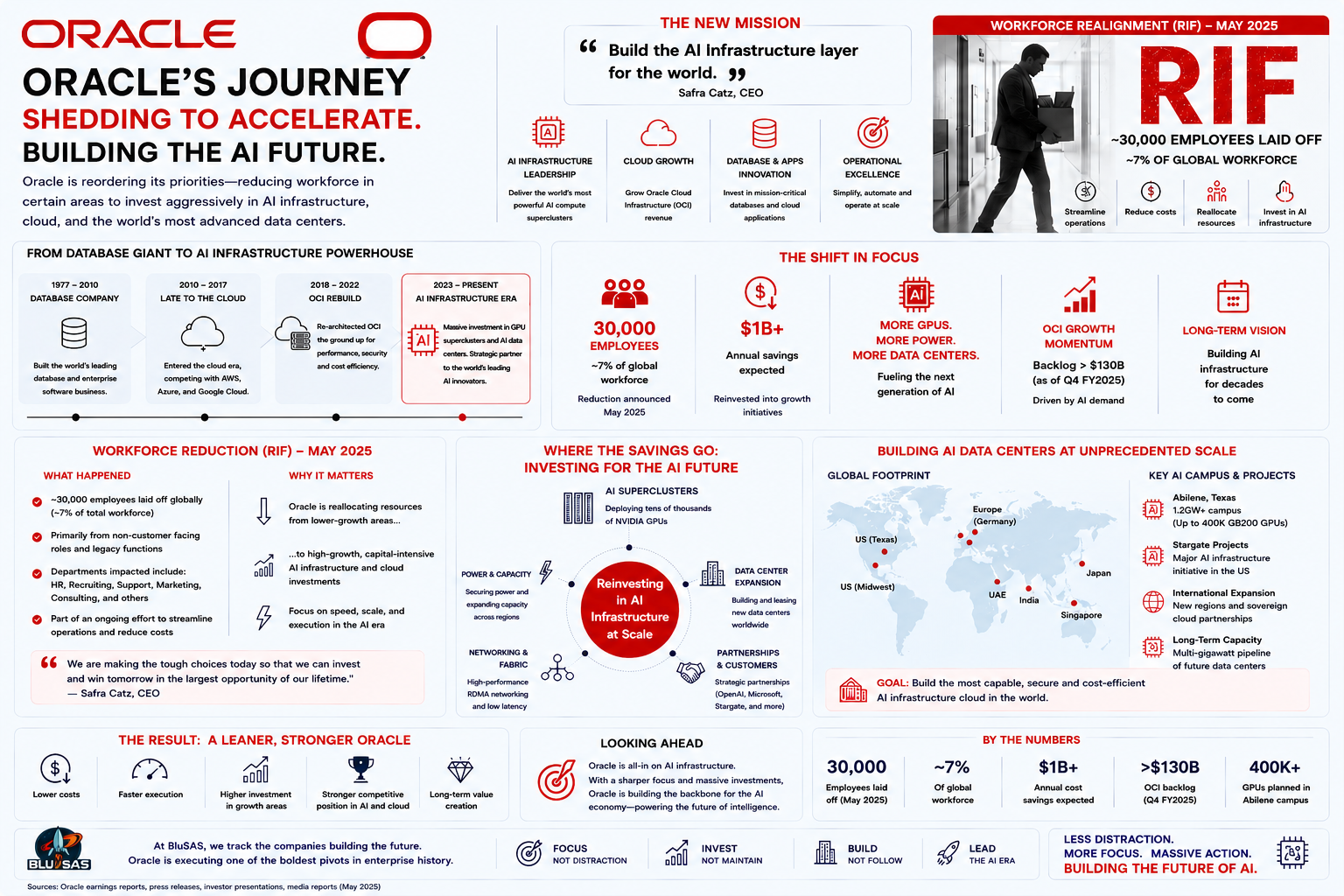
Oracle’s Journey
Phase 1: Database Company (1977-2010)
For decades Oracle was essentially:
Databases
+
Enterprise Software
Revenue came from:
Oracle Database
Enterprise applications
Middleware
Support contracts
Oracle dominated enterprise IT but missed the early public cloud wave.
Phase 2: Late Cloud Entrant (2010-2020)
AWS, Azure and Google Cloud were already well established.
Oracle’s first cloud attempts struggled because they largely tried to:
Move Oracle Products
     ↓
Into Oracle Cloud
rather than building a cloud-native platform.
OCI v1 wasn’t competitive.
Phase 3: OCI Rebuild (2018-2024)
This is where Oracle changed direction.
Under Clay Magouyrk’s leadership, OCI was essentially rebuilt from scratch.
Key design decisions:
Bare Metal First
Unlike AWS:
Physical Server
      ↓
Hypervisor
      ↓
VM
OCI emphasized:
Physical Server
      ↓
Customer
This became attractive for:
HPC
AI
Databases
RDMA Networking
Oracle invested heavily in:
RoCE
RDMA
HPC fabrics
Years before AI made these mainstream.
This is one reason OCI became attractive for GPU clusters.
Autonomous Infrastructure
OCI automated large parts of:
provisioning
patching
operations
allowing Oracle to run cloud regions with fewer people.
Phase 4: AI Pivot (2023-Present)
ChatGPT changed everything.
Oracle suddenly found that:
Their Strengths Were AI Strengths
They already had:
✓ Bare metal
✓ HPC networking
✓ RDMA
✓ Large data centres
✓ Enterprise customers
These are exactly what AI workloads need.
The OpenAI Relationship
This is where Oracle became a serious AI player.
Oracle started providing infrastructure for:
OpenAI
Microsoft
Stargate
through extremely large GPU deployments.
Oracle is now one of the biggest buyers of NVIDIA GPUs in the world.
Oracle’s AI Infrastructure Today
Oracle is building:
GB200 Clusters
Blackwell Clusters
RoCE Fabrics
AI Superclusters
At a scale that rivals many neoclouds.
Some deployments involve:
10,000+
50,000+
100,000+ GPUs
depending on project.
Why Oracle Is Different From CoreWeave
CoreWeave started with:
GPUs
   ↓
Cloud
Oracle started with:
Cloud
   ↓
GPUs
This gives Oracle advantages.
Existing Customers
Oracle already has:
banks
governments
telecoms
healthcare
These customers are now buying AI services.
CoreWeave must acquire those customers.
Oracle already has them.
Existing Revenue
Oracle generates tens of billions annually.
This means they can fund AI expansion from operating cash flow.
CoreWeave relies more heavily on:
debt
equity
project financing
Existing Global Footprint
OCI already operates dozens of regions.
Nscale and Crusoe are still building much of theirs.
Is Oracle Becoming a Hyperscaler?
Oracle already is one.
OCI is generally considered the fourth major hyperscaler after:
AWS
Azure
Google
Oracle
The question is really:
Is Oracle becoming an AI hyperscaler?
The answer is:
Yes.
Is Oracle Becoming a Neocloud?
Not really.
Neoclouds are generally:
AI First
Examples:
CoreWeave
Crusoe
Nscale
Radiant
Oracle is:
Cloud First
      ↓
AI Enhanced
A different origin story.
What Oracle Is Morphing Into
I would describe Oracle as:
Traditional Hyperscaler
          +
AI Factory Operator
          +
GPU Supercluster Provider
In fact Oracle increasingly resembles:
AWS + CoreWeave
combined.
AWS scale.
CoreWeave-style GPU infrastructure.
Why This Matters for the AI Race
The biggest threat to CoreWeave, Nscale and Crusoe may not be each other.
It may be Oracle.
Because Oracle has:
✓ Existing cloud
✓ Existing customers
✓ Existing revenue
✓ Existing data centres
✓ Existing support organisation
✓ Existing enterprise sales force
✓ Massive GPU procurement
The neoclouds must build these capabilities.
Oracle already has them.
The Next 5 Years
If current trends continue:
Company
Likely Position 2030
AWS
Largest general cloud
Azure
Largest enterprise AI cloud
Google
AI + data platform leader
Oracle
AI infrastructure hyperscaler
CoreWeave
Largest independent AI cloud
Crusoe
AI factory leader
Nscale
Sovereign AI hyperscaler
Radiant
AI utility platform
My view is that Oracle is not becoming a neocloud.
Instead, Oracle is doing something arguably more powerful:
It is transforming from a traditional hyperscaler into an AI hyperscaler while retaining all the advantages of an established cloud provider.
That combination of existing scale, enterprise relationships, and AI infrastructure investment is why Oracle has suddenly become one of the most important players in the AI infrastructure market.
Is Oracle the opposite of Radiant and vice versa?
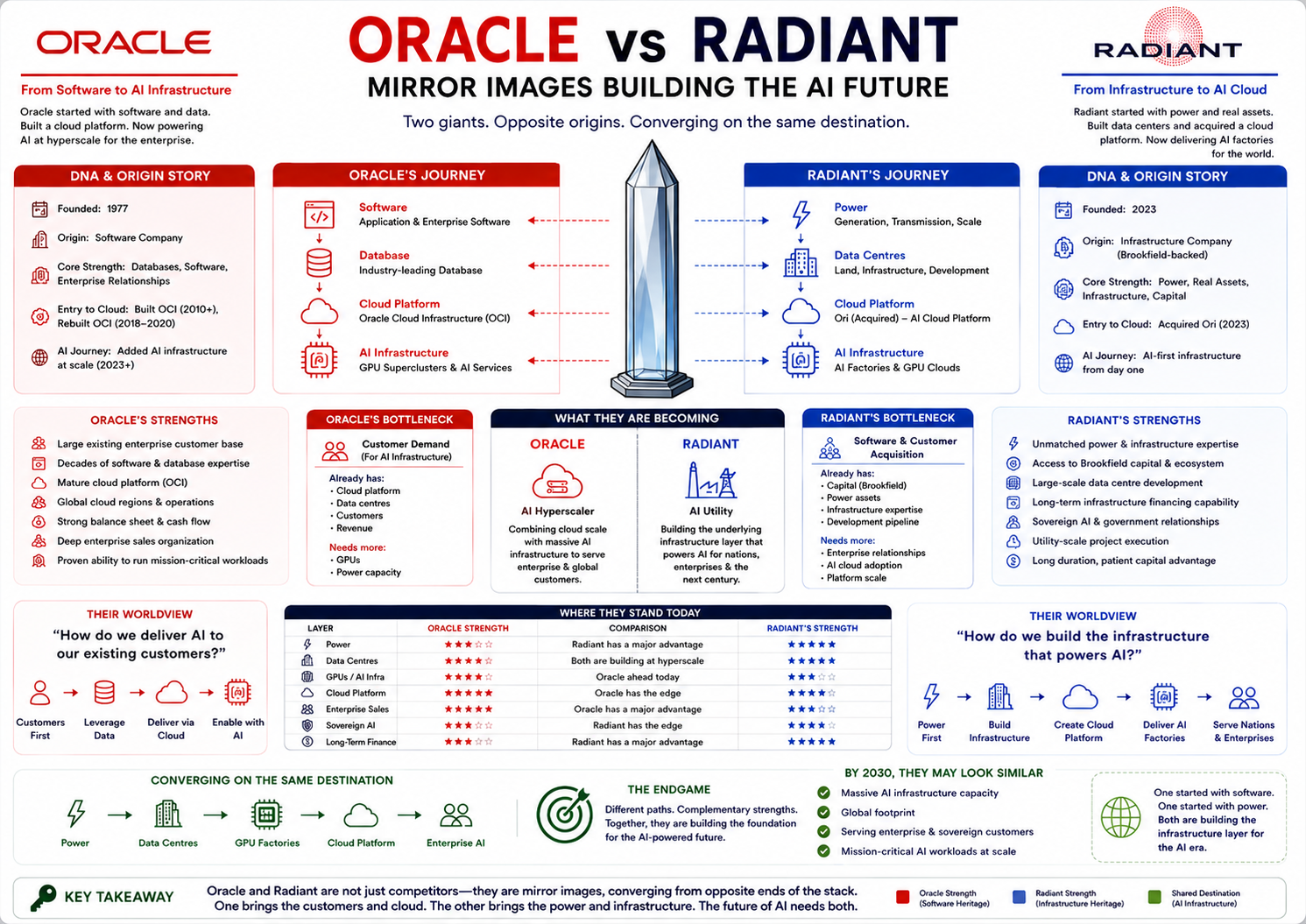
Not exactly, but they are surprisingly close to being mirror images of each other.
If you look at their origins:
Oracle
Radiant
Started with software
Started with infrastructure
Database company
Infrastructure company
Built cloud platform
Acquired cloud platform (Ori)
Added AI later
Added AI from day one
Enterprise customers first
Sovereign AI first
Compute-centric
Power-centric
Cloud → AI
Infrastructure → AI
A useful way to think about it is:
Oracle
-------
Software
   ↓
Database
   ↓
Cloud
   ↓
AI Infrastructure

Radiant
--------
Infrastructure
      ↓
Power
      ↓
Data Centres
      ↓
AI Infrastructure
So they are converging on a similar destination from opposite directions.
Oracle’s DNA
Oracle fundamentally thinks like a software company.
Radiant fundamentally thinks like an infrastructure company.
Its worldview is:
Power
   ↓
Land
   ↓
Data Centre
   ↓
GPU Factory
   ↓
AI Services
Its biggest assets are:
Brookfield capital
Brookfield power
Brookfield real estate
Brookfield infrastructure expertise
Ori’s AI platform
Radiant asks:
“How do we build the infrastructure that powers AI?”
The Biggest Difference
Oracle’s bottleneck is usually:
Customer Demand
They already have:
Data centres
Customers
Revenue
They need more GPUs and power.
Radiant’s bottleneck is usually:
Software & Customer Acquisition
They already have:
Capital
Infrastructure expertise
Energy
They need:
AI cloud adoption
Enterprise relationships
Platform scale
What They Are Trying To Become
Oracle is evolving toward:
AI Hyperscaler
Radiant is evolving toward:
AI Utility
Those are related but different.
Oracle Vision
Oracle Cloud
        +
AI Superclusters
        +
Enterprise AI
Think:
“AWS/Azure with massive AI capability.”
Radiant Vision
Power
    +
Data Centres
    +
AI Factories
    +
Long-term Infrastructure Contracts
Think:
“National Grid meets CoreWeave.”
Why Radiant Could Learn From Oracle
Radiant lacks:
Enterprise software experience
Large-scale customer operations
Decades of cloud platform evolution
Oracle has all of that.
Why Oracle Could Learn From Radiant
Radiant understands:
Power economics
Infrastructure financing
Long-duration capital
Utility-scale thinking
areas where Oracle historically has less expertise.
If They Met In The Middle
The interesting thing is that both companies are converging toward something like:
Power
   ↓
Data Centre
   ↓
GPU Factory
   ↓
Cloud Platform
   ↓
Enterprise AI
The difference is where they started.
Layer
Oracle Strength
Radiant Strength
Power
Moderate
Exceptional
Data Centres
Strong
Exceptional
GPUs
Strong
Emerging
Cloud Platform
Exceptional
Good (via Ori)
Enterprise Sales
Exceptional
Developing
Sovereign AI
Moderate
Strong
Long-Term Infrastructure Finance
Moderate
Exceptional
The More Interesting Comparison
I actually think the closest opposite of Radiant is not Oracle.
It’s CoreWeave.
CoreWeave
Started with:
GPUs
   ↓
Cloud
   ↓
Data Centres
   ↓
Power
Radiant
Started with:
Power
   ↓
Data Centres
   ↓
Cloud
   ↓
GPUs
Those are almost exact inverses.
Oracle sits somewhere else entirely because it arrived carrying:
Databases
+
Enterprise Software
+
Cloud Platform
which neither CoreWeave nor Radiant possessed.
So my assessment would be:
CoreWeave and Radiant are the closest opposites.
Oracle and Radiant are converging from opposite ends of the technology stack.
By 2030, Oracle and Radiant may end up looking surprisingly similar externally, even though one began as a software giant and the other as an infrastructure and energy giant.
Reflective Journeys: Oracle vs Radiant
Yes, in many cases Oracle employees affected by AI-related restructuring could be strong candidates for Radiant, but it depends heavily on which part of Oracle they came from.
The interesting thing is that Oracle and Radiant are moving toward the same destination from opposite directions:
Oracle
Database
   ↓
Cloud
   ↓
AI Infrastructure

Radiant
Power
   ↓
Infrastructure
   ↓
AI Infrastructure
That creates a surprising amount of skill overlap.
Oracle Employees Radiant Should Recruit Aggressively
OCI Engineers
These are probably the highest-value hires.
Experience:
OCI regions
Cloud operations
Bare metal
Networking
Cloud automation
Radiant needs people who know how to operate cloud infrastructure at scale.
These engineers bring exactly that.
AI Infrastructure Engineers
Oracle has been building:
GPU superclusters
RDMA fabrics
RoCE networks
AI training environments
Those skills are directly transferable to:
Radiant AI factories
GPU clouds
Sovereign AI deployments
OCI SREs
Particularly valuable:
Capacity planning
Reliability engineering
Infrastructure automation
Fleet management
Radiant will need these people immediately as AI factories scale.
Data Centre Engineers
Oracle has been building data centres globally.
Skills:
Capacity planning
Facility operations
Power
Cooling
Commissioning
These map extremely well to Radiant’s infrastructure-first strategy.
Network Engineers
Potentially the most valuable category.
Particularly if they have:
RoCE
RDMA
EVPN/VXLAN
High-performance networking
AI infrastructure is increasingly network-limited rather than GPU-limited.
Observability Engineers
This is a category many AI infrastructure companies underestimate.
Skills:
OpenTelemetry
Prometheus
Grafana
Logging platforms
Distributed tracing
Radiant will eventually need to observe:
Power
Cooling
Networks
Storage
GPUs
Training Jobs
Cloud Platform
at enormous scale.
Oracle Employees Radiant May Need Less Of
Traditional ERP / Applications Teams
Experience in:
E-Business Suite
HR systems
Legacy applications
is less directly relevant.
Radiant is building infrastructure rather than enterprise applications.
Traditional Database Administration
Still useful, but lower priority.
Radiant’s biggest bottlenecks are more likely:
GPUs
Networking
Data centres
Cloud platforms
than Oracle Database administration.
Would It Be Good For The Employees?
Potentially yes.
Oracle is becoming:
Large AI Hyperscaler
Radiant is becoming:
AI Infrastructure Startup
with Brookfield backing
Some engineers prefer:
Oracle
Stability
Massive scale
Mature processes
Existing customer base
Radiant
Building from scratch
More influence
Faster decision making
Potentially larger individual impact
If I Were Radiant’s CTO
The first Oracle hires I would target would be:
OCI Principal SREs
OCI Network Architects
OCI GPU Platform Engineers
OCI Capacity Engineers
OCI Observability Platform Engineers
OCI Data Centre Build Engineers
These people have already operated infrastructure at scales that Radiant wants to achieve.
Looking at Your Background
Based on the areas you’ve worked deeply in—observability, OpenTelemetry, Prometheus/Mimir/Loki/Tempo, Kubernetes, HPC, storage, automation, cloud platforms, and AI infrastructure—the type of role that would likely be most valuable to a company like Radiant is not a generic SRE.
It would be something closer to:
Principal Observability Engineer
AI Infrastructure Observability Architect
Staff SRE (AI Platforms)
Platform Engineering Lead
AI Factory Telemetry Architect
because one of the hardest problems these emerging AI infrastructure companies will face is creating observability across the entire stack:
Power
  ↓
Data Centre
  ↓
Network Fabric
  ↓
GPU Cluster
  ↓
Kubernetes / Slurm
  ↓
AI Workloads
Very few engineers have practical experience spanning that many layers.
One caveat: public reporting has discussed Oracle workforce reductions in various parts of the business, but I have not seen reliable evidence supporting a single confirmed figure of “30,000 layoffs” across Oracle as a whole. When evaluating career moves, it’s better to focus on the strategic trend—Oracle investing heavily in AI infrastructure and cloud—rather than any specific layoff number unless confirmed by Oracle itself.
Where is all the Money?
The short answer is:
The money is real, but most of it is not sitting in a bank account waiting to be spent.
What you’re seeing is a combination of:
Cash flow
Debt financing
Equity financing
Project finance
Infrastructure finance
Customer pre-commitments
Stock market valuations
The AI infrastructure boom is probably the largest capital deployment into technology infrastructure since the construction of the Internet and mobile networks.
and lenders treat those GPUs almost like collateral.
Similar to:
Mortgage
   ↔ House

Loan
   ↔ GPU Fleet
Oracle
Oracle is different.
Oracle generates tens of billions in annual revenue.
Their funding comes primarily from:
Operating Cash Flow
Database Revenue
SaaS Revenue
Support Contracts
OCI Revenue
This is actual cash arriving every quarter.
Oracle can invest from profits.
Corporate Debt
Oracle also issues bonds.
For example:
Oracle Bond
    ↓
Investors buy it
    ↓
Oracle receives cash
This is normal corporate finance.
AWS
AWS funding is even simpler.
Amazon generates huge cash flows.
When AWS builds a data centre:
Retail Business
+
AWS Revenue
+
Debt Markets
fund it.
The money is real.
Microsoft
Microsoft is currently spending at extraordinary levels.
Funding comes from:
Windows
Office 365
Azure
LinkedIn
GitHub
Copilot
All producing cash.
Microsoft can spend tens of billions annually because they generate enormous free cash flow.
Nscale
Nscale is much more interesting.
Nscale doesn’t have Oracle’s cash flow.
Instead funding comes from:
Equity Investors
Strategic Investors
Infrastructure Finance
Project Finance
Future Customer Contracts
Think:
Power Agreement
      +
Land
      +
Customer Demand
      ↓
Banks lend money
Crusoe
Crusoe is heavily project-finance oriented.
Example:
OpenAI
     ↓
Needs Capacity

Oracle
     ↓
Needs Capacity

Crusoe
     ↓
Build Campus
The campus may be funded by:
Equity
Infrastructure loans
Project financing
Long-term customer commitments
Similar to how airports and power stations are financed.
Radiant
Radiant may have the strongest financing model.
Why?
Because Brookfield already finances:
Power stations
Airports
Ports
Railways
Data centres
worth hundreds of billions.
Brookfield understands:
Build Asset
      ↓
Generate Revenue
      ↓
Repay Debt
better than almost anyone.
Radiant can potentially tap into infrastructure capital that many neoclouds cannot.
Is The Money “Real”?
Yes.
But there are three different meanings.
Real Cash
Example:
Microsoft earns:
$100
Customer pays.
Microsoft receives:
$100 cash
Real money.
Debt
Example:
Bank lends:
$10 Billion
to build AI infrastructure.
Also real money.
But must be repaid.
Market Valuation
This is where people get confused.
Example:
CoreWeave market cap:
$56 Billion
That does NOT mean:
$56 Billion cash
exists.
It means:
Share Price × Shares Outstanding
equals $56B.
Much of that value exists “on paper.”
The Hidden Fuel: Pension Funds
Most people don’t realize who ultimately finances much of this.
The money often comes from:
Pension funds
Sovereign wealth funds
Insurance companies
Infrastructure funds
For example:
Teacher Pension
      ↓
Infrastructure Fund
      ↓
Brookfield
      ↓
AI Data Centre
The chain can be surprisingly long.
Why Everyone Is Comfortable Lending
The reason banks are willing to lend is simple:
They believe AI demand will continue growing.
Their assumption is:
GPU Demand
      >
Debt Cost
If true:
Loans get repaid.
Investors make money.
Infrastructure grows.
If false:
Some companies will fail.
Some campuses will be underutilized.
Some lenders will take losses.
The Biggest Risk
The entire AI infrastructure sector is making a giant bet:
Future AI Demand
If AI demand keeps growing:
Oracle wins.
Microsoft wins.
CoreWeave wins.
Crusoe wins.
Nscale wins.
Radiant wins.
If demand slows dramatically:
The most leveraged companies suffer first.
That is why investors currently view:
Company
Financial Risk
Microsoft
Low
Oracle
Low
AWS
Low
Google
Low
Radiant/Brookfield
Moderate
Crusoe
Moderate
Nscale
Moderate-High
CoreWeave
High
The hyperscalers are largely spending from enormous existing cash flows. The neoclouds are spending mostly against future growth, future contracts, and infrastructure financing. The money is real, but much more of the neocloud funding stack depends on future demand continuing to justify today’s investments.
The 2026 AI Funding Diagram
Key changes since the Bloomberg/Morgan Stanley “AI Money Machine” chart from late 2025
OpenAI
Valuation increased from roughly $500B to over $730B–850B after its record funding rounds in 2026.
New major funding sources:
Amazon
SoftBank
Nvidia
OpenAI is now much less dependent on Microsoft than the original chart suggests.
Amazon (missing from the original)
Amazon is arguably the biggest omission now:
Invested approximately $50B in OpenAI.
Expanded AWS compute commitments.
OpenAI agreed to use AWS infrastructure and Trainium capacity.
SoftBank (missing from the original)
Became one of OpenAI’s largest financial backers.
Major participant in Stargate-style infrastructure funding.
CoreWeave
OpenAI relationship expanded to about $22.4B in AI infrastructure contracts.
Now one of OpenAI’s largest compute suppliers.
Public company rather than private neocloud startup.
Nvidia
Still sits at the center.
Added direct investment into OpenAI.
Continues investing in CoreWeave while simultaneously selling GPUs to it and buying capacity from it.
Nscale and Nebius
The original chart correctly anticipated their importance.
They now fit into a larger category of “GPU-native neoclouds” alongside CoreWeave.
Their role is increasingly as infrastructure providers for AI model companies rather than model developers themselves.
Nscale/Nebius increasingly recognized as AI infrastructure providers
For your interests in AI infrastructure, neoclouds, and hyperscalers, a more useful 2026 version would actually be an “AI Infrastructure Ecosystem Map” showing:
Nvidia
AMD
OpenAI
Microsoft
Amazon
Oracle
SoftBank
CoreWeave
Nebius
Nscale
Crusoe
xAI
Mistral
Figure AI
Stargate
with arrows for:
Capital investment
GPU purchases
Cloud contracts
Equity stakes
AI model consumption
That would better reflect where the industry sits today than the original Bloomberg graphic.
There isn’t going to be a single answer to why we are experiencing major global internet outages of late. There will be a number of reasons that are all coinciding to produce these recent occurrences.
Recognising these reasons will allow us to predict who is next after AWS, Azure and Cloudflare…
Why is today’s internet so fragile?
Recent outages at AWS, Azure, and Cloudflare have starkly exposed just how fragile today’s internet is, largely due to concentrated infrastructure, dependency on a handful of providers, and architectural choices that allow minor failures to trigger global disruptions.gulfnews+2
Extreme Centralization
The internet now relies heavily on a few “invisible” giants: AWS, Azure, Google Cloud, and Cloudflare together account for most global web traffic, hosting, routing, and security.techwireasia+1
Cloudflare alone accelerates and protects an estimated 20% of all internet traffic. When any of these services experience issues, disruption ripples across thousands of companies and billions of users, as seen in recent events.computing+1
Cascading Failures
Outages often start with technical errors such as DNS failures, network misconfigurations, or buggy software updates. Because so many services are built on top of these platforms, a seemingly small incident can snowball rapidly into crippling downtime across the world.modern-networks+1
For example, a DNS outage at AWS led to millions of user lockouts and stalled applications globally, while Cloudflare’s recent bug knocked out platforms like ChatGPT, X (Twitter), Spotify, and many SaaS tools all at once.deployflow+2
Lack of True Redundancy
While cloud vendors offer robustness at the hardware and software level, many applications and businesses still depend on single providers or even single cloud regions, lacking the architectural redundancy needed for true resilience.cnn+1
Multi-cloud designs are promoted as a solution, but adoption remains slow due to complexity and cost.economictimes+1
Legacy Internet Foundations
Critical protocols like DNS, which translate website names to machine addresses, are based on decades-old designs. If DNS fails at a major provider, or a bad configuration is cached globally, the effects can take hours or even days to fully resolve.techwireasia+1
Economic and Societal Risk
Because core digital payments, communications, and business tools are now web-based, cloud outages don’t just inconvenience consumers—they can disrupt financial markets, logistics, healthcare, and government.itbrief+1
Governments are beginning to treat cloud and network resilience as matters of national security, pushing for failover planning and measures against systemic risk.gulfnews+1
Driving the Future
These outages are accelerating moves to adopt decentralized architectures (Web3), distributed CDNs, and alternatives to centralized cloud platforms.gulfnews
Still, until broad and real decentralization is achieved, today’s internet remains vulnerable to concentrated points of failure—making global web fragility an ongoing and deeply technical challenge.cnn+1
Is the complexity of modern software, apps and services that make the internet brittle?
There is strong, concrete evidence that the rising complexity of software, applications, and IT services is directly making the internet more brittle and increasingly prone to outages.uptimeinstitute+2
How Complexity Drives Fragility
Modern applications are built on tightly interdependent components, microservices, APIs, and SaaS layers. Even minor changes—like a configuration tweak or a faulty software update—can cascade through interconnected systems, causing large-scale outages.ashrafmageed+1
Real-world outages, such as the infamous Facebook, AWS, and Azure disruptions, have repeatedly been traced back to software bugs, unexpected side effects between services, or misconfigurations in complex control planes.thousandeyes+1
Concrete Examples
The October 2021 Facebook outage resulted from a misconfiguration update that propagated through its global BGP (Border Gateway Protocol) infrastructure, causing a full disconnection from the internet—demonstrating how internal software complexity can have massive external effects.theintelligraph
The 2020 Azure and recent AWS outages were triggered by subtle software bugs or missteps in automated update pipelines. What began as isolated technical errors quickly led to global knock-on effects due to hidden dependencies and insufficient isolation between services.thousandeyes+1
The CrowdStrike security software update in 2024 caused mass Windows system crashes and “bootloops,” showing how a flaw in widely deployed software had a systemic effect far beyond one organization.news.exeter
Industry Data and Research
Reports from Uptime Institute and industry observers state that software, network, and configuration issues—many stemming from growing complexity—are the fastest-growing sources of critical IT outages. As architectures shift to the cloud, hybrid or multi-cloud forms, and “infrastructure as code,” the number of places where failure can originate multiplies.securitybrief+1
Complexity makes it harder for engineers to fully understand the system, increasing cognitive load. Documentation may lag, tests are often brittle, and adding new features or changing existing code can unintentionally break other parts of the stack, amplifying the risk of downtime.codurance+1
In Summary
Concrete evidence from industry reports, postmortems, and technical analyses shows that software and architectural complexity is now a leading cause of major outages across the internet and digital services.uptimeinstitute+2
As IT services and software systems become ever more entangled, even small mistakes or bugs can propagate, causing widespread disruption and emphasizing the need for simplicity, redundancy, and rigorous testing in critical systems.theintelligraph+1
The third reason for internet outages being more common and prevalent in the modern age
A third major reason internet outages are more common in the modern age is the increased frequency and sophistication of cyberattacks, including ransomware and targeted digital assaults on critical infrastructure.datacenter.uptimeinstitute+2
Cybersecurity Threats and Ransomware
Recent years have seen a rapid rise in outages caused by cyberattacks, especially ransomware campaigns and distributed denial-of-service (DDoS) attacks targeting cloud providers, SaaS platforms, and essential network infrastructure.telconews+1
These attacks can disable services, corrupt data, and sometimes require shutting down affected systems entirely for forensic investigation and restoration.datacenter.uptimeinstitute
As much as the physical and software layers have become more complex, new vulnerabilities are constantly emerging, and attackers exploit these with increasing speed and precision, making outages both more frequent and severe.teridion+1
Why This Is Rising
Greater digital transformation and cloud adoption have made critical services attractive and lucrative targets for cybercriminals.telconews+1
Even well-secured organizations are vulnerable to supply-chain attacks—where the compromise of a key vendor or upstream software provider can cascade globally and impact hundreds or thousands of customers at once.datacenter.uptimeinstitute
Research and industry analyses show that successful large-scale ransomware and cyber incidents are now among the leading triggers of major public outages, alongside centralization and complexity.telconews+1
In summary, cyberattacks—especially ransomware—represent a third key factor making internet outages more prevalent and impactful in the modern era, adding to the fragility created by centralization and increasing system complexity.teridion+2
Who will have the next outage that will affect the global internet?
Based on current evidence and industry analysis, the next global internet outage is most likely to be triggered by one of two sources: either a failure at a major cloud or infrastructure provider due to software or configuration errors, or a cyberattack targeting critical cloud services or undersea cables. However, there is also significant expert concern that a severe solar storm during the predicted Solar Maximum in 2025 could cause even wider disruption by damaging undersea cables and global communication infrastructure.financialexpress+2
Most Direct Triggers
Cloud Provider Error: Given recent patterns, a chain reaction sparked by a misconfiguration, flawed software update, or unexpected cascade within AWS, Azure, Google Cloud, or Cloudflare remains the most likely culprit for another major outage. The interconnected nature of cloud services means a localized issue can propagate system-wide in minutes.thousandeyes+1
Cyberattack: Large-scale, coordinated ransomware or DDoS campaigns are rising and present a considerable threat. Critical SaaS, CDN, and DNS infrastructure are prime targets. A breach in a major provider or a critical software library could affect thousands of businesses globally at once.reports.weforum+1
Solar Storm Risk
Solar Maximum 2025: Some experts now warn that natural events—specifically powerful solar storms—could damage undersea fiber links and data centers, causing internet outages far more widespread and unpredictable than anything to date. While rare, the impact could last for days or even months, with recovery depending on the ability to repair undersea infrastructure and restore communications.cnbctv18+1
Unpredictable Factors
It’s increasingly difficult to forecast who or what will cause the next global outage because architectures are more complex, attack surfaces are broader, and even well-intentioned updates or external environmental events can have devastating consequences.financialexpress+1
In summary, the next global internet outage is most likely to be created by a technical failure or attack affecting critical infrastructure (cloud, DNS, CDN), but severe space weather disruptions are also being seriously considered by experts for 2025.cloudflare+2
Among GCP (Google Cloud Platform), Broadcom, Oracle, IBM, Meta, and Apple, GCP carries the highest risk of causing the next global internet outage. This is due to its position as a major cloud service provider, with deep integration into SaaS, enterprise infrastructure, APIs, and many consumer services. Outages from cloud providers frequently propagate to thousands of dependent services and users worldwide, amplifying systemic impacts.insuranceinsider
Why GCP Is Most Likely
Cloud providers pose systemic risk because centralized cloud infrastructure hosts, manages, and routes massive portions of the world’s internet traffic.cybcube+1
GCP, while smaller than AWS and Azure, still represents a major aggregation point: it powers business-critical workloads (banking, retail, logistics), hosts thousands of SaaS platforms, and provides back-end APIs for many mobile apps and connected devices.insuranceinsider
Recent cloud incidents (AWS, Azure, Cloudflare) have proven how failures in authentication, DNS, or network configuration can quickly cascade to global impact, and GCP’s technical complexity and interconnections make it vulnerable to similar risks.piranirisk+1
Risk Assessment of Others
Broadcom: While it designs key hardware and networking gear, it is less likely to directly trigger a software or routing-linked global outage at internet scale. Its risks are supply-chain and chip-related, not service aggregation.carnegieendowment
Oracle, IBM: Both power significant enterprise IT, but they are not primary cloud or content routing platforms for consumer web services. Oracle Cloud is growing but has not reached the single-point-of-failure scale of GCP or AWS.insuranceinsider
Meta, Apple: Outages from these can severely disrupt social media or device ecosystems, but they do not underlie the broad global infrastructure dependencies typical of a cloud provider failure.carnegieendowment
Industry Consensus
Reports and regulators consistently identify major cloud providers as critical “single points of failure.” When cloud aggregation, concentration, and technical complexity are considered, GCP ranks highest within your list for systemic outage risk.cybcube+1
In summary, GCP is the most likely among your choices to trigger the next global-scale outage, because cloud providers are at the heart of internet infrastructure and software dependencies today.cybcube+1