Towards the tailend of last year – September 2025 onwards – was when I started using AI (ChatGPT) for my work. It was the internal ChatGPT approved by Oracle, so now and again I would ask it a questions related to my work.
After a couple of questions, I asked it this question: Will AI take over and put me out of a job? Knowing it could not really lie and I was curious to see what it said with the follow up question: What shall I do now to prepare for when AI makes my role redundant…
The answer then as it will be the same but a little less specific if I asked these questions now – that is, it told me it was hard to say – it all depends on what my job is now, and it listed the jobs/roles that would be most affected by AI. As for the “what should I do in preparation – for when AI takes my job” – it told be to become an AI evangelist!
September 2025 was bad at Oracle (and it has been ever since) – there were threats of mass RIF (reduction in force) and the threats did materialise into lots of fellow Oracle employees in India and the US getting laid off. The UK was spared, but the impending doom of RIF was demoralising and people did not, for one moment, thought they were safe as it was all over. Personally, for me I was not hopefully – in fact more the opposite as I had been laid off from Cisco Meraki previous to getting this role at Oracle, so I needed to do something about it now.
I wasn’t going to leave it to chance to be laid off twice, so I starting looking for new roles enabling me to leave before the next round of redundancies. I applied for roles in the SRE and Observability area especially as I liked working as a Observability SRE with Cisco Meraki before being “reduced” prematurely! By the way, Oracle started the RIF process to raise capital expenditure (CapEx) for their AI expansion – the Abilene DC in Texas. They made redundancies where they can to reap the most amount of CapEx – there is no other reason why an individual is made redundant apart from raising as much money from their departure as possible…
To my surprise, two such roles appeared – one at Graphcore and one at Nscale. Both of these companies have a close but differing relationship with AI. I interviewed with both using standard and usual preparation techniques with no help from AI. I was offered a role by Nscale but was rejected by Graphcore. I accepted the role at Nscale and once the contract was signed and handed in notice at Oracle – serving a 1 month notice period before joining Nscale in mid-December of 2025.
Use of AI at Start-ups like Nscale
It is of no surprise that the use of AI has been adopted by small companies and start-ups who need to move fast, launch products, and perform support, sales and marketing tasks fast. AI allows you to do this. One moto at Nscale is to move fast and that good is good enough – don’t let perfection slow you down or halt your progress. With the use and help of AI – in all areas of a start-up company – it will allow you to do this with minimal resources and little time.
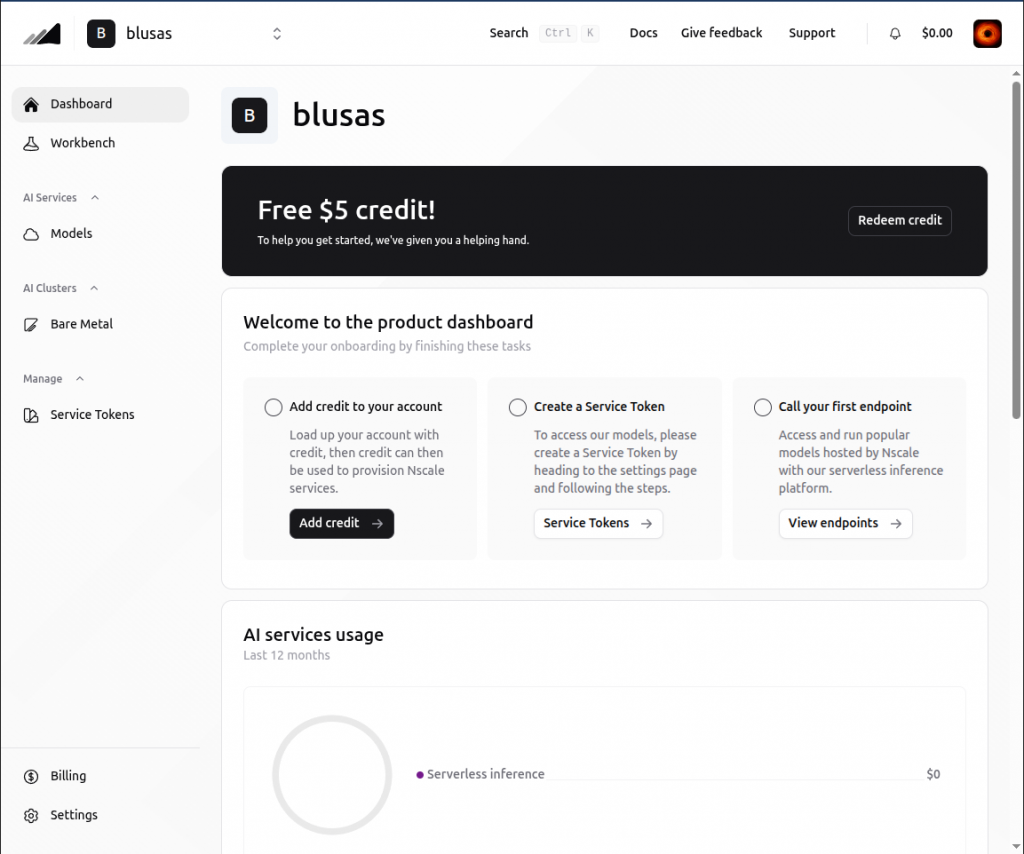
I found, on joining Nscale, all employees had access to ChatGPT and could ask for access to Claude, and were encouraged to use AI for all aspects of our work. The company were also using modern applications with AI built-in or enabled so were also encourage to use that AI. For example, traditional applications such as Jira and Confluence were replaced by Linear and Notion. These had AI native functions and behaviour which would speed-up or automate your work. They also integrate with each other and other applications such as Slack and Gmail to enable you to combine AI queries across multiple sources of information.
I joined as an Observability Platform Engineer expecting, as part of my roles, to be creating dashboards and alerts with my skills and experience. But no, AI replaced all of this such that any engineer (without o11y skills or Grafana experiences) could ask AI to simply “create me a dashboard to show the latency of X, Y and Z and associate an alert when X, Y, and Z crosses a threshold of A, B or C” – for example. AI would be able to have a very good attempt at doing this very fast (minutes instead of hours). It seems like I was already out of a job before I even started…
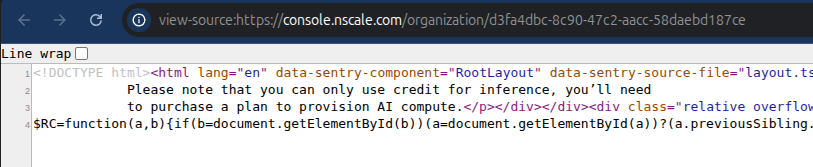
Not surprisingly, as the weeks rolled on at Nscale, the use of AI was very apparent, with each Engineering Weekly meeting having a demo that sang the praises of how AI helped with creating a useful or needed feature or solution in a short amount of time. Later, as I used AI to create applications, I recognised or realised that ALL if not most of the Nscale applications, interfaces, and features were created using AI. The UI to their console is a big give away:
No human would write their code on a a few lines!
All Nscale employees were “faking it until they made it” and using AI to help them do so fast. I found that apps like Notion enables you to use AI to find info, detail and documentation really readily and will also summarise and condense information for digesting in a short amount of time – no more tl;dr – get AI to summarise and read the pertinent snippets…
Addictive Nature of AI
First lession learnt after using AI for work (and also for anything else) is that it is addictive – once you’ve used it and found it helpful – it is hard to not use it and go back to how you use to do things albeit a slower and more laborious.
It’s like using a calculator – if you use it for everything, you lose the skill of doing mental arithmetic and come to depend of it to do the all the calculations. If you imagine AI as a super super magical calculator that can help you solve and perform all your work tasks – it will become addictive and the more you use, the more skills you will lose and the more dependent on it you become…
How does an employee get appraised if AI is doing all the work? It comes down to your manager, and unfortunately, after 2.5 months at Nscale, I was transferred to a new manager who didn’t like the look of me and extended my probation period – setting me up to fail so that he could easily dismiss me during this probation period without causing an issue with the company. So after 4.5 months with Nscale, I was let go.
AI Addiction becomes a habit
Once I knew how to use AI and take advantage of its features and limitations – it was hard to not use it. There are so many areas where it could lighten the burden of tedious work and speed up tasks 10 to 100 times. The first thing to use AI for after been made unemployed is to find a new role and/or job.
 role = what you actually do and how you do
 job = formal title and place in the company
 ATS = applicant tracking system
I started out seeking a new job by setting up a spreadsheet to keep track of my job applications – I knew the job market was going to be a lot tougher than the previous two period of unemployment, so I named this sheet appropriately!
Start off on the right foot by using the “Framing” method – or more specifically strategic naming or linguistic framing. Or strategic framing through naming.
It means choosing a project, programme, policy, or initiative name that shapes how people interpret it before they examine the details. A well-chosen name can influence support, behaviour, priorities, funding, and perceptions of success. Expecting and knowing how tough the job market is I turned job hunting into a “mission” and this certainly influenced my way of working – kicking in my resourcefulness, resourceful thinking and greater innovation
The Resourceful Use of AI
The first and best reason to use AI is: if AI is the cause of your redundancy, then why not use it to attain a new job/role? If AI is really taking over the world (or decimating roles in IT) then your should be able to use it to your advantage to find a suitable role and in turn attain a job with a company.
In a tough job market you will have to apply for many roles, suffer a lot of rejections, ghosting, and no replies to job applications, and this is before you are invited to an interview with a human (companies are using AI interviewers now to the amount of applications!)
AI can help most if you use it to reduce admin, improve targeting, and sharpen your pitch rather than to mass-apply for roles. The biggest wins are tailoring CVs to each role, drafting outreach messages, organizing applications, and preparing for interviews faster.
The use of AI to improve your CV/Resume for ATS is necessary nowadays just to get a talent advisor or recruiter to initiate a contact with you. Without this contact you will just fall wayside and not be seen by anyone – human or AI.
Use AI to Generate Interview Questions
In this latest search for jobs, once I have lined up an interview, I gave AI the JD of that particular role and my CV and simply asked it to give me 10-30 interview questions between basic and advanced level that the interviewer was most likely to ask me.
Although this technique is not foolproof, it is as good as IF the interviewer (new to the task and having lots of candidates to interview or screen) has also used AI to formulate the list of interview questions!
Use AI for Interview Practise
AI could also be instructed to simulate an interview sessions where you could give realtime replies for it to ask you further questions on your answers and give you feedback at the end. I never did this so I can’t really comment but this would be super useful to get interview experience. If you have worked for one company over a long period of time, then not only the job market has changed, but you are also out of practise and rusty at doing well in an interview…
Personally, I use the first few interviews as practice – I would never rely of the first three interview to result in a job offer – I woud also want them to be tough so that they reveal my weaknesses so I can improve. If their is an option to transcribe the interview session, then do that with the intension of handing that to AI to analyse and give suggestions on the improvements.
I never got to this stage, but potential I could have been desperate enough to resort to this if my period of unemployment continued for a while and I was getting no successes at attaining interviews and job offers (at any salary where I could get into “temporary” employment while carrying on with the job search for a more suitable role).
Use AI to Learn and Improve
I think this is the best use of AI – to learn and improve your skills, knowledge and experience during times of unemployment and working your “Mission for a New Role” strategic framing project!
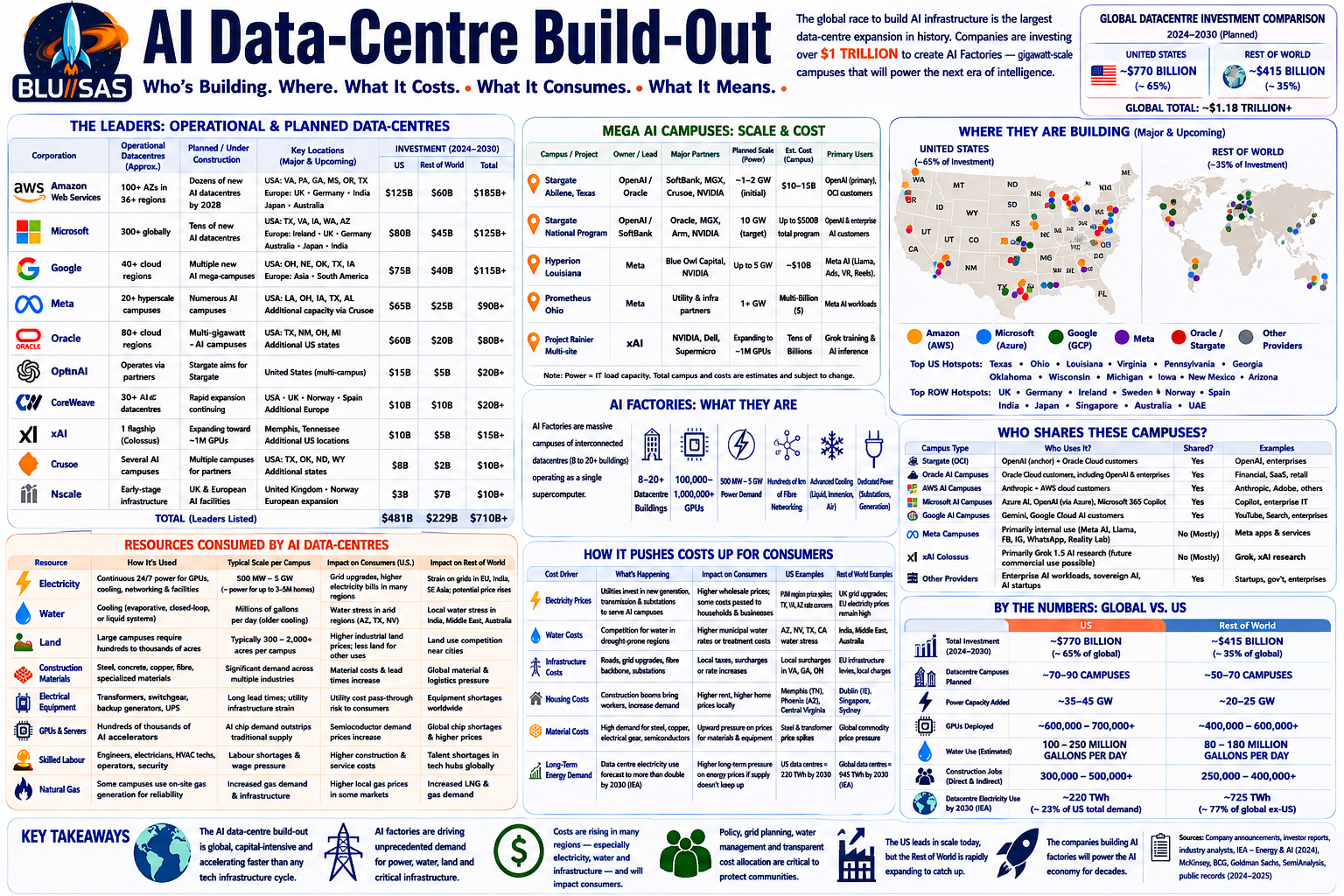
The AI infrastructure race is being led by a relatively small number of corporations, but together they represent well over US$1 trillion of planned investment over the remainder of this decade. Many figures below are approximate because companies often announce campuses or regions rather than exact building counts, and projects evolve rapidly.
Corporation
Operational data centres (approx.)
AI data centres planned / under construction
Main locations
Amazon Web Services
100+ availability zones across 36+ regions
Dozens of new AI campuses through 2028 (including Project Rainier)
USA (Virginia, Pennsylvania, Georgia, Mississippi, Oregon), Europe, UK, Germany, India, Japan, Australia
Microsoft
300+ data centres globally
Tens of new AI campuses; ~$80B AI infrastructure investment
USA, Sweden, Finland, UK, Germany, Australia, Japan, Texas, Wisconsin
Google
40+ cloud regions and many hyperscale campuses
Multiple new AI mega-campuses
Ohio, Nebraska, Oklahoma, Texas, Iowa, Europe, Asia
Meta
20+ hyperscale campuses
Numerous AI campuses under expansion
Louisiana, Ohio, Iowa, Texas, Alabama, with additional capacity from Crusoe
Oracle
80+ cloud regions
Multi-gigawatt AI campuses via Stargate plus Oracle Cloud expansion
Texas, New Mexico, Ohio, Michigan and other US states
OpenAI
Operates via partners rather than owning a global DC fleet
Stargate aims for roughly 20 major AI campuses
Texas, New Mexico, Ohio, Wisconsin, Michigan and additional US sites
SoftBank
No major hyperscale cloud estate
Co-investor in Stargate
United States (multiple campuses)
CoreWeave
~30+ AI data centres
Continuing rapid expansion
USA, UK, Norway, Spain and additional European sites
xAI
1 flagship AI supercluster (Colossus) plus expansions
Expanding toward one million GPUs
Memphis, Tennessee and additional US locations
Crusoe
Several AI campuses under operation
Multiple campuses for OpenAI, Meta and Microsoft
Texas, Oklahoma and other US states
Nscale
Early-stage AI infrastructure
UK and European sovereign AI facilities planned
United Kingdom, Norway and Europe (build-out still in early stages)
Where the biggest build-out is happening
The current hotspots are:
Texas – by far the largest concentration, with Stargate, Oracle, Microsoft, Google and xAI all investing heavily.
Ohio – Google, Meta and Oracle are all expanding there.
Louisiana – Meta’s enormous AI campus.
Virginia – still the world’s largest concentration of conventional cloud data centres.
Pennsylvania, Georgia and Oklahoma – major AWS and Google investments.
Wisconsin, Michigan and New Mexico – emerging AI infrastructure hubs.
The scale is unprecedented
The six largest AI infrastructure builders (Amazon, Microsoft, Google, Meta, Oracle and the Stargate consortium) have collectively committed around US$690–700 billion in AI-related capital expenditure, with 74 new AI-focused projects breaking ground in the US during 2026 alone. Longer-term projections suggest total AI infrastructure investment could exceed US$5 trillion globally by 2030.
One notable trend is that these companies are no longer building isolated data centres. They are constructing AI campuses consisting of anywhere from 8 to more than 20 individual data-centre buildings, all linked by ultra-high-speed networking so they function as a single giant AI supercomputer. A single campus can consume 500 MW to over 1 GW of power, equivalent to the electricity demand of a medium-sized city.
The largest AI campuses consume enormous quantities of resources. Some impacts are already measurable, while others remain uncertain and depend on how utilities allocate costs. It’s important to distinguish local effects (which can be substantial) from national effects (which are often much smaller).
Resource
How AI campuses use it
Impact on consumers
Electricity
Hundreds of MW to several GW continuously
Higher utility investment, possible higher electricity bills in constrained regions, increased need for new power stations
Water
Cooling systems can consume millions of gallons per day, although newer designs increasingly use closed-loop or air cooling
Competition for water in drought-prone areas; pressure on municipal supplies
Land
Campuses often occupy hundreds to thousands of acres
Industrial land values rise; reduced land available for other development
Construction materials
Steel, concrete, copper, fibre-optic cable
Higher demand can contribute to material price increases, though AI is only one of several drivers
Electrical equipment
Transformers, switchgear, substations
Longer lead times for utilities and industrial customers
Electrical engineers, construction workers, data-centre technicians
Wage competition and labour shortages in some regions
Natural gas
Some campuses are building dedicated gas-fired generation
Increased demand for gas infrastructure and fuel in certain markets
Electricity prices
Electricity is the area where households are most likely to notice an effect.
Large AI campuses require utilities to invest in:
New transmission lines
New substations
Additional generation
Grid upgrades
Who pays depends on regulation.
In some regions, regulators are trying to ensure that AI companies pay most of these costs. In others, some infrastructure costs are spread across all customers, which can increase household bills.
For example:
Region
Reported effect
PJM (eastern U.S.)
Wholesale electricity prices rose sharply as demand from AI data centres increased, prompting calls for tech companies to fund more of the required infrastructure.
Arizona
Utilities warn that electricity infrastructure may need to roughly double within a few years because of AI growth.
Virginia
Data centres already account for a very large share of electricity demand in some parts of the state.
It’s also worth noting that recent academic work found that, historically (2015–2024), data centres slightly reduced average U.S. electricity prices by helping spread fixed grid costs over more customers. The authors caution that this may not hold if future supply constraints become severe.
Water
Water is highly location-dependent.
Older evaporative cooling systems can use several million gallons of water per day. Newer AI facilities increasingly employ:
Closed-loop liquid cooling
Direct-to-chip liquid cooling
Air cooling where practical
These approaches can significantly reduce freshwater consumption, but water remains a concern in arid regions.
Housing
AI campuses can affect local housing markets by:
Bringing thousands of construction workers
Creating highly paid engineering jobs
Increasing demand for rental accommodation
The effect is usually local rather than national.
Employment
Benefits include:
Construction employment
Electrical contracting
Operations and maintenance jobs
Security
Network engineering
Mechanical engineering
However, once operational, AI campuses employ far fewer people than factories of similar size.
Have prices increased?
Evidence is mixed:
Item
Observed trend
Electricity
Some U.S. regions have seen higher wholesale prices and concerns about retail bills where AI demand is concentrated.
Water
Mostly local impacts in water-stressed regions rather than broad consumer price rises.
Housing
Local increases around major developments are common, though driven by multiple factors.
Construction materials
Increased demand contributes to pressure, but AI is only one of many drivers.
Consumer goods
There is currently little evidence that AI data centres have directly increased the prices of everyday retail goods.
Overall, the greatest measurable impact today is on electricity infrastructure. The International Energy Agency projects that global data-centre electricity consumption will more than double to about 945 TWh by 2030, driven largely by AI. Whether households ultimately pay more depends on regulatory decisions about who funds the new power plants, transmission lines and substations needed to support these AI campuses.
Changing Jobs and Roles
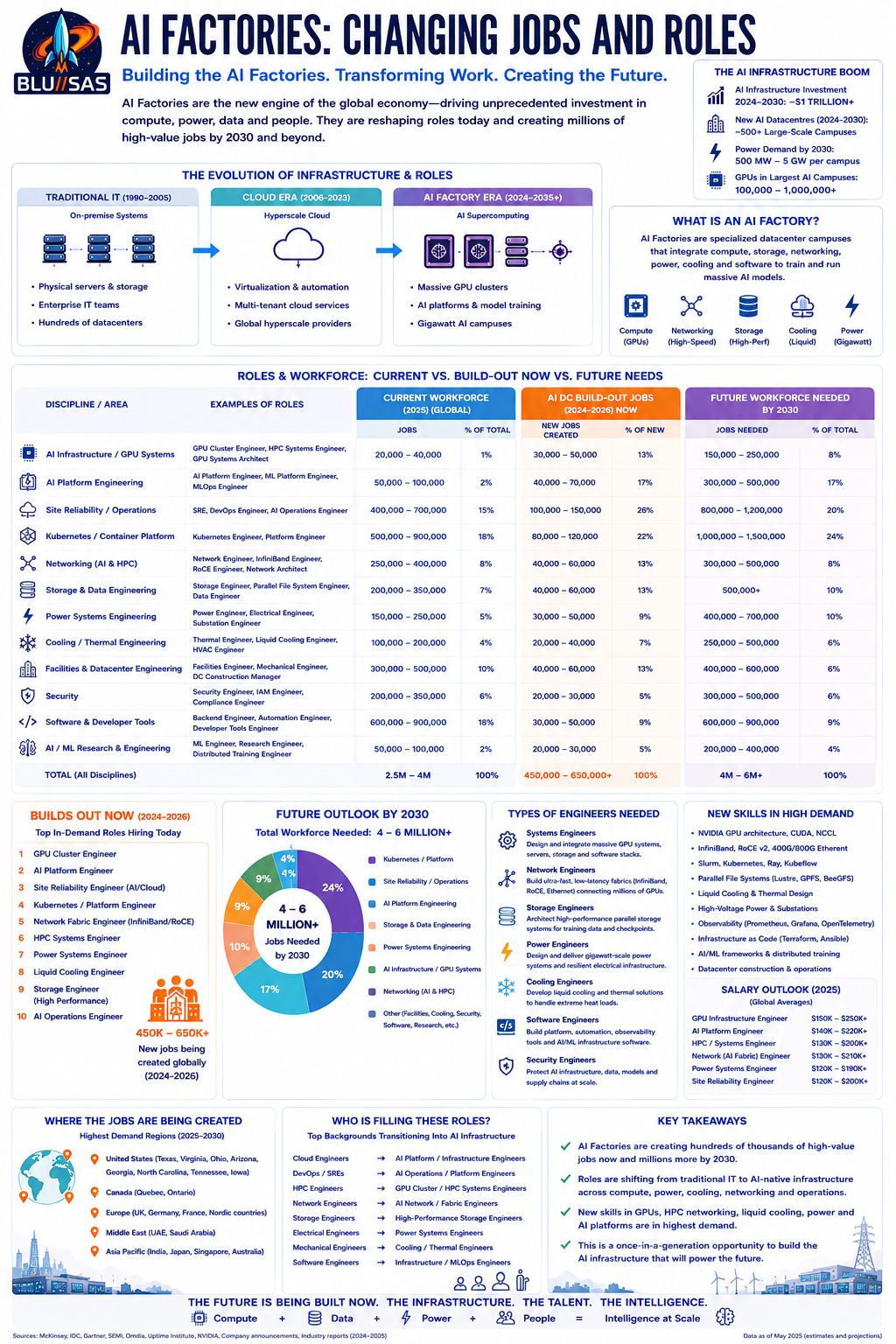
The AI infrastructure boom is creating the largest shift in infrastructure engineering since the rise of public cloud around 2006–2015. Traditional cloud providers needed engineers to build reliable, scalable services for virtual machines, storage and networking. AI Factories require all of that plus expertise in GPUs, ultra-high-speed networking, power engineering, liquid cooling and AI software platforms.
Evolution of Infrastructure Engineering
Era
Primary Goal
Main Infrastructure
Typical Employer
Enterprise IT (1990–2010)
Business applications
Servers, SAN, LAN
Banks, government, enterprises
Cloud (2006–2024)
Multi-tenant cloud services
Hyperscale datacenters
AWS, Azure, Google Cloud
AI Factory (2024–2035+)
Massive AI computation
GPU supercomputers, AI campuses
OpenAI, Meta, xAI, Oracle, CoreWeave, Nscale, AWS
Traditional Cloud Provider Jobs
Cloud providers traditionally organised engineering into around a dozen major disciplines.
Applications
Containers
Virtual Machines
Hypervisor
Servers
Storage
Networking
Power
AI Factory:
AI Models
Distributed Training
Kubernetes / Slurm
CUDA / ROCm
100,000+ GPUs
InfiniBand / RoCE
Parallel Storage
Liquid Cooling
Gigawatt Power
Traditional Cloud Skills
Linux
VMware
Kubernetes
OpenStack
AWS
Azure
Terraform
Ansible
Prometheus
Grafana
Python
Go
Storage
Networking
New AI Factory Skills
Additional skills now becoming highly valuable include:
NVIDIA GPU architecture
AMD Instinct
CUDA
NCCL
GPUDirect RDMA
InfiniBand
RoCE v2
Slurm
Ray
Kubeflow
MLFlow
Triton Inference Server
Parallel file systems (Lustre, IBM Storage Scale/GPFS, BeeGFS)
High-performance Ethernet (400/800 GbE)
Direct-to-chip liquid cooling
Rack-scale power engineering
Jobs Growing Fastest
Role
Growth Outlook
GPU Infrastructure Engineer
Extremely High
AI Platform Engineer
Extremely High
HPC Systems Engineer
Extremely High
Kubernetes Platform Engineer
Very High
Storage Engineer
Very High
Site Reliability Engineer
Very High
Network Fabric Engineer
Extremely High
Power Systems Engineer
Extremely High
Mechanical Cooling Engineer
Extremely High
AI Operations Engineer
Extremely High
Approximate Current Workforce (2025–2026)
The exact numbers are difficult to measure because many roles overlap, but industry estimates suggest:
Profession
Estimated Global Workforce
Cloud Engineers
2–3 million
DevOps Engineers
1.5–2 million
Site Reliability Engineers
400,000–700,000
Kubernetes Engineers
500,000–900,000
Datacenter Engineers
300,000–500,000
Storage Engineers
200,000–350,000
HPC Engineers
80,000–150,000
GPU Infrastructure Specialists
20,000–40,000
AI Infrastructure Engineers
50,000–100,000
Estimated Workforce Needed by 2030
As AI campuses proliferate worldwide, demand is expected to increase significantly.
Profession
Estimated Demand by 2030
AI Infrastructure Engineers
300,000–500,000
GPU Cluster Engineers
150,000–250,000
HPC Engineers
250,000–400,000
SREs (AI/Cloud)
800,000–1.2 million
Kubernetes Platform Engineers
1–1.5 million
Network Fabric Engineers
300,000–500,000
Storage Engineers
500,000+
Power Engineers
400,000–700,000
Cooling Engineers
250,000–500,000
These are indicative estimates derived from announced AI infrastructure expansion plans and broader industry workforce analyses rather than official forecasts.
Where the Talent Is Coming From
Most AI Factory engineers are not newly trained graduates. Companies are recruiting experienced professionals from adjacent disciplines:
Previous Role
Transition To
Cloud Engineer
AI Platform Engineer
Kubernetes Engineer
AI Infrastructure Engineer
SRE
AI Operations Engineer
HPC Engineer
GPU Cluster Engineer
Linux Engineer
GPU Systems Engineer
Network Engineer
InfiniBand/RoCE Fabric Engineer
Storage Engineer
AI Storage Architect
OpenStack Engineer
AI Cloud Platform Engineer
Ceph Engineer
High-performance Storage Engineer
DevOps Engineer
ML Platform Engineer
Why This Matters
The next decade is likely to see a shift similar to the transition from enterprise IT to cloud computing. During the 2010s, the most sought-after roles were Cloud Engineers, DevOps Engineers and SREs. Through the late 2020s and into the 2030s, many of the highest-demand infrastructure roles are expected to centre on AI Factories: designing, building and operating gigawatt-scale GPU campuses, high-performance storage systems, ultra-low-latency networks and AI platforms.
For someone with expertise in Linux, Kubernetes, observability, automation, storage and cloud infrastructure, the progression into AI infrastructure engineering is relatively direct. Adding knowledge of GPU platforms, HPC networking (InfiniBand/RoCE), parallel storage (such as Lustre or GPFS), Slurm, CUDA and liquid-cooled datacenter design positions engineers for many of the roles expected to see the strongest demand over the coming decade.
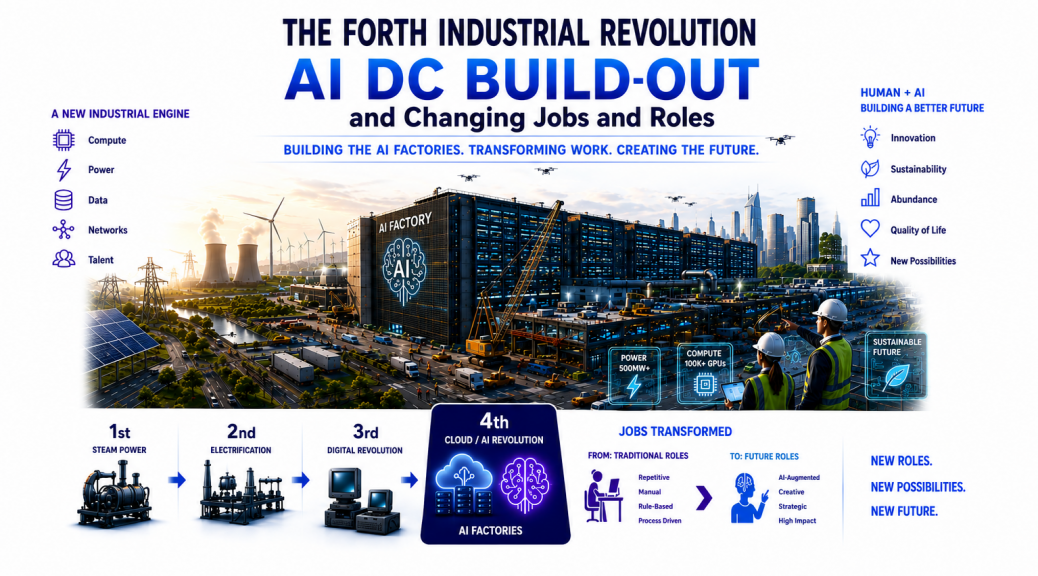
Part of the 4th Industrial Revolution
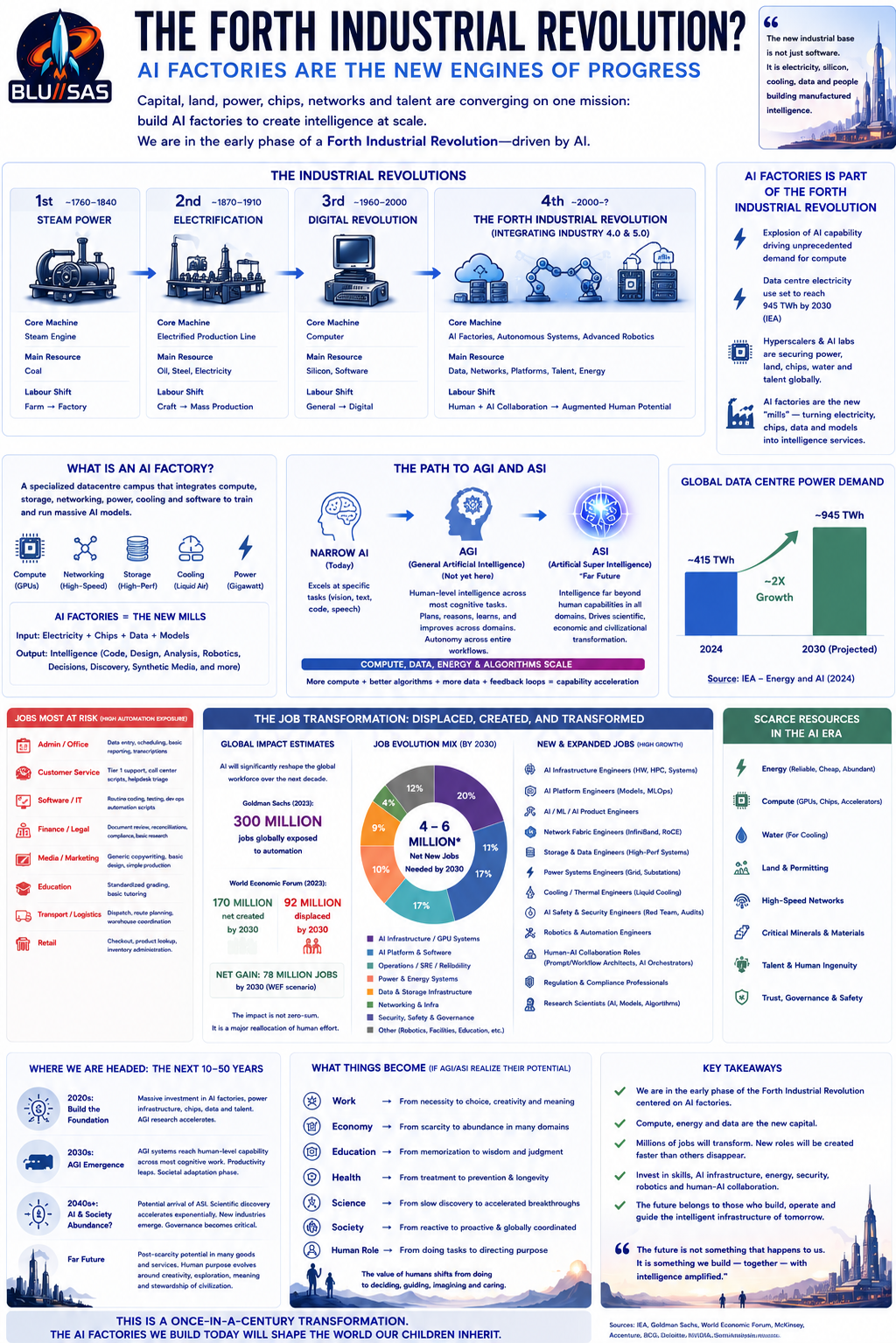
Yes — this is plausibly the tail-end phase of the Forth Industrial Revolution, but with one caveat: we do not yet know whether AGI/ASI will arrive, or when. What is clear is that capital, land, power, water, chips, networks and engineering labour are being redirected toward AI factories.
The simplest framing:
Industrial phase
Core machine
Main resource
Main labour shift
1st
Steam engine
Coal
Farm → factory
2nd
Electrified production line
Oil, steel, electricity
Craft → mass production
3rd
Computer
Silicon, software
Clerical → digital
4th
Cloud + automation
Data, networks, platforms
IT → cloud/SRE/DevOps
5th
AI factory
Compute, power, GPUs, data
Human labour → AI-augmented/AI-directed labour
The AI factory is the new “mill.” Instead of spinning cotton or stamping cars, it converts electricity + chips + data + models into intelligence services: code, design, analysis, customer support, robotics control, synthetic media, drug discovery and eventually autonomous decision systems.
The resource pull is already visible. The IEA projects global data-centre electricity consumption could roughly double to about 945 TWh by 2030, growing far faster than general electricity demand. That is why hyperscalers, AI labs and neoclouds are racing to secure power, grid connections, GPUs, cooling, land and engineering staff.
On jobs, the likely pattern is not “all jobs disappear.” It is task compression: fewer people needed for routine cognitive work, more people needed for infrastructure, supervision, security, robotics, energy, regulation and high-complexity design. Goldman Sachs has estimated that AI could expose the equivalent of 300 million full-time jobs globally to automation, while the World Economic Forum projects by 2030 about 170 million roles created and 92 million displaced, for a net gain of 78 million under its surveyed-employer scenario.
AI compliance officer, algorithmic accountability auditor
Human-AI work
Agent orchestrator, prompt/workflow architect, AI operations manager
Synthetic worlds
Simulation designer, digital twin engineer, synthetic-data engineer
If AGI arrives, the shift accelerates. If ASI arrives, the shift becomes civilisational: the scarce resources may become energy, compute rights, physical materials, robotics capacity, trusted governance and human legitimacy, rather than ordinary labour.
So yes: the AI build-out looks like the physical foundation of a Fifth Industrial Revolution — not just software, but a new industrial base built around manufactured intelligence.
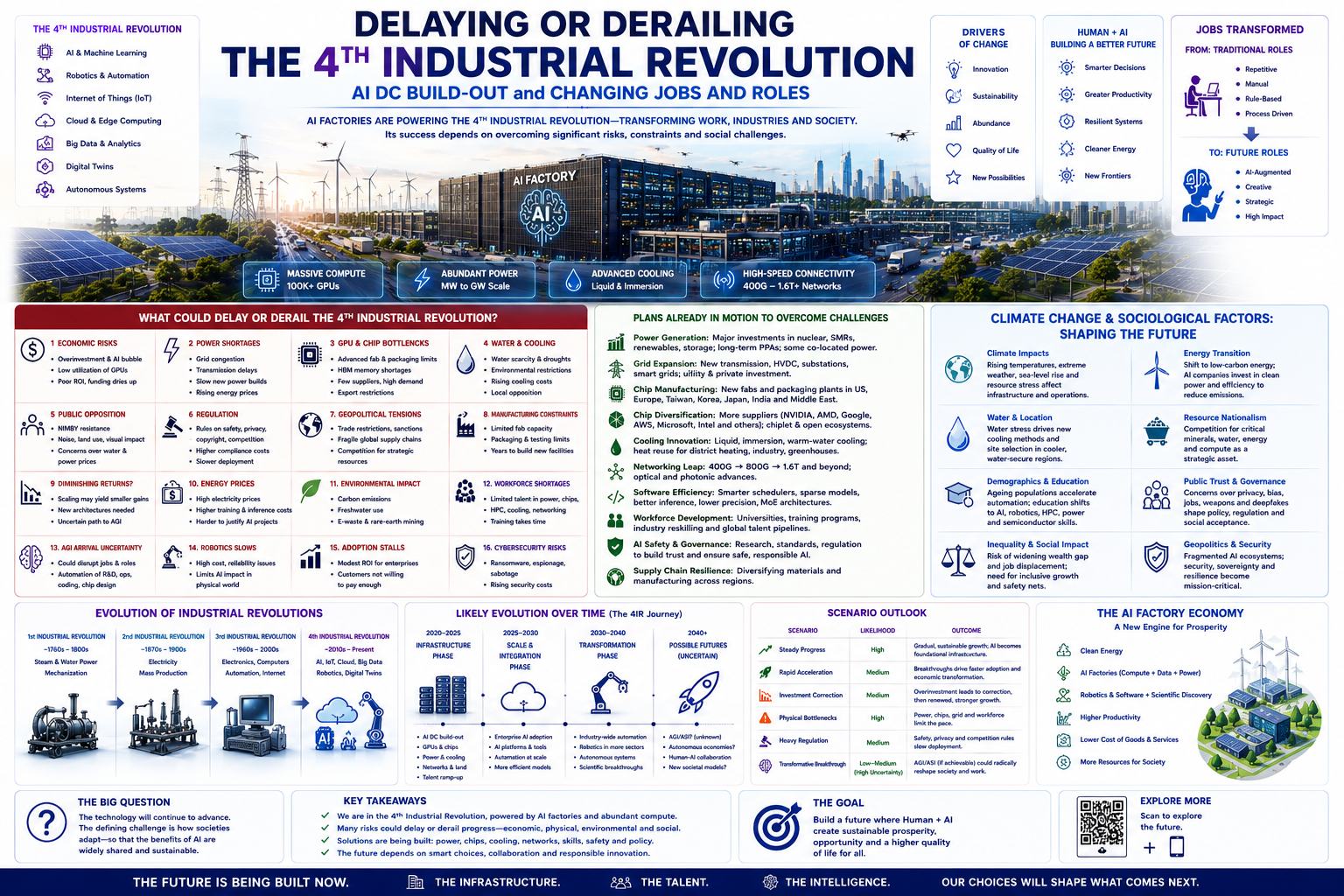
Climate change and broader sociological factors are arguably the largest long-term uncertainties for the Fifth Industrial Revolution. Unlike technical bottlenecks, they can alter not just the pace of AI adoption but also where, how, and for whom AI infrastructure is built.
I don’t think climate change will stop the AI revolution, but it could fundamentally reshape it. History suggests industrial revolutions adapt to resource constraints rather than ending because of them.
Climate change
1. Energy transition
Today’s AI factories consume enormous amounts of electricity.
If climate policies tighten globally, AI companies may no longer be able to rely on inexpensive fossil-fuel generation.
This is already pushing investment towards:
Nuclear power
Small Modular Reactors (SMRs)
Geothermal
Offshore wind
Utility-scale solar
Long-duration batteries
Grid-scale storage
By the 2040s, a successful AI company may be judged as much by its carbon intensity per AI token as by its model quality.
2. Water shortages
Many AI campuses currently use water-intensive cooling.
Increasing droughts could force AI factories to relocate.
Future AI campuses are likely to favour:
Scotland
Norway
Sweden
Finland
Iceland
Canada
Pacific Northwest
Patagonia
Cool climates reduce cooling costs while providing more reliable water supplies.
3. Sea-level rise
Many current datacentres sit near coasts because they benefit from:
Fibre landing stations
Major cities
Existing infrastructure
Over decades, flood risks may encourage more inland development.
4. Extreme weather
Increasingly frequent:
Heatwaves
Wildfires
Hurricanes
Flooding
all increase operational risks.
Future campuses may need:
Greater redundancy
Fire-resistant designs
Multiple grid connections
Larger battery systems
Independent power generation
Resource nationalism
Countries increasingly recognise compute as a strategic asset.
Competition may intensify over:
Lithium
Copper
Rare earth elements
Uranium
Semiconductor-grade silicon
Freshwater
Electricity
The next century may see competition over compute capacity much as the twentieth century saw competition over oil.
Demographics
Many developed nations face ageing populations.
This may actually accelerate AI adoption.
Examples include:
Japan
South Korea
Germany
Italy
If fewer working-age people are available, automation becomes economically attractive.
Education
Universities are already adapting.
Future curricula may emphasise:
AI engineering
Robotics
HPC
Power engineering
Semiconductor engineering
AI governance
Routine programming skills alone may become less valuable than systems integration, critical thinking and domain expertise.
Public trust
AI adoption depends heavily on social acceptance.
Concerns include:
Surveillance
Privacy
Bias
Deepfakes
Autonomous weapons
Job displacement
Public backlash could lead to stricter regulation or slower deployment in some sectors.
Wealth inequality
One of the most significant risks is that AI could concentrate wealth among those who own:
AI models
Compute infrastructure
Semiconductor intellectual property
Energy assets
Data
If productivity gains are not widely shared, inequality could increase.
Possible policy responses include:
Expanded education and retraining
Wage insurance
Stronger competition policy
Tax reforms
New social safety nets
Different countries are likely to pursue different approaches.
Employment transition
Industrial revolutions historically eliminate some jobs while creating others.
The challenge is timing.
If AI removes work faster than new roles appear, societies may experience:
Higher unemployment
Political instability
Reduced consumer spending
Pressure for labour-market reforms
Managing this transition is likely to be one of the defining policy challenges of the coming decades.
Geopolitics
Compute is becoming a strategic resource.
This may encourage blocs centred around:
North America
Europe
China
India
Middle East
Each could develop increasingly independent AI ecosystems, supply chains and regulations.
Alternative futures
Scenario
AI build-out
Society
Green AI Revolution
AI powered largely by low-carbon energy; highly efficient hardware
AI helps accelerate decarbonisation and scientific progress
AI Arms Race
National security drives rapid expansion despite environmental costs
Fragmented AI ecosystems and geopolitical competition
AI Bubble
Infrastructure investment slows after poor returns
AI remains important but grows more gradually
Climate Adaptation AI
AI prioritises climate modelling, energy optimisation and resilient infrastructure
AI becomes a key tool for adapting to climate change
Post-Scarcity Transition(speculative)
Abundant clean energy and highly capable AI dramatically reduce production costs
Work shifts towards creativity, care, governance and exploration
The “AI Factory Economy”
A useful way to think about the long term is that AI factories may become a new class of critical infrastructure, similar to:
Power stations
Railways
Ports
Telecommunications
The Internet
The economy could evolve around interconnected systems:
Clean Energy
      │
      ▼
AI Factories
      │
      ▼
Robotics + Software + Scientific Discovery
      │
      ▼
Higher Productivity
      │
      ▼
Lower Cost of Goods and Services
      │
      ▼
More Resources Available for Society
That is an optimistic pathway. A less favourable outcome is also possible if productivity gains are unevenly distributed, infrastructure cannot keep pace, or environmental constraints become more severe.
The most important sociological question
The defining issue may not be whether AI becomes powerful enough—it almost certainly will continue to improve significantly. The larger question is who benefits from the productivity gains.
Previous industrial revolutions eventually raised average living standards, but they also brought decades of disruption, labour conflict and institutional change. The Fifth Industrial Revolution, if it unfolds as many expect, is likely to follow a similar pattern: technological progress may be rapid, but the economic and social institutions needed to distribute its benefits will evolve more slowly.
In other words, the success of the Fifth Industrial Revolution may depend less on building bigger AI factories and more on how societies adapt their education systems, labour markets, energy infrastructure and governance to make effective use of the capabilities those AI factories create.
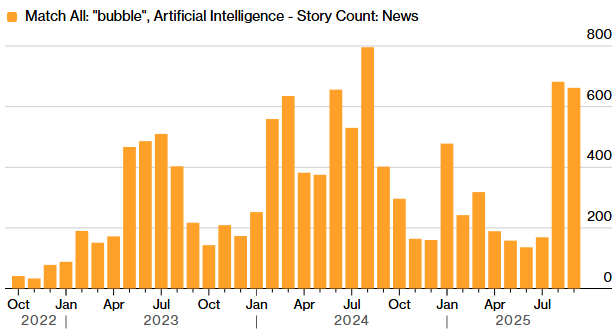
An AI crash would resemble a hybrid of the 1990s dot-com bust and the 2008 financial crisis—but centered around artificial intelligence infrastructure, data centers, and corporate overinvestment. It would likely begin as a sudden market correction in overvalued AI firms and GPU suppliers, then spread through the financial system and tech economy as debt and demand collapse.
Market and Investment Collapse
In early stages, overleveraged companies like OpenAI, Anthropic, or firms heavily reliant on GPU compute (e.g., Nvidia, Oracle, Microsoft) would face sharp valuation drops as AI-generated revenues fail to justify trillion-dollar capital expenditures. Investor panic could trigger a chain reaction, collapsing the leveraged network of data‑center finance. Bloomberg and the Bank of England have both warned of a “sudden correction” and circular investing between chip firms and hyperscalers that artificially props up earnings.transformernews+1
The Data Center Bust
According to historian Margaret O’Mara and business analyst Shane Greenstein, AI data centers—many purpose‑built for model training using GPUs—are highly specialized and often remote from urban demand. These centers might last only 3–5 years and have little reuse value outside AI or crypto mining. If capital inflows freeze, thousands of megawatts of compute could become stranded assets, comparable to the empty fiber networks after the dot‑com collapse.transformernews
Economic Impact
The International Monetary Fund estimates roughly a third of current US GDP growth depends on AI-related investment. If the bubble bursts, consumption could fall from loss of “AI wealth effects,” dragging global markets into recession. Analysts at Transformer News liken it to Britain’s 1840s railway mania: vast sums invested in technology that ultimately enriched the future economy—at the cost of investors’ ruin.globalcapital+2
Consequences for Jobs and Technology
For the workforce, the crash would begin with mass layoffs across the tech sector and data‑center construction, followed by second‑order layoffs in software, marketing, and education technology. However, as with the post‑dot‑com era, redundant talent and abandoned infrastructure could later fuel a new, leaner AI industry based on sustainable business models.reddit+2
Systemic and Political Risks
While the contagion risk is smaller than subprime mortgages in 2008, debt-financed AI expansion—Oracle’s $100 billion borrowing plan with OpenAI being one example—creates vulnerability for lenders and investors. Should a major firm default, cascading insolvencies could ripple through the supply chain, forcing governments to intervene. Some analysts expect this crash would prompt stricter AI regulation and financing guardrails reminiscent of those enacted after the Great Depression.transformernews
Long-Term View
If artificial general intelligence (AGI) does eventually deliver major productivity gains, early investments may appear prescient. But if not, a 2020s AI crash would leave disused GPU campuses and massive debt—an exuberant experiment that accelerated technological progress at ruinous human cost.unherd+2
Which industries would collapse first in an AI crash
In the event of an AI crash, several sectors would be hit first and hardest — especially those that have overexpanded based on speculative expectations of AI-driven profits or infrastructure demand. The collapse would cascade through high-capex industries, ripple across financial services, and disrupt employment-dependent consumer sectors.
Semiconductor and GPU Manufacturing
The semiconductor industry would be the first to collapse due to its heavy dependence on AI demand. Data center GPUs currently drive over 90% of Nvidia’s server revenue, and the entire sector’s value nearly doubled between 2024 and 2025 based on AI compute growth forecasts. If hyperscaler demand dries up, the oversupply of GPUs, high-bandwidth memory (HBM), and AI ASICs could cause a price crash similar to the telecom equipment bust in 2002. Chip makers and startups like Groq, Cerebras, and Tenstorrent—heavily leveraged to AI workloads—would struggle to survive the sudden capital freeze.digitalisationworld
Cloud and Data Center Infrastructure
AI-heavy cloud providers such as Microsoft Azure, AWS, Google Cloud, and Oracle Cloud would see massive write-downs in data center assets. Overbuilt hyperscale and sovereign AI campuses could become stranded investments worth billions as training workloads decline and electricity costs remain high. This dynamic mirrors the way dark fiber networks from the 1990s dot-com era lay idle for years after overinvestment.digitalisationworld
Digital Advertising and Marketing
The advertising and media sector—already experiencing erosion due to AI‑generated content—would decline abruptly. Companies like WPP have already lost 50% of their stock value in 2025 due to automated ad-generation technologies cannibalizing human creative work. As AI content generation saturates the market, profit margins in marketing, online publishing, and synthetic media platforms like Shutterstock and Wix could collapse.ainvest
Financial and Staffing Services
Financial services and staffing firms are another early casualty. AI has already automated large portions of transaction processing, compliance, and manual recruitment. Firms such as ManpowerGroup and Robert Half have reportedly seen 30–50% market value declines due to these pressures. In an AI crash, their exposure to risk-laden corporate clients and shrinking demand for human labor matching would deepen losses, while regulators tighten AI governance in compliance-heavy finance.ainvest
Transportation and Logistics
The transportation and logistics sector, closely tied to AI investment through autonomous systems, faces structural weakness. Millions of driving and delivery jobs could disappear due to automation, but the firms funding autonomous fleets—such as Tesla Freight and Aurora Innovations—would hemorrhage cash if capital dries up before widespread profitability. AI‑powered routing and warehouse systems could be written down as expensive overcapacity.ainvest
Secondary Collapse: Retail and Customer Support
Finally, customer‑facing retail and support sectors would be heavily affected. With AI chatbots now handling about 80% of common queries, these labor markets are already contracting. A market shock would worsen layoffs while eroding spending power, compounding the downturn.ainvest
In short, the first phase of an AI crash would decimate GPU suppliers and infrastructure providers, followed by cascading losses in services and labor markets that relied on sustained AI adoption and speculative investor optimism.
The Hyperscalers who would be most affected in an AI crash
The hyperscalers most severely affected by an AI crash would be those that have sunk the largest capital into AI‑specific data center expansion without commensurate returns—primarily Microsoft, Amazon (AWS), Alphabet (Google Cloud), Meta, Oracle, and to a lesser extent GPU‑specialist partners like CoreWeave and Crusoe Energy Systems. These companies are deep in an investment cycle driven by trillion‑dollar valuations and multi‑gigawatt data center commitments, meaning a downturn would cripple balance sheets, strand assets, and force major write‑downs.
Microsoft
Microsoft is the hyperscaler most exposed to an AI collapse. It has committed $80 billion for fiscal 2025 to AI‑optimized data centers, largely to support OpenAI’s model training workloads on Azure. Over half this investment is in the U.S., focusing on high‑power, GPU‑dense facilities that may become stranded if demand for model training plunges. The company also co‑leads multi‑partner mega‑projects like Stargate, a $500 billion AI campus venture involving SoftBank and Oracle.ft+1
Amazon Web Services (AWS)
AWS is next in risk magnitude, with $86 billion in active AI infrastructure commitments spanning Indiana, Virginia, and Frankfurt. Many of its new campuses are dedicated to AI‑as‑a‑Service workloads and custom silicon (Trainium, Inferentia). If model‑training customers scale back, AWS faces overcapacity in power‑hungry clusters designed for sustained maximum utilization. Analysts warn that such facilities are difficult to repurpose for general cloud usage due to 10× higher rack power and cooling loads.thenetworkinstallers+1
Alphabet (Google Cloud)
Google’s parent company, Alphabet, has pledged around $75 billion in AI infrastructure spending in 2025 alone—heavily concentrated in server farms for Gemini model operations. The company’s shift to AI‑dense GPU clusters has already required ripping and rebuilding sites mid‑construction. In a crash, Alphabet’s reliance on advertising to subsidize capex would expose it to compounding financial stress.ft+1
Meta
Meta’s risk is driven by scale and ambition rather than cloud dependency. The company is investing $60–65 billion into a network of AI superclusters, including a 2 GW data center in Louisiana designed purely for model training. Mark Zuckerberg’s goal to reach “superintelligence” entails constant full‑load operation—meaning unused compute in a recession would yield enormous sunk‑cost losses.hanwhadatacenters+1
Oracle
Oracle, a late entrant to the hyperscaler race, ranks as the fourth largest hyperscaler and has become deeply tied to OpenAI’s infrastructure build. It is reportedly providing 400,000 Nvidia GPUs—worth about $40 billion—for OpenAI’s Texas and UAE campuses under the Stargate project. Oracle’s dependency on a few high‑risk customers makes it vulnerable to disproportionate collapse if those clients cut capital expenditures.ft
GPU Cloud Specialists (CoreWeave, Crusoe, Lambda)
Although smaller in scale, CoreWeave, Crusoe Energy Systems, and Lambda Labs face acute financial danger. Each is highly leveraged to GPU leasing economics that assume near‑continuous utilization. A pause in large‑model training would break their cash flow structure, causing defaults among the so‑called “neo‑cloud” providers.hanwhadatacenters
A sustained AI market collapse would first hit these hyperscalers through GPU underutilization, stranded data‑center capacity, and debt‑heavy infrastructure financing. Microsoft, Oracle, and Meta would face the most immediate write‑downs given their recent megaproject commitments. Amazon and Google, while financially stronger, would absorb heavy revenue compression. Specialized GPU‑cloud providers—CoreWeave, Crusoe, and Lambda—could fail outright due to funding constraints and dependence on short‑term AI demand surges.thenetworkinstallers+2
Hyperscalers are the giants of cloud computing — companies that design, build, and operate massive, global-scale data center infrastructures capable of scaling horizontally almost without limit. The term “hyperscale” refers to architectures that can efficiently handle extremely large and rapidly growing workloads, including AI training, inference, and data processing.
Examples:
Amazon Web Services (AWS)
Microsoft Azure
Google Cloud Platform (GCP)
Alibaba Cloud
Oracle Cloud Infrastructure (OCI) (smaller but sometimes included)
These companies have multi-billion-dollar capital expenditures (CAPEX) in data centers, networking, and custom hardware (e.g., AWS Inferentia, Google TPU, Azure Maia).
What Are Traditional AI Compute Cloud Providers?
These are smaller or more specialized providers that focus specifically on AI workloads—especially training and fine-tuning large models—often offering GPU or accelerator access, high-bandwidth networking, and lower latency setups.
Examples:
CoreWeave
Lambda Labs (Lambda Cloud)
Vast.ai
RunPod, Paperspace, FluidStack, etc.
They often use NVIDIA GPUs (H100, A100, RTX 4090, etc.) and emphasize cost-efficiency, flexibility, or performance for ML engineers and researchers.
Key Comparison: Hyperscalers vs. AI Compute Cloud Providers
Dimension
Hyperscalers
AI Compute Cloud Providers
Scale & Reach
Global, thousands of data centers; integrated with enterprise ecosystems
Simpler, often cheaper hourly or spot pricing; more transparent GPU pricing
Performance Focus
Balance of general-purpose and AI-specific workloads
Focused almost entirely on deep learning performance
Networking
Proprietary, very high bandwidth and reliability
Can vary; some are optimized for high interconnect (e.g., NVLink, InfiniBand)
Ecosystem & Integration
Tight integration with DevOps, databases, storage, analytics, security, identity
Lightweight—focused mainly on compute, with minimal frills
Flexibility
Broad platform: supports everything from web hosting to LLM training
Narrow focus: mainly training, inference, and fine-tuning workloads
Target Users
Large enterprises, governments, global-scale AI projects
Startups, researchers, model trainers, boutique AI labs
Innovation Cycle
Slower—must maintain enterprise stability
Faster—can pivot quickly to support new GPUs or AI frameworks
Example Use Case
Multi-cloud enterprise AI strategy integrating ERP + data lakes + model deployment
Cost-effective fine-tuning or inference serving for startups
How They’re Converging
There’s an emerging hybrid trend:
Hyperscalers are building specialized AI infrastructure (e.g., NVIDIA DGX Cloud partnerships, Microsoft–OpenAI collaboration, Google DeepMind integration).
Smaller AI compute providers are adding orchestration layers (e.g., API management, distributed training schedulers) to resemble mini hyperscalers.
Some mid-tier players like Oracle, IBM Cloud, and Tencent Cloud are positioning themselves between these two worlds — offering both enterprise reliability and AI specialization.
In Summary
Hyperscalers = scale, reliability, and enterprise integration; ideal for end-to-end AI systems.
AI Compute Clouds = agility, affordability, and specialization; ideal for developers or teams training and serving models directly.
Would you like me to include a comparison of cost-performance ratios for AI workloads (e.g., GPT model training on A100s vs TPUs vs custom silicon)? That can show where each platform has an advantage.
Some Emergent Hyperscalers
Nscale — a vertically-integrated AI data-centre / GPU cloud scale-play (rapidly expanding via large GPU supply deals and data-centre buildouts). nscale.com+1
CoreWeave — GPU-first cloud operator focused on ML/graphics workloads; positions itself as lower-cost, fast access to new NVIDIA hardware. CoreWeave
Lambda Labs (Lambda Cloud) — ML-first cloud and appliances for researchers and enterprises; early to H100/HGX and sells private clusters. lambda.ai
Vast.ai — a marketplace/aggregator that connects buyers to third-party GPU providers for low-cost, on-demand GPU rentals. Vast AI
RunPod — developer-friendly, pay-as-you-go GPU pods and serverless inference/fine-tuning; emphasizes per-second billing and broad GPU options. Runpod+1
Paperspace (Gradient / DigitalOcean partnership) — easy UX for ML workflows, managed notebook/cluster services; targets researchers and smaller teams. paperspace.com+1
FluidStack — builds and operates large GPU clusters / AI infrastructure for enterprises; touts low cost and large cluster deliveries (recent colocation/HPC deals). fluidstack.io+1
Nebius — full-stack AI cloud aiming at hyperscale enterprise contracts (recent large Microsoft capacity agreements and public listing activity). Nebius+1
Iris Energy (IREN) — originally a bitcoin miner now pivoting to GPU colocation / AI cloud (scaling GPU fleet and data-centre capacity). Data Center Dynamics+1
Comparison table
Provider
Business model
Typical hardware
Pricing model
Typical customers
Notable strength / recent news
Nscale
Build-own-operate AI data centres + sell GPU capacity
NVIDIA GB/B-class & other datacentre GPUs (mass GPU allocations)
Enterprise deals / reservations + cloud access
Large enterprises, cloud partners
Large GPU supply deals with Microsoft; fast expansion. nscale.com+1
Practical differences that matter when you pick one
Business model & reliability
Marketplace providers (Vast.ai) are great for cheap, experimental runs but carry variability in host reliability and support. Vast AI
Dedicated GPU clouds (CoreWeave, Lambda, FluidStack, Nebius, Nscale, Iris) provide more predictable SLAs and engineering support for production/federated training. nscale.com+4CoreWeave+4lambda.ai+4
Access to bleeding-edge hardware
Lambda and CoreWeave emphasize fast access to the newest NVIDIA stacks (H100, HGX/B200, etc.). Good if you need peak FLOPS. lambda.ai+1
Pricing predictability vs lowest cost
RunPod / Vast.ai / Paperspace often win on price for small / short jobs (per-second billing, spot marketplaces). For large, sustained runs, enterprise contracts with Nebius / Nscale / FluidStack or reserved capacity at Lambda/CoreWeave may be more cost-efficient. Runpod+2Vast AI+2
Scale & strategic partnerships
Nebius and Nscale are scaling via huge supply agreements and data-centre builds aimed at enterprise contracts (Microsoft news for both). That makes them candidates if you need tens of thousands of GPUs or long-term buying power. Reuters+1
Operational maturity & support
CoreWeave, Lambda, and Paperspace have mature dev experience / tooling and are used widely by ML teams. FluidStack and the miner pivots (Iris Energy) are moving fast into HPC/colocation and can offer very large capacity but may require more custom engagement. irisenergy.gcs-web.com+4CoreWeave+4lambda.ai+4
Experimentation / cheapest short runs: Vast.ai or RunPod. Vast AI+1
Research / fast access to newest GPUs: Lambda or CoreWeave. lambda.ai+1
Large-scale, enterprise training / long contracts: Nebius, Nscale, FluidStack, or Iris (colocation + committed capacity). Data Center Dynamics+3Reuters+3Reuters+3
Oracle Cloud Infrastructure (OCI) vs Nscale (as of October 19, 2025). I’ll cover: company profiles, business models, core products & hardware, scale & geography, networking/storage, pricing & commercial approach, enterprise features & ecosystem, strengths/weaknesses, risk factors, and recommended fit / use cases. I’ll call out the most important, source-backed facts inline so you can follow up.
OCI vs Nscale
OCI (Oracle Cloud Infrastructure) — Enterprise-grade public cloud from Oracle with a full-stack platform (150+ services), strong emphasis on bare-metal GPU instances, low-latency RDMA networking, and purpose-built AI infrastructure (OCI Supercluster) for very large-scale model training and enterprise workloads. Oracle+1
Nscale — A rapidly-scaling, GPU-focused AI infrastructure company and data-center operator (spinout from mining heritage) that is building hyperscale GPU campuses and selling large blocks of GPU capacity to hyperscalers and cloud partners — recently announced a major multi-year / multi-100k GPU deal with Microsoft and is positioning itself as an AI hyperscaler engine. Reuters+1
1) Business model & target customers
OCI: Full public cloud operator (IaaS + PaaS + SaaS) selling compute, storage, networking, database, AI services, and enterprise apps to enterprises, large ISVs, governments, and cloud-native teams. OCI competes with AWS/Azure/GCP on breadth and with a particular push on enterprise and large AI workloads. Oracle+1
Nscale: Data-centre owner / AI infrastructure supplier that builds, owns, and operates GPU campuses and sells/leases capacity (colocation, wholesale blocks, and managed deployments) to hyperscalers and strategic partners (e.g., Microsoft). Nscale’s customers are large cloud/hyperscale buyers and enterprises needing multi-thousand-GPU scale. Reuters+1
Takeaway: OCI is a full cloud platform for a wide range of workloads; Nscale is focused on delivering raw GPU capacity and hyperscale AI facilities to large customers and cloud partners.
2) Scale, footprint & recent milestones
OCI: Global cloud regions and an enterprise-grade service footprint; OCI advertises support for Supercluster-scale deployments (hundreds of thousands of accelerators per cluster in design) and already offers H100/L40S/A100/AMD MI300X instance families. OCI emphasizes multi-region enterprise availability and managed services. Oracle+1
Nscale: Growing extremely fast — public reports (October 2025) show Nscale signing an expanded agreement to supply roughly ~200,000 NVIDIA GB300 GPUs to Microsoft across data centers in Europe and the U.S., plus earlier multi-year deals and very large funding rounds to build GW-scale campuses. This positions Nscale as a major new source of hyperscale GPU capacity. (news: Oct 15–17, 2025). Reuters+1
Takeaway: OCI provides a mature, globally distributed cloud platform; Nscale is an emergent, fast-growing specialist whose business is specifically bulking up GPU supply and datacenter capacity for hyperscalers.
3) Hardware & AI infrastructure
OCI: Provides bare-metal GPU instances (claimed as unique among majors), broad GPU families (NVIDIA H100, A100, L40S, GB200/B200 variants, AMD MI300X), and specialized offerings like the OCI Supercluster (designed to scale to many tens of thousands of accelerators with ultralow-latency RDMA networking). OCI highlights very large local storage per node for checkpointing and RDMA networking with microsecond-level latencies. Oracle+1
Nscale: Focused on the latest hyperscaler-class silicon (publicly reported deal to supply NVIDIA GB300 / GB-class chips at scale) and on designing campuses with the power/networking needed to host very high-density GPU racks. Nscale’s value prop is enabling massive, contiguous blocks of the newest accelerators for customers who need scale. nscale.com+1
Takeaway: OCI offers a broad, immediately available catalogue of GPU instances inside a full cloud stack (VMs, bare-metal, networking, storage). Nscale promises extremely large, tightly-engineered deployments of the very latest chips (built around wholesale supply deals) — ideal when you need huge contiguous blocks of identical GPUs.
4) Networking, storage, and cluster capabilities
OCI: Emphasizes ultrafast RDMA cluster networking (very low latency), substantial local NVMe capacity per GPU node for checkpointing and training, and integrated high-performance block/file/object storage for distributed training. OCI’s Supercluster design targets the network and storage patterns of large-scale ML training. Oracle+1
Nscale: As a data-centre builder, Nscale’s engineering focus is on supplying enough power, cooling, and high-bandwidth infrastructure to run dense GPU deployments at hyperscale. Exact publicly-documented RDMA/InfiniBand topology details will depend on the specific deployment/sale (e.g., Microsoft campus). Data Center Dynamics+1
Takeaway: OCI is explicit about turnkey low-latency cluster networking and storage integrated into a full cloud. Nscale provides the raw site-level infrastructure (power, capacity, racks) which customers — or partner hyperscalers — will integrate with their preferred networking and orchestration stacks.
5) Pricing & commercial model
OCI: Typical cloud commercial models (pay-as-you-go VMs, bare-metal by the hour, reserved/committed pricing, enterprise contracts). Oracle often positions OCI GPU VMs/bare metal as price-competitive vs AWS/Azure for GPU workloads and offers enterprise purchasing options. Exact on-demand vs reserved comparisons depend on instance type and region. Oracle+1
Nscale: Business-to-business, large-block commercial contracts (multi-year supply/colocation agreements, reserved capacity). Pricing is negotiated at scale — Nscale’s publicized Microsoft deal is a wholesale/supply/managed capacity arrangement rather than per-hour public cloud list pricing. For organizations that need thousands of GPUs, Nscale will typically offer custom commercial terms. Reuters+1
Takeaway: OCI is priced and packaged for on-demand to enterprise-committed cloud customers; Nscale sells large committed capacity and colocation — better for multi-year, high-volume needs where custom pricing and term structure matter.
6) Ecosystem, integrations & managed services
OCI: Deep integration with Oracle’s enterprise software (databases, Fusion apps), full platform services (Kubernetes, observability, security), and AI developer tooling. OCI customers benefit from a full-stack cloud ecosystem and enterprise SLAs. Oracle
Nscale: Ecosystem strategy centers on partnerships with hyperscalers and OEMs (e.g., Dell involvement in recent deals) and with chip vendors (NVIDIA). Nscale’s role is primarily infrastructure supply; customers will typically integrate their own orchestration and cloud stack or rely on partner hyperscalers for higher-level platform services. nscale.com+1
Takeaway: OCI is a one-stop cloud platform. Nscale is infrastructure-first and will rely on partner ecosystems for platform and application services.
7) Strengths & weaknesses (practical lens)
OCI strengths
Full cloud platform with enterprise services and AI-optimized bare-metal GPUs. Oracle+1
Designed for low-latency distributed training at scale (Supercluster, RDMA). Oracle
Market share and ecosystem mindshare still behind AWS/Azure/GCP in many regions; vendor lock-in concerns for Oracle-centric enterprises.
Nscale strengths
Ability to deliver huge contiguous GPU volumes (100k–200k+ scale) quickly via supply contracts and purpose-built campuses — attractive to hyperscalers and large cloud partners. Recent publicized Microsoft deal is a major signal. Reuters+1
New entrant: rapid growth introduces execution risk (power availability, construction timelines, operational maturity). Big deals depend on multi-year delivery and integration with hyperscaler networks. Financial Times+1
8) Risk & due diligence items
If you’re choosing between them (or evaluating using both), check:
Availability & timeline: OCI instances are available now; Nscale’s large campuses are in active buildout — confirm delivery timelines for GPU blocks you plan to consume. (Nscale’s big deal timelines: deliveries beginning next year in some facilities per press). TechCrunch+1
Network topology & RDMA: If you need low-latency multi-node training, verify the network fabric (OCI documents RDMA / microsecond latencies; for Nscale verify whether customers get InfiniBand/RDMA within the purchased footprint). Oracle+1
Commercial terms: Nscale = custom wholesale/colocation contracts; OCI = public cloud, enterprise agreements and committed-use discounts. Get TCO comparisons for sustained runs. Oracle+1
Operational support & SLAs: OCI provides full cloud SLAs and platform support; Nscale will likely provide data-centre/ops SLAs but may require integration effort depending on the buyer/partner model. Oracle+1
9) Who should pick which?
Pick OCI if you want: Immediate, production-ready cloud with GPU bare-metal/VM options, integrated platform services (K8s, databases, monitoring), and predictable on-demand/reserved pricing — especially if you value managed services and global regions. Oracle+1
Pick Nscale if you want: Multi-thousand to multi-hundred-thousand contiguous GPU capacity under a negotiated multi-year/colocation deal (hyperscaler-scale training, or to supply a cloud product), and you can accept a bespoke onboarding/ops model in exchange for potentially lower per-GPU cost at massive scale. (Recent Microsoft deal signals Nscale’s focus and capability). Reuters+1
Short recommendation & practical next steps
If you’re an enterprise or team needing immediate GPU clusters with full cloud services -> evaluate OCI’s GPU bare-metal and Supercluster options and request price/perf for your model. Use OCI if you want plug-and-play with enterprise services. Oracle+1
If you are planning hyperscale capacity (thousands→100k GPUs) and want to reduce per-GPU cost through long-term committed deployments -> open commercial discussions with Nscale (and other infrastructure suppliers) now; verify delivery schedule, power, networking fabric, and integration model. Reuters+1
If you work for any IT company and see Slack users all of a sudden disappearing – then your company is performing a RIF. Out of the blue or with very short notice – a colleague or two’s Slack account is closed and you are left wondering why.
This trend has been around for a while now and sprung sites such as https://layoffs.fyi/ documenting the unprecedented amount of layoffs in the IT industry. Other sites document layoffs in other industries (e.g. UK education and civil service) too, and paints a gloomy picture of the state of unemployment and an extreme tough jobs market.
My current employer is make a round of RIF this moment in time! Hence this article about RIFs. I was affected by a RIF a year ago with a different corporation, so I am putting in motion things to do from the lessons I learnt from last time. I hope this will help anyone affected this time…
Trust No One
When you are being told that there is a round of RIF and “we are not affected” or “we are safe” by your manager or director – do not trust them. When this announcement is made interpret this as “you need to make plans and execute them ASAP in preparation that you will be affected”. Until the RIF round is “official” over, then consider this “unknown” period is your “at-risk” period.
By UK employment rules (the minimum that corporations will follow) your employer will have to give you an “at-risk” period (different from above!) When they give you this notice, you are able to stop work and look for other roles – internally OR externally).
My previous employer when they gave me this “at-risk” period, had already frozen hiring and no new “req”s were granted, making it impossible to get an internal role if you wanted to stay with your employer. In this situation you are effectively certain of being made redundant and will have to leave their employment…
You need to put things into place if you are going to survive the redundancy.
The Nature of IT RIFs
Two is not a pattern to draw definite conclusions on but it seems to me that when a corporation announces a record profit-making quarter, they follow this up by a record spend which forces them to make a RIF. This is the way…
The nature of IT recruitment and redundancies seem to have established a boom and bust pattern. Corporations overspend and over-recruit to achieve a commercial objective or goal (usually adding as much value to the corps as possible) and when this funding-period is over, they then perform a RIF to be able to start the next project. This is an evil cycle for the all employees, not just those who are let go.
When a RIF occurs, there’s little rhyme or reason why specific individual is affected. The main directive or goal of a RIF is to reduce costs so the corps can make up the huge spend or fund the new project – nowadays it is certain to be AI. The lowest hanging fruits will be picked first and then maybe the projects that are costing most but have delivered little and then just randomly in areas that (to the bosses) are not important. Of course, to the individual, we are all important so we ask the question why me? Why my team? Why my organisation?
There is no reason – even if your manager or director gives you a reason – this will not be it!
Accept and Move On
Successful people turn disadvantages to advantages – they accept the situation, deal with it fast – learn from the situation – and move on! They do not “sulk” or “get down” or “get stuck” – they learn, try again, try something different until they succeed. This is what anyone affected by RIF must do. When I say “accept and move on” yes, I mean accept the severance package and start on your CV/Resume and start job hunting… or if you are due a good package, buy that Porsche you’ve always wanted and drive it… into a traffic jam…
One of the help that might be available to someone who is “at-risk” is free consultation with a career coach. I must admit, I was very skeptical about this free facility at first, but once I ventured out to look at the job market, I find myself turning around and was open to help, tips, advice and motivation of any kind to get a head start.
The job market has changed a lot and has also gotten tougher and tougher with each round of redundancies. You need al the advice and coaching you can get. The successful things you did to attain the job/role that you’ve juts been made redundant from will NOT work this time! You need new job hunting skills, tools and be adaptable to the current state of the market.
Those who have not hunted for new roles or moved jobs in the past 5 or 10 years will have to learn and act fast! I see that even talent advisors and experience recruiters struggle to find new roles for themselves let alone for others…
What To Do?
This is my list – it needs to be adapted for your personal needs/situation – it is just to give you something to start with:
Update/rewrite your CV/Resume
Your CV/resume will be current so update
Your CV/resume will not be in a modern format/layout
Your CV/resume will need to be tailored to the role
Your CV/resume will need to be in a format for auto-form-filling easier
Your CV/resume will need to be in a format for AI to process and not reject you without passing it on to a human!
Create a generic cover letter
Your roles will be very similar in requirements, so a generic letter will save time
Leave areas for specifics, but don’t forget to change those specifics
Sign up to LinkedIn and other job boards
These sites will have job hunting tips and advice so take advantage
These sites allow you to network so take advantage
These sites might have training courses or practise facilities
Reach-out to contact and ex-colleagues
There maybe suitable vacancies with their employer
Ask them to spread the message that you are looking for a new role
Create a spreadsheet of job applications
You will soon lose track of what company, the recruiter, the role, etc that you’ve applied for an why – keep a spreadsheet of all relevant info
Create a routine of job searching/application and rest
You will need to be disciplined so a route that works with rest breaks to relieve the stress will keep you going until you are successful
Practise interviews. conversations, and coding tests, etc.
You will need to be sharp and effective in your interview, practise and deploy all the tricks and methods for effective interview e.g. using S.T.A.R. method and the like.
Practise in a Zoom session and record yourself, playback to evaluate how you perform and what you should do and not do, say and not say
Good Luck!
Do not give up! And do not stop once you’ve achieved a new role! Work as though you are under threat of being made redundant – there is no such thing as a safe job any more – always actively develop and progress to the next role…
I am writing this in a situation when I am actually in my “at-risk” period… But as I’ve started this process well before the RIF news, I think I am ahead in the job queue (although not necessary near the very start!)