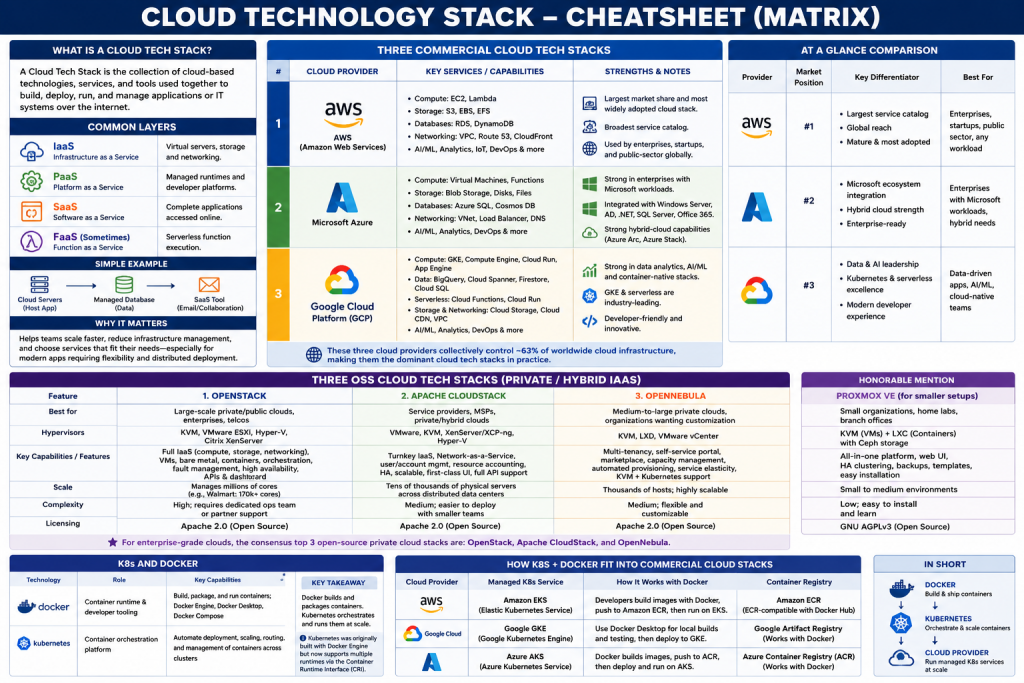
A Cloud Tech Stack is the collection of cloud-based technologies, services, and tools used together to build, deploy, run, and manage applications or IT systems. It usually includes layers such as infrastructure, platform services, and software delivered over the internet.
Common layers
- Infrastructure as a Service (IaaS): virtual servers, storage, and networking.
- Platform as a Service (PaaS): managed runtimes and developer platforms.
- Software as a Service (SaaS): complete applications accessed online.
- Sometimes Function as a Service (FaaS): serverless code execution.
Simple example
A web app might use cloud servers to host the app, a managed database for data, and a SaaS tool for email or collaboration. In practice, the “stack” is just the set of pieces that work together to deliver the service.
Why it matters
A cloud tech stack helps teams scale faster, reduce infrastructure management, and choose services that fit their needs. It is especially useful for modern apps that need flexibility and distributed deployment.
Three Commercial Cloud Tech Stacks
It is generally understood as the top three cloud platforms themselves, since each platform provides its own integrated stack of services. The three most popular are:
1. AWS (Amazon Web Services)
- Largest market share and most widely adopted cloud stack
- Broadest service catalog: compute (EC2), storage (S3), databases (RDS, DynamoDB), serverless (Lambda), networking, AI/ML, and more
- Used by enterprises, startups, and public-sector organizations globally
2. Microsoft Azure
- Second-largest cloud provider, especially strong in enterprises with Microsoft workloads
- Integrated with Windows Server, Active Directory, .NET, SQL Server, and Office 365
- Strong hybrid-cloud capabilities (Azure Arc, Azure Stack) and extensive enterprise adoption
3. Google Cloud Platform (GCP)
- Third-largest cloud provider, replacing Kubernetes + Docker–centric stacks with GCP-native services
- Core stack includes:
- Compute: Google Kubernetes Engine (GKE), Compute Engine, Cloud Run, App Engine
- Data: BigQuery, Cloud Spanner, Firestore, Cloud SQL
- Serverless: Cloud Functions, Cloud Run
- Storage & networking: Cloud Storage, Cloud CDN, VPC
- Notable for data analytics, AI/ML, and container-native architectures
These three cloud providers collectively control about 63% of worldwide cloud infrastructure, making them the dominant cloud tech stacks in practice.
Three OSS Cloud Tech Stacks
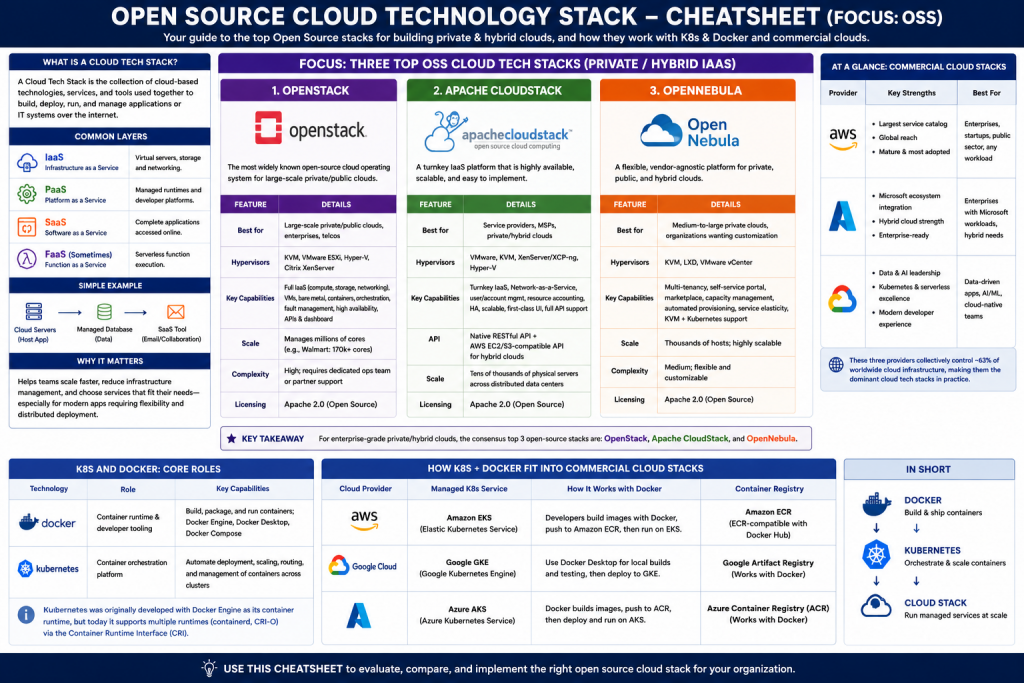
These are top three most popular open-source tech stacks for building your own cloud (private or hybrid IaaS):
1. OpenStack
OpenStack is the most widely known open-source cloud operating system, controlling large pools of compute, storage, and networking resources via APIs and a dashboard. It provides full IaaS functionality for virtual machines, bare metal, and containers, plus orchestration, fault management, and high availability.
2. Apache CloudStack
CloudStack is a turnkey IaaS platform that includes the entire stack: compute orchestration, Network-as-a-Service, user/account management, resource accounting, and a first-class UI. It’s designed to be highly available, highly scalable, and easy to implement with a small team.
| Feature | Details |
|---|
3. OpenNebula
OpenNebula is a turnkey, flexible, vendor-agnostic platform for private, public, and hybrid clouds atop virtualized data centers. It supports KVM and Kubernetes in a shared environment, with multi-tenancy, automated provisioning, and service elasticity.
Honorable mention: Proxmox VE (for smaller setups)
Proxmox VE integrates KVM VMs and LXC containers with Ceph storage and high-availability clustering in a single Debian-based platform. It’s best for small organizations and home labs due to its easy installation and quick learning curve.
For enterprise-grade clouds, the consensus is OpenStack, CloudStack, and OpenNebula as the top three open-source private cloud stacks.
K8s and Docker
Docker and Kubernetes serve different but complementary roles in container-based infrastructure:
Core roles
| Technology | Role | Key capabilities |
|---|---|---|
| Docker | Container runtime & developer tooling | Build, package, and run containers; Docker Engine, Docker Desktop, Docker Compose |
| Kubernetes | Container orchestration platform | Automate deployment, scaling, routing, and management of containers across clusters |
Kubernetes was originally developed with Docker Engine as its container runtime, but today it supports multiple runtimes (containerd, CRI-O) via the Container Runtime Interface (CRI).
How K8s + Docker Fit Into Commercial Cloud Stacks (AWS, GCP, Azure)
All three major providers offer managed Kubernetes services where Docker is used for container development and K8s for orchestration:
In commercial clouds:
- Developers use Docker Desktop/CLI to build images locally
- Images are pushed to the cloud’s container registry (ECR/ACR/GCR)
- Kubernetes manifests deploy those images to managed K8s clusters
- The cloud provider handles control plane management, while you manage workloads
How K8s + Docker Fit Into Open-Source Cloud Stacks (OpenStack, CloudStack, OpenNebula)
Open-source private cloud platforms integrate K8s + Docker to deliver containerized workloads alongside VMs:
OpenStack
- Magnum service: Self-service provisioning of Kubernetes, Docker Swarm, and Mesos clusters on VMs or bare metal
- Kolla & OpenStack-helm: Containerize the OpenStack control plane itself for easier deployment
- Cinder block storage, Neutron networking, and enterprise storage systems all work with containers
- Run containers on bare metal or VMs with full enterprise storage/networking support
Apache CloudStack & OpenNebula
Both support K8s as an orchestration layer on top of their compute/storage/networking resources, allowing you to:
- Deploy containerized apps alongside traditional VM workloads
- Use Terraform/IaC to provision K8s clusters with compute nodes
- Integrate with CI/CD pipelines and version-controlled deployment files
Docker Enterprise Container Cloud (Mirantis)
- Provides a multi-cloud management layer that deploys certified Kubernetes clusters on:
- Offers a single management API across all providers, avoiding vendor lock-in
- Includes Stacklight for logging, monitoring, and alerting
Key Advantages of K8s + Docker Across Both Stacks
Summary
- Docker is the container runtime and developer tooling for building/packaging containers
- Kubernetes is the orchestration layer that scales and manages those containers
- In commercial clouds, they’re integrated into managed services (EKS/GKE/AKS) with cloud-native registries
- In open-source clouds, they’re added as orchestration layers on top of OpenStack/CloudStack/OpenNebula, often via Magnum or similar services
- Together, they enable container-native, cloud-agnostic architectures whether you’re on AWS, GCP, Azure, or your own private cloud