Download here: https://www.proxmox.com/en/downloads/proxmox-virtual-environment
Proxmox Virtual Environment (PVE) is a free, open-source enterprise virtualization platform. It combines multiple infrastructure technologies into a single management platform:
- KVM for full virtual machines
- LXC for lightweight Linux containers
- Software-defined storage (ZFS and Ceph)
- Software-defined networking (SDN)
- High Availability (HA) clustering
- Integrated backup support via Proxmox Backup Server
- Web-based management interface and REST API
Unlike traditional hypervisors that require separate products for clustering, storage, networking and management, Proxmox integrates everything into one platform.
Core architecture
              Web GUI / REST API / CLI
                         │
        ┌────────────────┼────────────────┐
        │                │                │
      KVM VMs        LXC Containers     HA Manager
        │                │                │
        └────────────────┼────────────────┘
                         │
                 Linux Kernel + QEMU
                         │
         ┌───────────────┬──────────────┐
         │               │              │
        ZFS           Ceph RBD        NFS/CIFS
         │               │              │
         └───────────────┼──────────────┘
                         │
                  Physical servers
Why it has become so popular
Proxmox has become one of the most popular virtualization platforms because it offers:
- No per-core licensing
- Enterprise-grade clustering
- Excellent ZFS support
- Built-in Ceph integration
- Easy live migration
- HA without additional software
- Modern web interface
- REST API for automation
- Large community
It has become particularly popular for:
- Homelabs
- SMEs
- MSPs
- Universities
- HPC labs
- AI clusters
- Edge computing
What’s new in Proxmox VE 9.2-1?
Version 9.2-1 (released 21 May 2026) is one of the biggest operational improvements since the 9.x series began.
1. Dynamic Load Balancer
This is arguably the headline feature.
Previously:
- You manually balanced VMs.
- One node could become overloaded.
- HA only restarted failed VMs.
Now:
The Cluster Resource Scheduler (CRS) continuously monitors node utilisation and can automatically migrate HA-managed VMs to improve cluster balance while respecting HA policies.
Think of it as:
VMware DRS—finally arriving in Proxmox.
For an SRE this means:
- lower CPU hotspots
- better RAM distribution
- improved cluster utilisation
- less manual intervention
2. WireGuard SDN fabrics
Software Defined Networking gains native WireGuard support.
Instead of building tunnels manually, SDN can now use WireGuard fabrics.
Ideal for:
- multi-site clusters
- home lab + cloud
- disaster recovery
- remote edge clusters
This makes secure networking dramatically easier.
3. Better BGP / EVPN support
Networking receives major upgrades:
- Route Maps
- Prefix Lists
- BGP filtering
- OSPF redistribution
- IPv6 EVPN underlay
- Better EVPN controller options
This moves Proxmox SDN much closer to enterprise data centre networking.
4. Custom CPU Model Manager
Previously:
CPU modelswere edited using configuration files.
Now there is a GUI under:
Datacenter
    →
Custom CPU Models
You can:
- create CPU profiles
- edit profiles
- delete profiles
- inspect supported CPU flags
This is extremely useful for mixed CPU clusters.
Example:
Intel Xeon E5
AMD EPYC
You can expose a compatible CPU feature set across all hosts for live migration.
5. HA Arm / Disarm
Cluster maintenance has become much easier.
You can now temporarily disarm the High Availability manager.
Before:
Maintenance often triggered:
- fencing
- unwanted migrations
- HA recovery actions
Now:
    Disarm HA
        ↓
Perform maintenance
        ↓
      Arm HA
        ↓
 Everything resumes
This is one of the most requested enterprise features.
6. Updated software stack
9.2 updates almost every major component:
| Component | Version |
|---|---|
| Debian | 13.5 Trixie |
| Linux Kernel | 7.0 |
| QEMU | 11.0 |
| LXC | 7.0 |
| ZFS | 2.4 |
| Ceph | Tentacle 20.2.1 |
| Alternative Ceph | Squid 19.2.x |
7. Better Ceph support
Ceph Tentacle is now the recommended release.
Benefits include:
- better performance
- improved recovery
- newer BlueStore features
- updated replication
- improved management
This is especially valuable if you’re building a hyper-converged infrastructure.
8. Storage improvements
9.2 also improves:
- ZFS performance
- storage management
- replication
- snapshot handling
- integration with Ceph
9. General stability
Hundreds of fixes include improvements to:
- VM migration
- clustering
- networking
- storage
- GUI responsiveness
- API behaviour
- backup handling
Why this matters for your homelab
Given the OpenStack/Ceph/Kubernetes homelab you’ve been planning, Proxmox 9.2 is a particularly good foundation because it provides:
- Dynamic load balancing across your cluster as VM workloads change.
- Native WireGuard SDN, making it easier to extend your lab securely or connect remote sites.
- Custom CPU models, useful if your cluster contains heterogeneous hardware (for example, different Xeon generations).
- Improved HA maintenance, reducing operational friction during upgrades and testing.
- Ceph Tentacle support, aligning well with a modern hyper-converged storage stack.
- Linux 7.0 and newer QEMU/LXC, bringing broader hardware compatibility and performance improvements.
For a three-node homelab evolving into OpenStack, Kubernetes, Ceph, and Slurm, Proxmox VE 9.2 is currently the most capable release to build on.
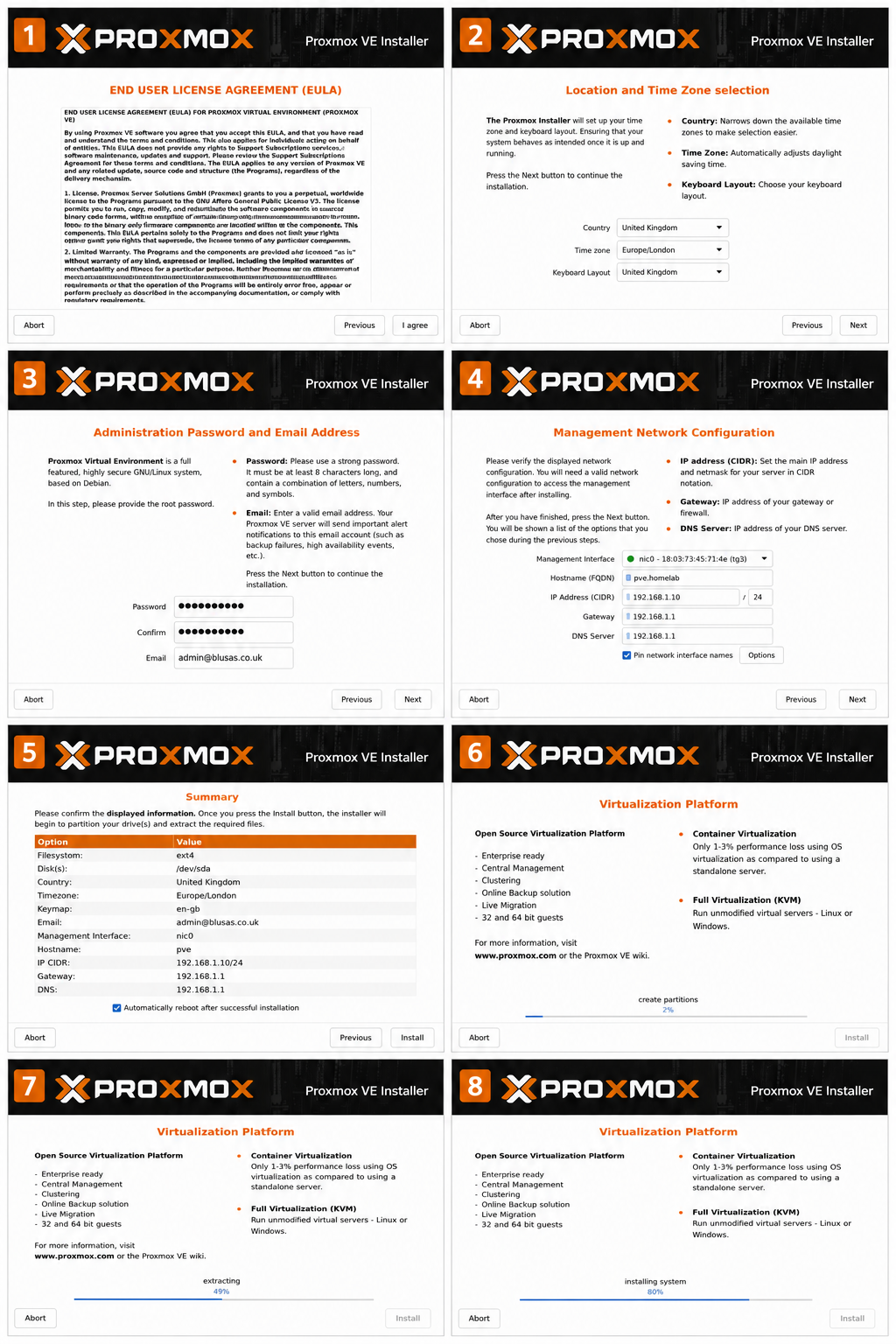
Homelab Install
Install screens below – click to view image: