“Neocloud” (sometimes written neo cloud) is a term for a new generation of cloud providers that specialize in AI computing rather than offering the full range of traditional cloud services. They focus heavily on providing high-performance GPUs for AI training and inference.
How neoclouds differ from traditional cloud providers
| Traditional cloud (AWS, Azure, Google Cloud) | Neocloud |
|---|---|
| Broad range of services (databases, storage, networking, analytics, etc.) | Primarily focused on AI and GPU computing |
| Designed for many types of workloads | Optimized specifically for AI/ML workloads |
| Large hyperscale platforms | Often smaller, AI-focused companies |
| GPU capacity can be limited or expensive | Aim to provide faster access to GPUs and lower costs |
Why neoclouds became popular
The explosion of generative AI created huge demand for GPUs such as NVIDIA H100 and Blackwell chips. Many organizations struggled to obtain enough AI compute from traditional cloud providers, creating an opportunity for specialized GPU cloud companies.
Examples of neocloud providers
Some well-known neocloud companies include:
- CoreWeave
- Lambda
- Crusoe
- Nebius
- Together AI
These companies provide GPU-as-a-Service (GPUaaS) and AI-focused infrastructure.
Simple analogy
Think of traditional cloud providers as a large supermarket that sells everything, while a neocloud is a specialty store focused almost entirely on AI computing power. It may offer fewer services overall, but it is optimized for AI workloads and often provides better access to GPUs.
Nscale a European Neocloud?
Today, a more representative list of major neoclouds would include:
| Company | Region | Notes |
|---|---|---|
| Nscale | UK / Europe | Full-stack AI infrastructure, sovereign AI cloud, GPU cloud, data centre developer. |
| CoreWeave | US | Often regarded as the archetypal neocloud. |
| Nebius | Europe | AI cloud and GPU infrastructure provider. |
| Lambda | US | GPU cloud focused on AI training and inference. |
| Crusoe | US | AI data centres and GPU cloud infrastructure. |
| Together AI | US | AI platform plus infrastructure. |
Nscale’s positioning is actually slightly different from some of the others because it is trying to be vertically integrated:
- Building or owning AI data centres.
- Procuring GPU fleets at massive scale.
- Operating AI cloud services.
- Offering sovereign AI infrastructure for governments and enterprises.
- Running full-stack AI platforms rather than just renting GPUs.
Some analysts now classify Nscale as an AI hyperscaler rather than merely a neocloud because of the scale it is targeting. ABI Research ranked Nscale as the overall leader among 14 neocloud providers in its 2026 assessment.
What’s interesting is that the neocloud landscape appears to be splitting into three tiers:
- GPU rental companies – essentially GPU-as-a-Service.
- AI cloud platforms – GPUs plus AI tooling.
- AI hyperscalers – own data centres, networking, power, GPUs, and cloud platform.
Nscale is deliberately pursuing category 3. The company describes itself as a vertically integrated AI cloud and has announced very large-scale deployments in Europe and the US.
If you compare Nscale, CoreWeave, and Crusoe specifically, I’d place them like this:
| Area | Nscale | CoreWeave | Crusoe |
|---|---|---|---|
| Sovereign European AI | Strongest | Limited | Limited |
| GPU Cloud | Strong | Very Strong | Strong |
| Data Centre Ownership | Extensive strategy | Growing | Extensive |
| AI Hyperscaler Ambition | Very High | High | High |
| European Presence | Strongest | Moderate | Moderate |
| Microsoft Partnerships | Significant | Significant | Significant |
From a European perspective, Nscale is probably the closest thing Europe currently has to a home-grown AI hyperscaler.
No. If we’re talking about Europe specifically, I would actually argue the opposite:
CoreWeave is currently ahead in deployed AI infrastructure, while Nscale is ahead in announced future European capacity.
Those are very different things.
CoreWeave’s position in Europe
CoreWeave already has:
- European headquarters in London.
- Two operational UK data centres.
- Expansion into Norway, Sweden, and Spain.
- Billions already committed and deployed into European infrastructure.
- A mature GPU cloud platform that is already serving customers globally.
By 2025, CoreWeave had announced European expansion into Norway, Sweden, and Spain alongside its existing UK footprint.
More importantly, CoreWeave entered Europe after already becoming a large-scale AI cloud provider in the US. They brought:
- Operational expertise
- Existing customers
- Existing software platform
- Existing GPU fleet
That is a major advantage.
Where Nscale is stronger
Nscale’s strength is the future build pipeline.
Publicly announced projects include:
- Stargate Norway
- Sines (Portugal)
- UK AI campus developments
- Iceland expansion plans
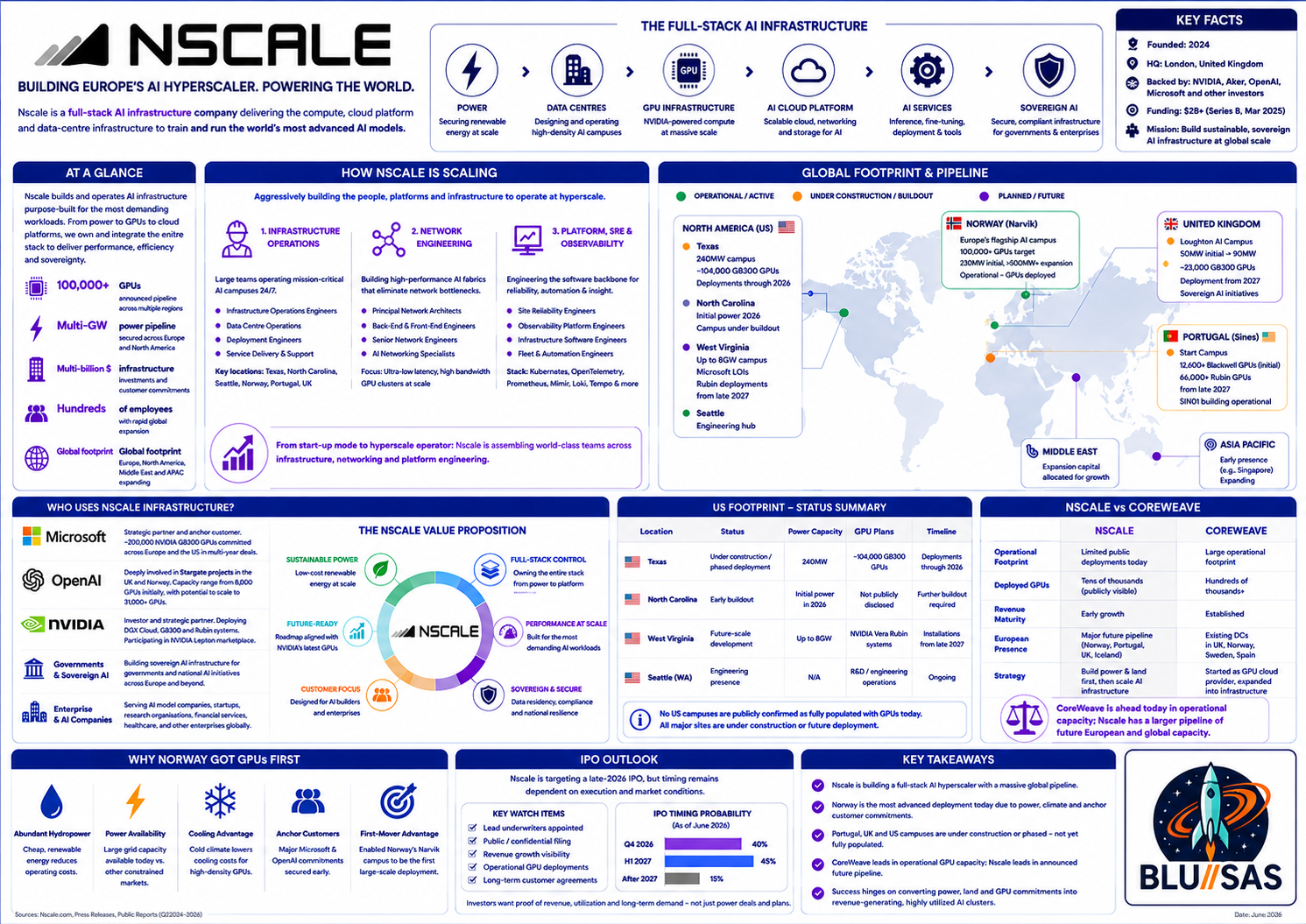
Some of these projects are absolutely enormous on paper. The Norway Stargate project alone targets 100,000 NVIDIA GPUs.
Portugal is also positioned as one of Nscale’s flagship European hubs, with 12,600+ Blackwell GPUs initially and much larger Rubin deployments planned later.
The key distinction
If you compare today’s operational reality:
| Metric | CoreWeave | Nscale |
|---|---|---|
| Operational GPU cloud | Ahead | Behind |
| Existing customer workloads | Ahead | Behind |
| Software/cloud platform maturity | Ahead | Behind |
| European operational experience | Ahead | Behind |
| Publicly visible deployed GPU capacity | Ahead | Behind |
If you compare future announced European capacity:
| Metric | CoreWeave | Nscale |
|---|---|---|
| Norway buildout | Large | Very large |
| Portugal | Limited public presence | Major flagship site |
| Sovereign AI initiatives | Some | Strong focus |
| OpenAI-linked projects | Limited | Significant |
| Future European MW pipeline | Large | Potentially larger |
A useful analogy
Today, CoreWeave is closer to:
“We already run a large AI cloud and are expanding into Europe.”
Nscale is closer to:
“We are building some of Europe’s largest AI campuses and will become a major AI cloud.”
Those are different stages of maturity.
The question investors are asking
The debate isn’t really:
“Can Nscale catch CoreWeave?”
The debate is:
“Can Nscale turn announced power, land, and GPU commitments into revenue-producing clusters before demand or financing conditions change?”
CoreWeave has already demonstrated it can operate large GPU fleets and monetize them. Nscale is in the process of proving that at the same scale.
One interesting point: some recent reporting has questioned the extent to which both companies’ European investment announcements translate into immediately operational facilities, noting that some “new data centre” claims are actually deployments into existing colocation facilities rather than brand-new campuses. That criticism has been directed at both Nscale and CoreWeave.
So as of mid-2026:
- Operationally: CoreWeave is ahead in Europe.
- Announced future European capacity: Nscale may have the larger headline pipeline.
- Execution risk: Nscale has more to prove because a larger proportion of its European footprint is still future-dated.
Is Nscale’s IPO still on target for late 2026?
As of June 2026, there is no publicly filed prospectus, no announced exchange, and no confirmed IPO date for Nscale.
The strongest public indication that an IPO is still being pursued comes from industry reports stating that Nscale was planning a fall/late-2026 IPO and was pursuing additional US data-centre acquisitions ahead of that listing.
However, there are several reasons to be cautious about assuming it is “on target”:
Reasons it could still happen in late 2026
- The AI infrastructure sector remains one of the hottest areas in public markets.
- Investors have rewarded AI infrastructure companies such as CoreWeave since its public debut.
- Nscale has announced very large infrastructure commitments involving Microsoft and multiple multi-hundred-megawatt campuses, which is the type of growth story public investors currently like.
Reasons it could slip into 2027
The challenge is that public-market investors increasingly want proof of:
- Revenue growth
- Actual GPU deployments
- Utilization rates
- Long-term customer contracts
- Cash-flow visibility
rather than just power agreements and future construction plans.
Unlike CoreWeave, which entered public markets after operating large GPU fleets for years, much of Nscale’s most ambitious capacity remains future-dated. That creates execution risk that investors will scrutinize heavily.
What I would watch for
If Nscale is genuinely targeting a late-2026 IPO, I would expect to see during the next few months:
- Appointment of lead underwriters (Goldman Sachs, Morgan Stanley, JPMorgan, etc.).
- Public filing activity or confidential filing reports.
- More detailed revenue disclosures.
- Announcements of operational GPU deployments, not just planned deployments.
- Additional long-term customer agreements.
My assessment
If I had to assign probabilities today:
| Outcome | Probability |
|---|---|
| IPO in Q4 2026 | ~40% |
| IPO slips into H1 2027 | ~45% |
| IPO delayed beyond 2027 | ~15% |
That’s not based on any insider information—just on where Nscale appears to be in its infrastructure rollout compared with where most AI infrastructure companies are when they ring the bell.
The most important signal is not the IPO date itself. It’s whether Nscale can demonstrate that its Norway, Texas, Portugal, and future UK capacity are being converted into revenue-generating GPU clusters with high utilization. If that evidence emerges during 2026, a late-2026 IPO becomes much more plausible.
CoreWeave
CoreWeave is an AI cloud provider that specializes in delivering large-scale GPU infrastructure for AI training, inference, HPC, rendering, and scientific computing.
The company started life as a GPU-focused cloud provider and has evolved into one of the largest independent AI infrastructure companies in the world.
Unlike AWS, Azure, and Google Cloud, which offer AI as part of a broader cloud portfolio, CoreWeave is almost entirely focused on GPU-accelerated workloads.
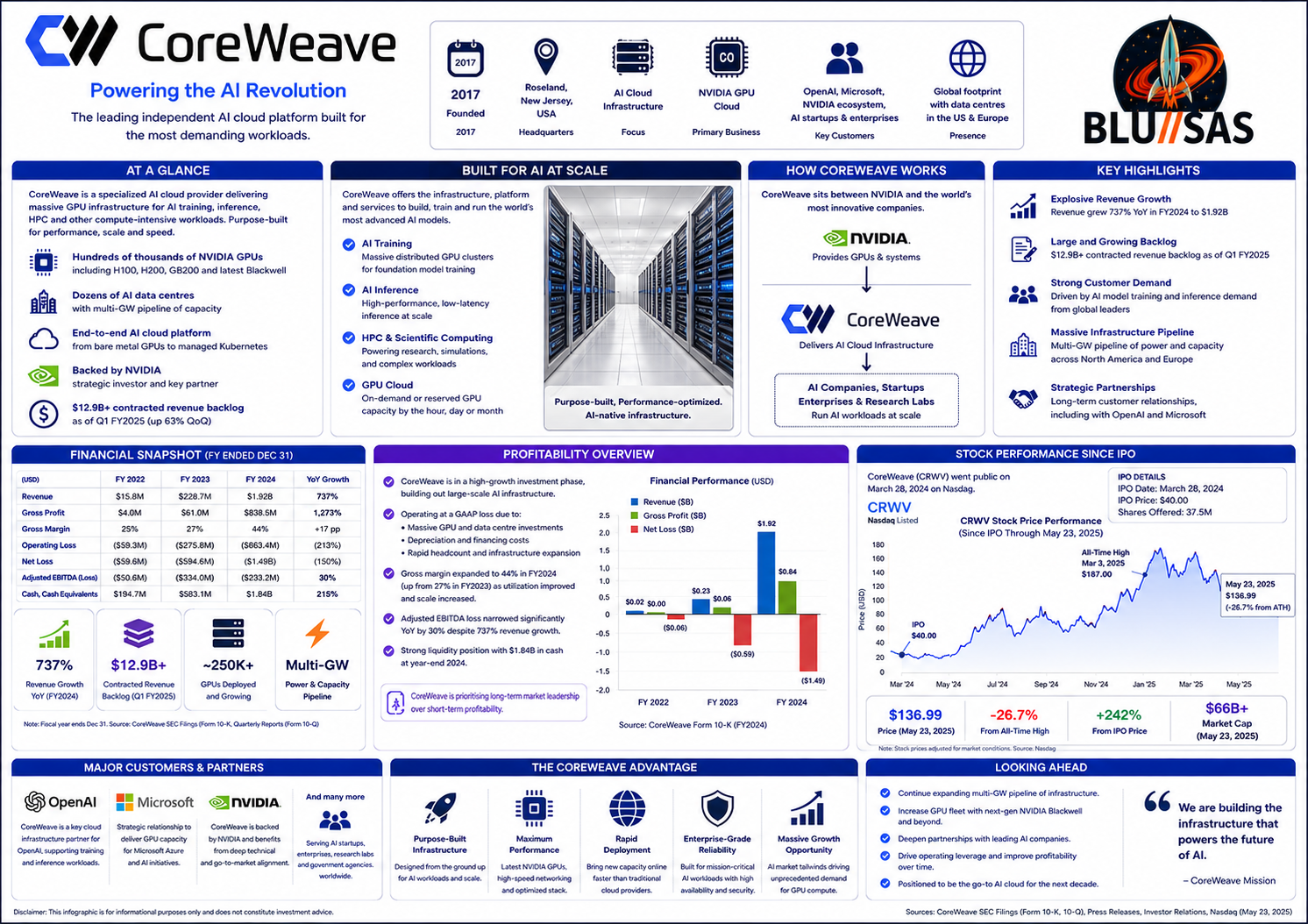
| Category | Details |
|---|---|
| Founded | 2017 |
| Headquarters | Roseland, New Jersey, USA |
| Focus | AI Cloud Infrastructure |
| Primary Business | GPU-as-a-Service |
| Main Customers | OpenAI, Microsoft, NVIDIA ecosystem, AI startups |
| Major Hardware | NVIDIA H100, H200, GB200, Blackwell |
| Competitors | AWS, Azure, Google Cloud, Crusoe, Lambda, Nscale |
How CoreWeave Started
The company originally operated in cryptocurrency mining.
Management realized early that:
- GPUs used for mining
- GPUs used for AI training
- GPUs used for rendering
all required similar infrastructure.
When the AI boom began following the success of ChatGPT, CoreWeave pivoted aggressively into AI compute.
This turned out to be one of the best-timed pivots in the technology industry.
CoreWeave’s Business Model
Think of CoreWeave as:
NVIDIA
   ↓
CoreWeave
   ↓
AI Companies
Instead of:
NVIDIA
   ↓
Microsoft Azure
AWS
Google Cloud
   ↓
AI Companies
CoreWeave sits between NVIDIA and AI customers.
What Services Does CoreWeave Offer?
1. AI Training Clusters
Used for:
- Large Language Models (LLMs)
- Foundation Models
- Multimodal Models
- Scientific AI
Examples:
- GPT-style models
- Image generation models
- Robotics models
Typical infrastructure:
- Thousands of GPUs
- InfiniBand networking
- Petabytes of storage
2. AI Inference
After a model is trained:
Training
   ↓
Model
   ↓
Inference
Inference is what happens when:
- You ask ChatGPT a question
- Generate an image
- Run a chatbot
CoreWeave provides infrastructure for this at scale.
3. HPC
High Performance Computing workloads:
- Weather modelling
- Genomics
- Drug discovery
- CFD
- Physics simulations
This is an area where CoreWeave competes with traditional HPC centres.
4. GPU Cloud
Instead of buying:
- H100s
- H200s
- Blackwell systems
Customers rent them by:
- Hour
- Day
- Month
Why NVIDIA Likes CoreWeave
NVIDIA has invested in CoreWeave because CoreWeave helps NVIDIA:
- Deploy GPUs faster
- Reach AI startups
- Increase GPU utilization
- Expand GPU cloud capacity
NVIDIA has been both a supplier and investor.
CoreWeave Infrastructure
Typical CoreWeave clusters contain:
NVIDIA GPUs
      │
InfiniBand
      │
GPU Nodes
      │
High-speed Storage
      │
Kubernetes
      │
Customer Workloads
Technologies typically include:
- NVIDIA DGX
- HGX
- InfiniBand
- RoCE
- Kubernetes
- Slurm
- Object Storage
How Big is CoreWeave?
By 2026, CoreWeave is operating or building infrastructure measured in:
- Hundreds of thousands of GPUs
- Multiple gigawatts of power
- Dozens of AI data centres
This puts them among the largest AI-focused cloud providers globally.
Why Microsoft Matters
One of CoreWeave’s biggest customers has been Microsoft.
Microsoft has used CoreWeave capacity to supplement Azure AI infrastructure when Azure could not provision GPUs quickly enough.
This relationship helped accelerate CoreWeave’s growth enormously.
CoreWeave vs Nscale
| Area | CoreWeave | Nscale |
|---|---|---|
| Founded | 2017 | 2024 |
| Stage | Mature AI cloud | Emerging AI hyperscaler |
| GPUs Deployed Today | Very Large | More Limited |
| Revenue | Much Higher | Earlier Growth |
| Operational Experience | Extensive | Building |
| US Presence | Major | Growing |
| Europe Presence | Growing | Large Future Pipeline |
| Data Centres | Operating Today | Many Future Builds |
| AI Cloud Platform | Mature | Developing |
What Would Interest an SRE?
For someone coming from:
- Kubernetes
- Observability
- OpenTelemetry
- Prometheus
- Mimir
- Loki
- Tempo
- HPC
CoreWeave is fascinating because it combines:
Infrastructure Scale
Thousands of servers per cluster.
AI Networking
- InfiniBand
- RoCE
- GPUDirect RDMA
Storage
- High-throughput parallel storage
- Object storage
- Checkpointing
Reliability
When a training run consumes:
10,000 GPUs
×
7 days
a single infrastructure failure can cost millions of dollars.
This creates unique SRE challenges around:
- Cluster reliability
- GPU scheduling
- Capacity management
- Fleet automation
- Telemetry at hyperscale
- AI workload observability
Why CoreWeave is Important
CoreWeave is one of the first companies to prove that a specialist AI cloud provider can compete with traditional hyperscalers.
The company effectively created a new category:
Traditional Cloud
AWS
Azure
GCP

vs

AI Cloud
CoreWeave
Crusoe
Lambda
Nscale
That category is now one of the fastest-growing areas of infrastructure technology and is driving much of the current AI infrastructure build-out worldwide.
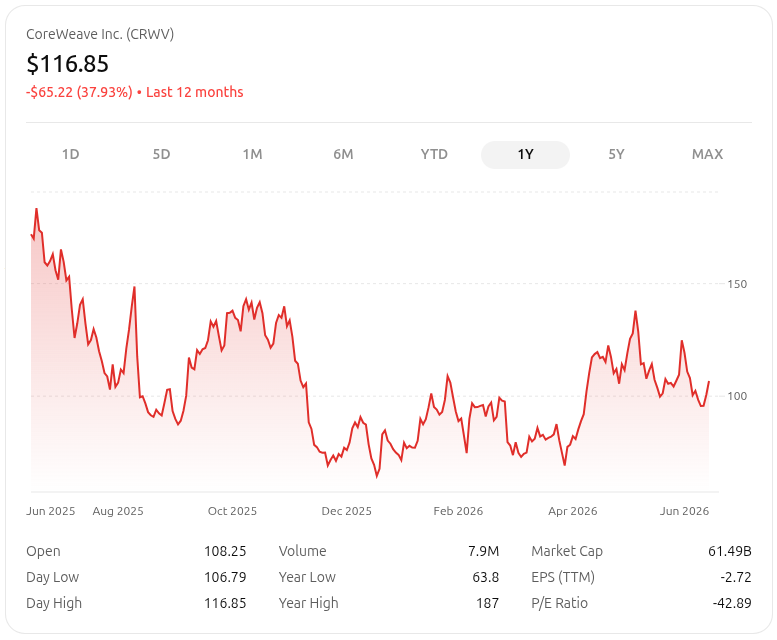
CoreWeave’s stock has had one of the most volatile post-IPO journeys in the AI infrastructure sector.
Share Price Since IPO
CoreWeave completed its Nasdaq IPO in March 2025 under the ticker CRWV. The IPO was downsized before launch, raising about $1.5 billion rather than the larger amount initially targeted.
The broad trajectory has been:
| Period | Approximate Story |
|---|---|
| Mar 2025 IPO | Weak initial reception and downsized offering |
| Apr–Jun 2025 | Strong AI enthusiasm drove shares sharply higher |
| Jun 2025 | Reached all-time highs around $187/share |
| H2 2025 | Significant correction as investors focused on debt, losses, and data-centre execution |
| Early 2026 | Recovery driven by AI demand, Anthropic, Meta, OpenAI and enterprise growth |
| Jun 2026 | Trading around $107/share |
Recent trading puts the company at a market capitalization of roughly $56 billion.
The Good News Financially
Revenue Growth Is Extraordinary
CoreWeave is one of the fastest-growing infrastructure companies in the market.
Examples include:
- Revenue more than doubled year-over-year in multiple recent quarters.
- Enterprise adoption is expanding beyond AI labs into financial services and large enterprises.
- Revenue backlog reached approximately $99.4 billion as of Q1 2026.
That backlog is enormous and provides strong visibility into future revenue.
Major Customers
CoreWeave has secured relationships with:
These are arguably the most important AI infrastructure customers on the planet.
Scale Advantage
Reuters recently noted that CoreWeave has:
- More than 1 GW already deployed
- More than 3.5 GW contracted for future deployment
This places it among the largest dedicated AI infrastructure operators globally.
The Risks
Massive Debt Load
This is the biggest concern.
CoreWeave financed much of its growth through:
- Asset-backed debt
- Infrastructure loans
- GPU-backed financing
- Convertible notes
Multiple analysts and investors have pointed to the company’s very large debt burden as its primary financial risk.
The business model requires spending billions before revenue arrives.
Still Losing Money
Despite explosive revenue growth, CoreWeave remains unprofitable on a net-income basis.
Investors are essentially betting that:
Revenue Growth
        >
Interest Costs + Depreciation + Expansion Costs
over the long term.
Recent earnings showed revenue beating expectations while margins and profitability remained under pressure.
Customer Concentration
Historically, a large portion of revenue has come from a relatively small number of customers.
If:
- OpenAI
- Microsoft
- Meta
- Anthropic
decide to build more capacity themselves, future growth could be affected.
This is one reason investors closely watch customer mix and backlog growth.
Why Investors Still Like It
The bullish thesis is straightforward:
- AI demand continues growing.
- GPU supply remains constrained.
- Training and inference workloads keep increasing.
- CoreWeave owns and operates the infrastructure needed to satisfy that demand.
In that scenario, today’s debt becomes manageable because revenue grows faster than financing costs.
Compared with Nscale
If I compare the two today:
| Area | CoreWeave | Nscale |
|---|---|---|
| Public Company | Yes | Not yet |
| Market Cap | ~$56B | Private |
| Revenue | Multi-billion | Much smaller |
| Operational GPU Capacity | Very large | Limited publicly visible |
| Revenue Backlog | ~$99B | Not publicly disclosed at same level |
| Debt | Very high | Much lower today |
| Execution Risk | Moderate | High |
| Infrastructure Maturity | Established | Emerging |
CoreWeave’s biggest challenge is financial leverage.
Nscale’s biggest challenge is execution.
CoreWeave has already proven it can build and operate AI infrastructure at scale. The question investors are asking is whether it can generate enough cash flow to justify the enormous capital expenditure and debt required to stay ahead in the AI compute race.
Crusoe
Crusoe is arguably the third major AI infrastructure challenger behind CoreWeave and the large hyperscalers, and alongside Nscale and Radiant in the race to build AI factories.
What makes Crusoe unique is that it evolved from an energy company into an AI infrastructure company.
Its progression has been roughly:
Flared Gas Capture
        ↓
Power Generation
        ↓
Bitcoin Mining
        ↓
GPU Infrastructure
        ↓
AI Cloud
        ↓
AI Factories
Today the company describes itself as an “AI Factory Company” rather than a traditional cloud provider.
Current Position
Valuation
Crusoe raised:
- $600M Series D (2024)
- $1.375B Series E (2025)
at a valuation exceeding $10 billion.
There are also industry reports suggesting private-market discussions at significantly higher valuations during 2026, though these are not official company figures.
Funding Strength
Crusoe has now raised approximately:
- $3.8B+ equity funding
- Additional billions in project finance and credit facilities
including a $750M Brookfield-backed credit facility.
Compared with many startups, Crusoe has become exceptionally well capitalized.
The Abilene AI Campus
The company’s flagship project is:
Abilene, Texas
This has become one of the largest AI infrastructure projects in the world.
Public reports describe:
- 1.2 GW campus
- Up to ~400,000 NVIDIA GB200-class GPUs planned
- $15B+ joint venture funding
- Major Oracle/OpenAI involvement
- Multiple operational buildings already online
This campus is one of the key foundations of the Stargate ecosystem.
Relationship With OpenAI, Oracle & Microsoft
Crusoe sits at the center of a fascinating triangle:
OpenAI
   │
Oracle
   │
Crusoe
   │
Microsoft
Recent developments have been mixed:
Positive
Oracle states:
- Abilene remains on schedule
- Two buildings are operational
- Additional Stargate capacity remains under development
Complicated
Several planned expansions have changed tenants or scope.
Reports indicate:
- OpenAI and Oracle stepped back from some expansion plans.
- Microsoft subsequently agreed to lease part of the adjacent capacity.
- Meta has reportedly evaluated some available capacity.
This isn’t necessarily bad news—it may actually demonstrate that demand is broad enough that multiple hyperscalers are competing for capacity.
Revenue Performance
Industry estimates suggest:
| Year | Revenue |
|---|---|
| 2024 | ~$276M |
| 2025 | ~$998M |
| 2026 | Potentially >$2B |
These are not audited public-company figures but are widely cited estimates reflecting the company’s rapid growth trajectory.
If accurate, Crusoe would be among the fastest-growing infrastructure companies globally.
Why Investors Like Crusoe
1. Speed
Crusoe has developed a reputation for building AI infrastructure extremely quickly.
Some investors explicitly cite build speed as a competitive advantage versus traditional data-center developers.
2. Vertical Integration
Unlike many competitors, Crusoe controls:
Power
   ↓
Generation
   ↓
Infrastructure
   ↓
Data Centres
   ↓
GPU Cloud
This resembles Radiant’s strategy and increasingly resembles Nscale’s.
3. AI Factory Focus
The company is moving beyond:
GPU Rentaltoward:
Complete AI Factorieswhich is where the largest contracts are emerging.
Current Challenges
1. Customer Concentration
Much of Crusoe’s growth is tied to:
- OpenAI
- Oracle
- Microsoft
This creates concentration risk.
If one customer changes strategy, large projects can be affected.
2. Capital Intensity
Like CoreWeave, Crusoe requires enormous capital expenditures.
Building:
- Multi-GW campuses
- Power infrastructure
- GPU fleets
requires tens of billions of dollars.
3. Project Volatility
Recent examples include:
- Wyoming project pause
- Changing Stargate scope
- Customer reallocations between OpenAI, Oracle, Microsoft and others
This demonstrates that even the hottest AI infrastructure projects are not immune to execution risk.
How Crusoe Compares
| Category | CoreWeave | Crusoe | Nscale | Radiant |
|---|---|---|---|---|
| Public Company | Yes | No | No | No |
| Valuation | ~$56B market cap | $10B+ private | Private | Private |
| AI Cloud Platform | Mature | Growing rapidly | Emerging | Ori platform |
| Operational AI Infrastructure | Very large | Large | Smaller today | Early |
| AI Factory Focus | Strong | Very strong | Very strong | Very strong |
| Energy Integration | Moderate | Strong | Strong | Exceptional |
| IPO Candidate | Already public | Likely future IPO | Potential IPO | Long-term possibility |
What I Think of Crusoe
Among the “new hyperscalers”:
- CoreWeave is currently the operational leader.
- Crusoe is probably the most advanced private AI infrastructure company.
- Nscale has one of the largest future pipelines.
- Radiant may have the strongest long-term capital structure because of Brookfield.
Crusoe’s biggest strength is that it has already proven it can deliver and operate very large AI campuses while still retaining startup-level speed. Its biggest challenge is moving from a few gigantic flagship projects into a diversified, repeatable AI infrastructure business that is less dependent on any single customer or project.
CoreWeave vs Crusoe vs Nscale
These are arguably the three most important “Neoclouds” today.
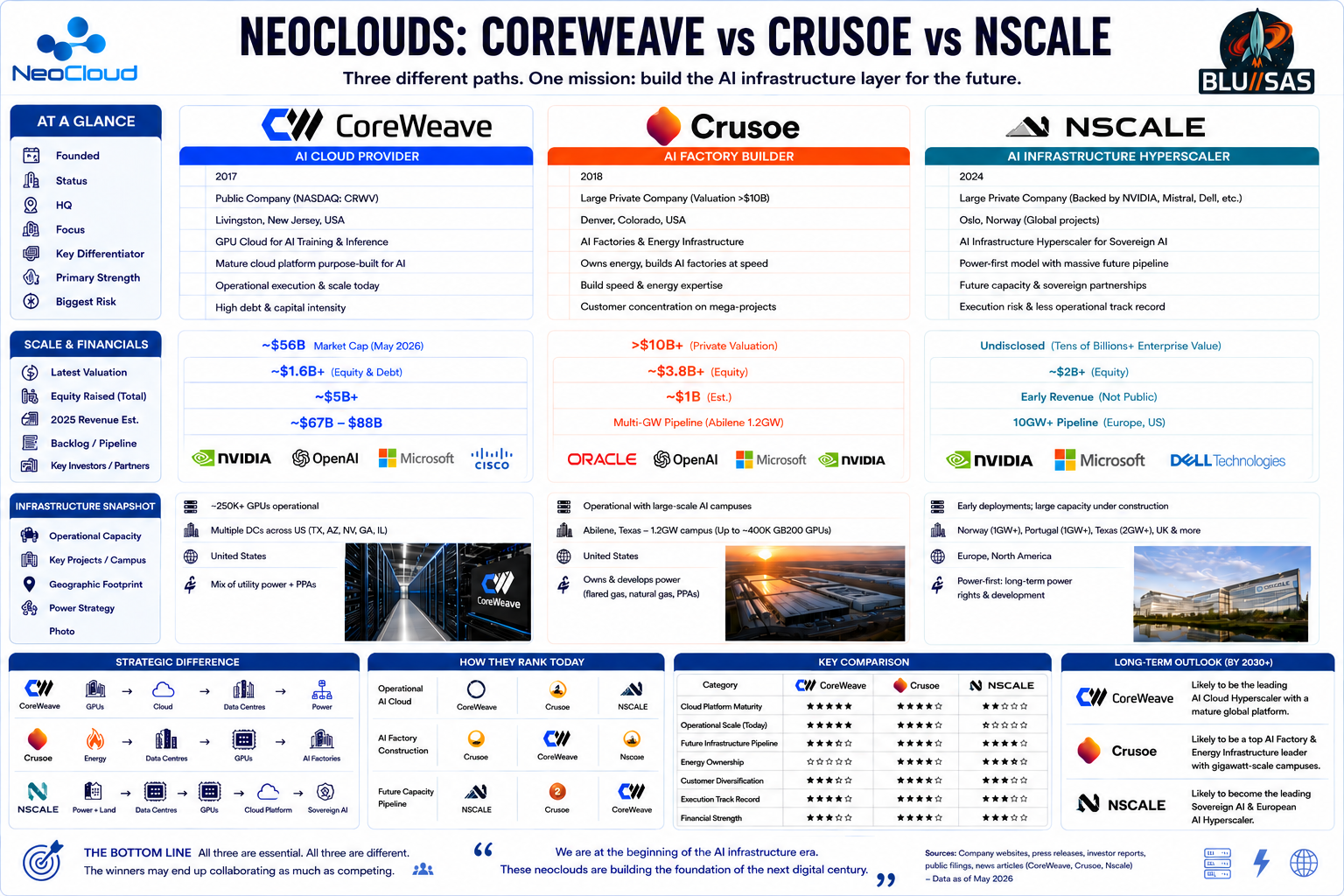
All three are trying to become the AI-era equivalent of hyperscalers, but they are taking very different paths.
Executive Summary
| Company | CoreWeave | Crusoe | Nscale |
|---|---|---|---|
| Founded | 2017 | 2018 | 2024 |
| Status | Public company | Large private company | Large private company |
| Core Identity | AI cloud provider | AI factory builder | AI infrastructure hyperscaler |
| Geographic Strength | US | US | Europe |
| Operational Maturity | Highest | High | Emerging |
| AI Cloud Platform | Most mature | Growing | Developing |
| Energy Ownership | Limited | Strong | Strong |
| Future Capacity Pipeline | Large | Very Large | Enormous |
| Biggest Risk | Debt | Customer concentration | Execution |
| Biggest Strength | Operational excellence | Infrastructure delivery | Power + future capacity |
CoreWeave is currently winning on execution. Crusoe is winning on AI factory construction. Nscale is winning on future infrastructure ambition.
1. CoreWeave
What CoreWeave Is
CoreWeave is fundamentally an AI-native cloud provider.
Think:
AWS for GPUsexcept purpose-built for:
- AI training
- AI inference
- LLMs
- HPC
Its cloud platform is already mature and heavily used by large AI companies. CoreWeave operates dozens of data centres, hundreds of thousands of GPUs, and has become one of NVIDIA’s most important cloud partners.
Strengths
- Most mature software platform
- Largest operational fleet
- Strong OpenAI, Microsoft, Meta, Anthropic relationships
- Fastest revenue growth
- Proven ability to monetize GPUs
CoreWeave reported more than $5B revenue and a backlog approaching $67B-$88B depending on reporting period.
Weaknesses
- Huge debt load
- Heavy capex requirements
- Customer concentration
- Public market scrutiny
2. Crusoe
What Crusoe Is
Crusoe is best described as:
Energy Company
        +
AI Factory Builder
        +
GPU Cloud
It started by monetizing stranded energy and evolved into building some of the largest AI campuses in the world.
The Abilene campus in Texas has become one of the flagship AI infrastructure projects globally and is tied to Oracle and OpenAI’s broader Stargate ecosystem.
Strengths
- Extremely fast construction capability
- Strong energy expertise
- Large-scale AI factory delivery
- Deep OpenAI/Oracle ecosystem integration
Weaknesses
- Smaller cloud platform than CoreWeave
- Less diversified customer base
- Still heavily tied to a few mega-projects
What Crusoe Wants To Become
Crusoe appears to be evolving toward:
AI Factory Companyrather than simply a GPU cloud.
3. Nscale
What Nscale Is
Nscale is pursuing the most ambitious infrastructure vision.
Their strategy is:
Power
   ↓
Land
   ↓
Data Centres
   ↓
GPUs
   ↓
Cloud Platform
They are effectively trying to build a European AI hyperscaler from scratch.
Strengths
- Massive future pipeline
- Strong sovereign AI positioning
- European leadership position
- Large power commitments
- Strong Microsoft/OpenAI/NVIDIA relationships
Weaknesses
- Much of capacity remains future-dated
- Less operational experience
- Less mature cloud platform
- Execution risk
Public reporting has highlighted that several headline projects remain in buildout or planning phases rather than being fully operational today.
The Strategic Difference
CoreWeave
Started with:
GPUsThen added:
Cloud
→ Data Centres
→ Power
Crusoe
Started with:
EnergyThen added:
Data Centres
→ GPUs
→ AI Factories
Nscale
Started with:
Power + InfrastructureThen added:
GPUs
→ Cloud
→ Sovereign AI
Which Company Is Furthest Ahead Today?
Operational AI Cloud
Winner:
🥇 CoreWeave
Reason:
- Largest operational fleet
- Most mature software platform
- Largest customer base
AI Factory Construction
Winner:
🥇 Crusoe
Reason:
- Abilene
- Stargate involvement
- Proven delivery capability
Future Capacity Pipeline
Winner:
🥇 Nscale
Reason:
- Norway
- Portugal
- Texas
- UK projects
- Sovereign AI initiatives
Which Is Closest To Becoming a New Hyperscaler?
Today
CoreWeave
   ↑
   |
Crusoe
   |
Nscale
By 2030 (Potential)
CoreWeave
Crusoe
Nscale
All three could be major AI infrastructure providers, but they will likely specialize differently:
| Company | Likely Long-Term Identity |
|---|---|
| CoreWeave | AI Cloud Hyperscaler |
| Crusoe | AI Factory & Energy Infrastructure Leader |
| Nscale | Sovereign AI & European AI Hyperscaler |
From an SRE / Cloud Infrastructure Perspective
If you wanted to work on the most technically mature environment today:
CoreWeave
If you wanted to build some of the world’s largest AI campuses:
Crusoe
If you wanted to help create a new AI hyperscaler from the ground up:
Nscale
That is the clearest distinction between the three companies as of mid-2026.
Who is Radiant?
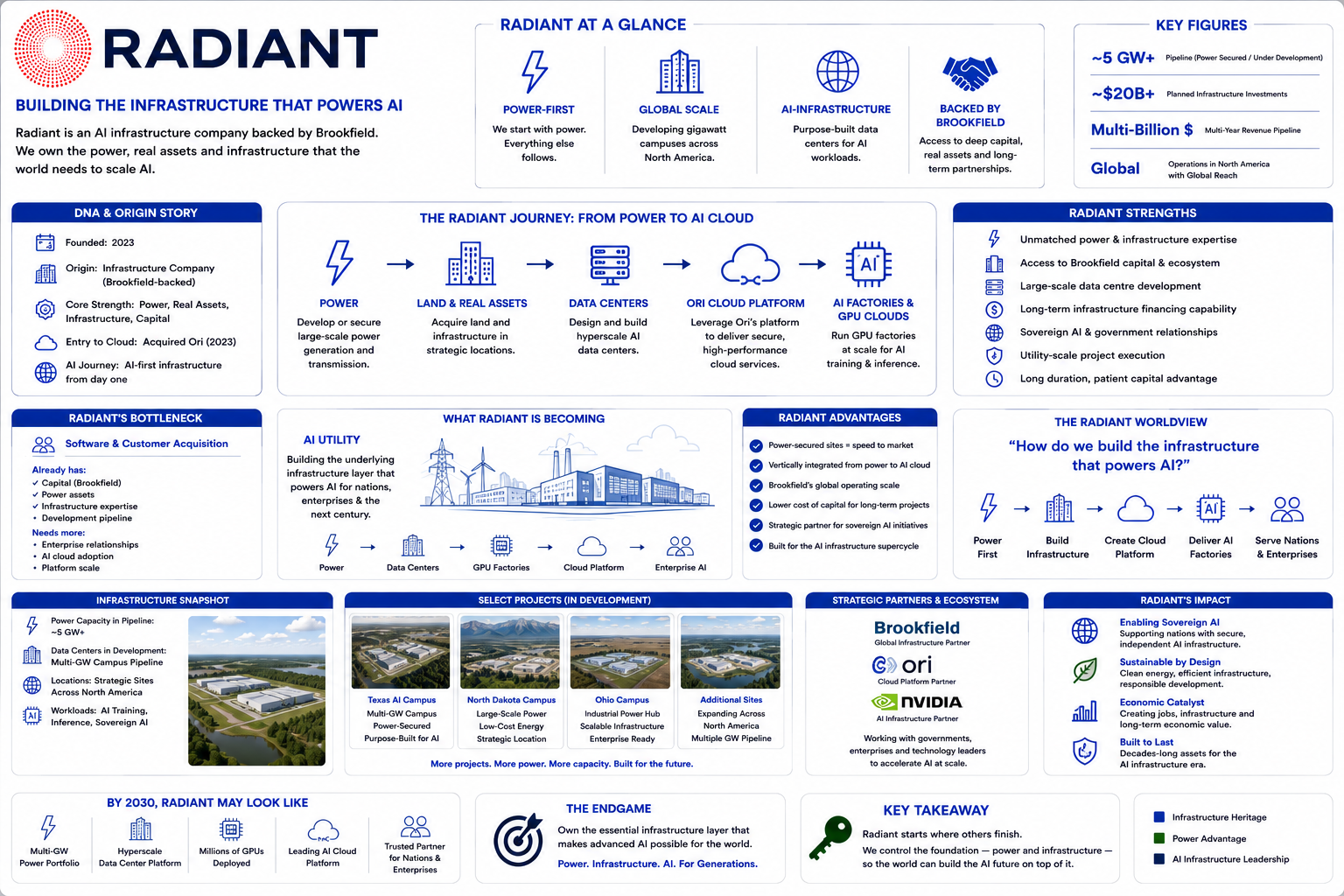
Radiant/Ori is one of the more interesting challengers because they are not trying to copy CoreWeave or Nscale exactly.
Instead, they are attempting to combine:
- Brookfield’s enormous infrastructure and energy assets
- Ori’s AI cloud software platform
- NVIDIA’s AI factory ecosystem
- Sovereign AI demand from governments and large enterprises
into a vertically integrated AI infrastructure company.
What is Ori?
Before the merger, Ori Industries was a UK AI cloud company founded in 2019.
Ori built:
- Distributed GPU cloud infrastructure
- AI model training platforms
- AI deployment services
- Multi-location AI compute services
The company operated AI infrastructure across more than 20 global locations and developed software to orchestrate AI workloads across GPU infrastructure.
Think of Ori as:
What CoreWeave built:
GPU Cloud Platform

What Ori built:
Distributed AI Infrastructure Platform
Ori’s technology is arguably the key intellectual property in the merger.
What is Radiant?
Radiant is Brookfield’s AI infrastructure company.
Brookfield is one of the world’s largest infrastructure investors with hundreds of billions under management spanning:
- Power generation
- Transmission
- Renewable energy
- Real estate
- Data centres
- Infrastructure projects
Radiant was created to become Brookfield’s AI compute platform.
Why Brookfield Matters
This is where Radiant becomes potentially disruptive.
Most AI clouds have a structure like:
Raise Venture Capital
        ↓
Buy GPUs
        ↓
Rent Datacentre Space
        ↓
Sell Compute
CoreWeave largely grew this way.
Nscale is evolving toward:
Power
  ↓
Datacentres
  ↓
GPUs
  ↓
Cloud Platform
Radiant starts with:
Brookfield Capital
       +
Brookfield Power
       +
Brookfield Land
       +
Brookfield Datacentres
       +
Ori Software
That means they potentially have access to cheaper capital than most AI startups.
Their Stated Strategy
Radiant has publicly described itself as a vertically integrated AI infrastructure platform.
Target customers include:
- Sovereign governments
- Hyperscalers
- Tier-1 telecom operators
- Large enterprises
Rather than simply renting GPUs to startups.
Their focus appears to be:
AI Factories
Large installations of:
- NVIDIA GPUs
- AI networking
- AI storage
- AI orchestration software
built for nations and large corporations.
The NVIDIA Connection
Radiant is built around NVIDIA’s AI factory vision.
Public statements indicate:
- NVIDIA contributed capital to Brookfield’s AI fund.
- NVIDIA will supply GPUs.
- Radiant will deploy NVIDIA DSX AI factories.
This places them squarely in the same ecosystem as:
- CoreWeave
- Crusoe
- Lambda
- Nscale
but with a heavier focus on sovereign infrastructure.
How They Intend to Join the Hyperscaler Club
The strategy appears to be:
Phase 1: Acquire Software
Acquire Ori.
Result:
GPU Cloud Software
AI Orchestration
AI Platform Expertise
✓ Completed.
Phase 2: Leverage Brookfield Infrastructure
Use Brookfield’s:
- powered land
- data centres
- energy assets
instead of building everything from scratch.
This is a major advantage versus startups.
Phase 3: Build Sovereign AI Factories
Target:
- governments
- national AI initiatives
- regulated industries
This aligns well with Europe’s push toward sovereign AI and AI factories.
Phase 4: Scale Like a Utility
This is probably the most important difference.
Several executives have stated they want AI infrastructure financed like:
Power Stations
Utilities
Rail Networks
Airports
rather than venture-backed cloud startups.
That could significantly lower financing costs compared with many GPU cloud providers.
How Do They Compare?
| Company | CoreWeave | Nscale | Radiant |
|---|---|---|---|
| Founded | 2017 | 2024 | 2026 |
| Public | Yes | No | No |
| Core Strength | Operating GPU clouds | Building AI campuses | Infrastructure + software |
| Main Backer | Public markets | Investors/NVIDIA | Brookfield |
| Focus | AI cloud | AI hyperscaler | AI utility model |
| Sovereign AI | Moderate | Strong | Very Strong |
| Capital Access | Good | Good | Potentially Exceptional |
| Operational GPU Scale Today | Highest | Lower | Very Early |
What Could Make Radiant Dangerous?
If you look at this as an SRE or infrastructure engineer, the biggest threat to competitors is not technology.
It is cost of capital.
CoreWeave’s biggest weakness is debt.
Nscale’s biggest challenge is execution.
Radiant’s pitch is:
“We already own the power, land, infrastructure financing, and data-centre expertise. We just needed the AI cloud software.”
That is precisely what the Ori acquisition gives them.
If Brookfield genuinely deploys the AI Infrastructure Fund at the scale discussed publicly (up to $10B fund commitments and potentially much larger through co-investment structures), Radiant could become one of the few companies capable of competing with CoreWeave, Nscale, Crusoe, and the hyperscalers in the sovereign AI factory market.
For someone with a background in Kubernetes, OpenStack, HPC, AI infrastructure, observability, Ceph, Slurm, and GPU platforms, Radiant is arguably one of the most interesting companies to watch over the next 2–3 years because they are trying to build the “AI utility company” rather than just another GPU cloud.
Is Radiant Ramping Up Recruitment?
If I were advising Radiant’s leadership after the Brookfield + Ori merger, I would not primarily hire more software developers or more data-centre staff initially.
The biggest challenge is integrating:
Energy Infrastructure
      +
Data Centres
      +
GPU Factories
      +
Cloud Platform
      +
Sovereign AI
into a single operating model.
That requires a very specific set of engineers.
Tier 1 — Recruit Immediately
These are the highest-priority hires.
1. Principal AI Infrastructure Architects
Need 5–10 globally.
Background:
- CoreWeave
- Microsoft Azure
- AWS
- Oracle Cloud
- NVIDIA
- Crusoe
- Nscale
Skills:
- AI factories
- Multi-GW campuses
- GPU fabrics
- Infrastructure strategy
These people define the architecture.
Without them everyone builds different solutions.
2. Staff/Principal GPU Platform Engineers
Need 20–50.
Skills:
- Kubernetes
- GPU Operator
- Slurm
- CUDA
- MIG
- NCCL
- DGX/HGX
Responsibilities:
GPU lifecycle
GPU scheduling
GPU utilization
GPU observability
These are the people that actually make expensive GPUs productive.
3. Staff Network Engineers
Need 20–40.
The AI industry is becoming:
Network Limited
rather than
GPU Limited
Experience:
- InfiniBand
- RoCE
- EVPN/VXLAN
- Arista
- NVIDIA Spectrum
- Mellanox
Sources:
- Meta
- Microsoft
- NVIDIA
- Oracle OCI
- Azure
4. Site Reliability Engineers
Need 30–60.
Not generic web SREs.
Need:
- Kubernetes
- Linux
- GPU clusters
- Storage
- Automation
Focus:
Reliability
Capacity
Performance
Automation
5. Observability Platform Engineers
Need 10–20.
This is where many AI companies are currently weak.
Technology:
- OpenTelemetry
- Prometheus
- Mimir
- Loki
- Tempo
- ClickHouse
- Kafka
Mission:
Observe
Everything
including:
- GPUs
- Power
- Cooling
- Storage
- Training jobs
- Networks
This is one of the areas where someone with your background would be valuable.
Tier 2 — Build During Year One
6. OpenStack Engineers
Many sovereign customers still want:
Private Cloudrather than:
Public GPU CloudNeed:
- Nova
- Neutron
- Cinder
- Ironic
Especially for government customers.
7. Storage Engineers
Need 15–30.
Experience:
- Ceph
- Lustre
- BeeGFS
- Weka
- VAST
AI clusters consume storage at enormous scale.
8. Infrastructure Software Engineers
Need 20–50.
Build:
- Fleet management
- Provisioning
- Capacity systems
- Internal developer platforms
Languages:
- Go
- Python
- Rust
9. Platform Security Engineers
Need 10–20.
Focus:
- Supply chain security
- GPU isolation
- Sovereign compliance
- Zero trust
Tier 3 — The Secret Weapon
These are the hires that separate a cloud provider from an AI hyperscaler.
10. HPC Engineers
Need 20–40.
Backgrounds:
- National labs
- Universities
- Supercomputing centres
Skills:
- Slurm
- MPI
- InfiniBand
- Parallel filesystems
These people understand:
10,000 GPU training jobsbetter than most cloud engineers.
11. Power Systems Engineers
This is where Brookfield can dominate.
Need:
- Utility engineers
- Grid engineers
- High-voltage engineers
Most AI companies have very few.
Brookfield already has many.
Radiant should integrate them directly.
12. Cooling Engineers
Future AI factories may be:
100MW+
500MW+
1GW+
Cooling becomes strategic.
Need expertise in:
- Liquid cooling
- Direct-to-chip
- Immersion
The Leadership Layer
Radiant’s biggest risk is organizational silos.
Avoid:
Brookfield Team
          |
          |
       Ori Team
Instead build:
AI Infrastructure
     |
     +-- Energy
     +-- Datacentres
     +-- GPU Platform
     +-- SRE
     +-- Observability
     +-- Security
If I Had £100M Hiring Budget
I’d prioritize:
| Role | Approx Headcount |
|---|---|
| GPU Platform Engineers | 40 |
| SREs | 40 |
| Network Engineers | 30 |
| Infrastructure Software Engineers | 30 |
| Storage Engineers | 20 |
| Observability Engineers | 15 |
| HPC Engineers | 20 |
| Security Engineers | 15 |
| AI Infrastructure Architects | 10 |
| Power/Cooling Specialists | 20 |
Total: ~240 specialist engineers.
The Three Most Valuable Hires
If Radiant could only hire three categories tomorrow:
- Principal GPU Platform Engineers
- Principal AI Networking Engineers
- Principal Observability/SRE Engineers
Those three groups determine whether a 100,000-GPU AI factory operates at:
95% utilizationor
60% utilizationThe difference is potentially hundreds of millions of dollars per year in infrastructure efficiency. For a company trying to become an AI utility, those engineering disciplines are arguably more important than almost any other technical hiring category.
Oracle’s Journey
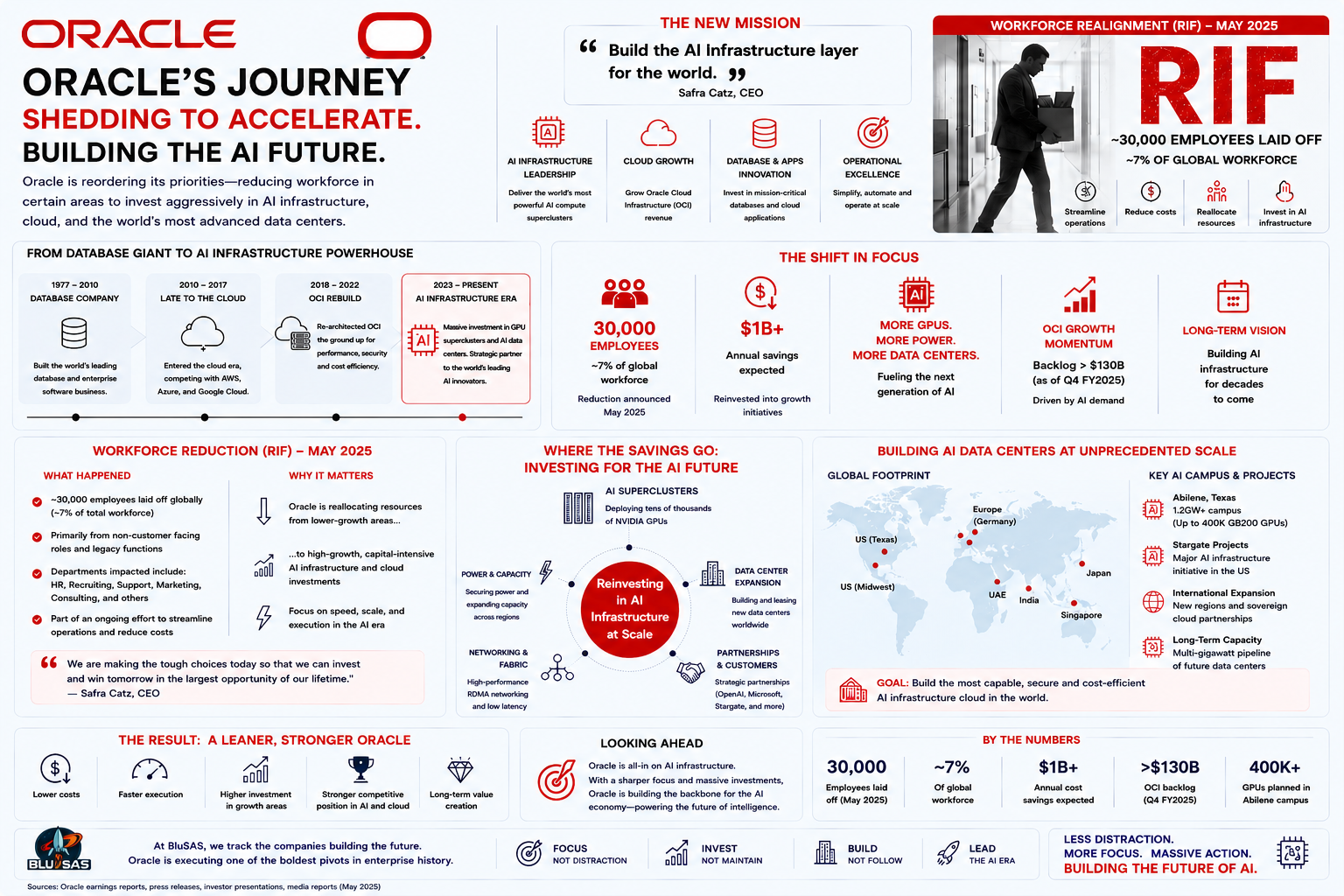
Phase 1: Database Company (1977-2010)
For decades Oracle was essentially:
Databases
+
Enterprise Software
Revenue came from:
- Oracle Database
- Enterprise applications
- Middleware
- Support contracts
Oracle dominated enterprise IT but missed the early public cloud wave.
Phase 2: Late Cloud Entrant (2010-2020)
AWS, Azure and Google Cloud were already well established.
Oracle’s first cloud attempts struggled because they largely tried to:
Move Oracle Products
     ↓
Into Oracle Cloud
rather than building a cloud-native platform.
OCI v1 wasn’t competitive.
Phase 3: OCI Rebuild (2018-2024)
This is where Oracle changed direction.
Under Clay Magouyrk’s leadership, OCI was essentially rebuilt from scratch.
Key design decisions:
Bare Metal First
Unlike AWS:
Physical Server
      ↓
Hypervisor
      ↓
VM
OCI emphasized:
Physical Server
      ↓
Customer
This became attractive for:
- HPC
- AI
- Databases
RDMA Networking
Oracle invested heavily in:
- RoCE
- RDMA
- HPC fabrics
Years before AI made these mainstream.
This is one reason OCI became attractive for GPU clusters.
Autonomous Infrastructure
OCI automated large parts of:
- provisioning
- patching
- operations
allowing Oracle to run cloud regions with fewer people.
Phase 4: AI Pivot (2023-Present)
ChatGPT changed everything.
Oracle suddenly found that:
Their Strengths Were AI Strengths
They already had:
✓ Bare metal
✓ HPC networking
✓ RDMA
✓ Large data centres
✓ Enterprise customers
These are exactly what AI workloads need.
The OpenAI Relationship
This is where Oracle became a serious AI player.
Oracle started providing infrastructure for:
- OpenAI
- Microsoft
- Stargate
through extremely large GPU deployments.
Oracle is now one of the biggest buyers of NVIDIA GPUs in the world.
Oracle’s AI Infrastructure Today
Oracle is building:
GB200 Clusters
Blackwell Clusters
RoCE Fabrics
AI Superclusters
At a scale that rivals many neoclouds.
Some deployments involve:
10,000+
50,000+
100,000+ GPUs
depending on project.
Why Oracle Is Different From CoreWeave
CoreWeave started with:
GPUs
   ↓
Cloud
Oracle started with:
Cloud
   ↓
GPUs
This gives Oracle advantages.
Existing Customers
Oracle already has:
- banks
- governments
- telecoms
- healthcare
These customers are now buying AI services.
CoreWeave must acquire those customers.
Oracle already has them.
Existing Revenue
Oracle generates tens of billions annually.
This means they can fund AI expansion from operating cash flow.
CoreWeave relies more heavily on:
- debt
- equity
- project financing
Existing Global Footprint
OCI already operates dozens of regions.
Nscale and Crusoe are still building much of theirs.
Is Oracle Becoming a Hyperscaler?
Oracle already is one.
OCI is generally considered the fourth major hyperscaler after:
- AWS
- Azure
- Oracle
The question is really:
Is Oracle becoming an AI hyperscaler?
The answer is:
Yes.
Is Oracle Becoming a Neocloud?
Not really.
Neoclouds are generally:
AI FirstExamples:
- CoreWeave
- Crusoe
- Nscale
- Radiant
Oracle is:
Cloud First
      ↓
AI Enhanced
A different origin story.
What Oracle Is Morphing Into
I would describe Oracle as:
Traditional Hyperscaler
          +
AI Factory Operator
          +
GPU Supercluster Provider
In fact Oracle increasingly resembles:
AWS + CoreWeave
combined.
AWS scale.
CoreWeave-style GPU infrastructure.
Why This Matters for the AI Race
The biggest threat to CoreWeave, Nscale and Crusoe may not be each other.
It may be Oracle.
Because Oracle has:
✓ Existing cloud
✓ Existing customers
✓ Existing revenue
✓ Existing data centres
✓ Existing support organisation
✓ Existing enterprise sales force
✓ Massive GPU procurement
The neoclouds must build these capabilities.
Oracle already has them.
The Next 5 Years
If current trends continue:
| Company | Likely Position 2030 |
|---|---|
| AWS | Largest general cloud |
| Azure | Largest enterprise AI cloud |
| AI + data platform leader | |
| Oracle | AI infrastructure hyperscaler |
| CoreWeave | Largest independent AI cloud |
| Crusoe | AI factory leader |
| Nscale | Sovereign AI hyperscaler |
| Radiant | AI utility platform |
My view is that Oracle is not becoming a neocloud.
Instead, Oracle is doing something arguably more powerful:
It is transforming from a traditional hyperscaler into an AI hyperscaler while retaining all the advantages of an established cloud provider.
That combination of existing scale, enterprise relationships, and AI infrastructure investment is why Oracle has suddenly become one of the most important players in the AI infrastructure market.
Is Oracle the opposite of Radiant and vice versa?
Not exactly, but they are surprisingly close to being mirror images of each other.
If you look at their origins:
| Oracle | Radiant |
|---|---|
| Started with software | Started with infrastructure |
| Database company | Infrastructure company |
| Built cloud platform | Acquired cloud platform (Ori) |
| Added AI later | Added AI from day one |
| Enterprise customers first | Sovereign AI first |
| Compute-centric | Power-centric |
| Cloud → AI | Infrastructure → AI |
A useful way to think about it is:
Oracle
-------
Software
   ↓
Database
   ↓
Cloud
   ↓
AI Infrastructure

Radiant
--------
Infrastructure
      ↓
Power
      ↓
Data Centres
      ↓
AI Infrastructure
So they are converging on a similar destination from opposite directions.
Oracle’s DNA
Oracle fundamentally thinks like a software company.
Its worldview is:
Application
    ↓
Database
    ↓
Cloud Platform
    ↓
Infrastructure
Its biggest assets are:
- Enterprise customers
- Databases
- SaaS products
- Sales organisation
- OCI platform
AI is an extension of those assets.
Oracle asks:
“How do we deliver AI to our existing customers?”
Radiant’s DNA
Radiant fundamentally thinks like an infrastructure company.
Its worldview is:
Power
   ↓
Land
   ↓
Data Centre
   ↓
GPU Factory
   ↓
AI Services
Its biggest assets are:
- Brookfield capital
- Brookfield power
- Brookfield real estate
- Brookfield infrastructure expertise
- Ori’s AI platform
Radiant asks:
“How do we build the infrastructure that powers AI?”
The Biggest Difference
Oracle’s bottleneck is usually:
Customer DemandThey already have:
- Data centres
- Customers
- Revenue
They need more GPUs and power.
Radiant’s bottleneck is usually:
Software & Customer AcquisitionThey already have:
- Capital
- Infrastructure expertise
- Energy
They need:
- AI cloud adoption
- Enterprise relationships
- Platform scale
What They Are Trying To Become
Oracle is evolving toward:
AI HyperscalerRadiant is evolving toward:
AI UtilityThose are related but different.
Oracle Vision
Oracle Cloud
        +
AI Superclusters
        +
Enterprise AI
Think:
“AWS/Azure with massive AI capability.”
Radiant Vision
Power
    +
Data Centres
    +
AI Factories
    +
Long-term Infrastructure Contracts
Think:
“National Grid meets CoreWeave.”
Why Radiant Could Learn From Oracle
Radiant lacks:
- Enterprise software experience
- Large-scale customer operations
- Decades of cloud platform evolution
Oracle has all of that.
Why Oracle Could Learn From Radiant
Radiant understands:
- Power economics
- Infrastructure financing
- Long-duration capital
- Utility-scale thinking
areas where Oracle historically has less expertise.
If They Met In The Middle
The interesting thing is that both companies are converging toward something like:
Power
   ↓
Data Centre
   ↓
GPU Factory
   ↓
Cloud Platform
   ↓
Enterprise AI
The difference is where they started.
| Layer | Oracle Strength | Radiant Strength |
|---|---|---|
| Power | Moderate | Exceptional |
| Data Centres | Strong | Exceptional |
| GPUs | Strong | Emerging |
| Cloud Platform | Exceptional | Good (via Ori) |
| Enterprise Sales | Exceptional | Developing |
| Sovereign AI | Moderate | Strong |
| Long-Term Infrastructure Finance | Moderate | Exceptional |
The More Interesting Comparison
I actually think the closest opposite of Radiant is not Oracle.
It’s CoreWeave.
CoreWeave
Started with:
GPUs
   ↓
Cloud
   ↓
Data Centres
   ↓
Power
Radiant
Started with:
Power
   ↓
Data Centres
   ↓
Cloud
   ↓
GPUs
Those are almost exact inverses.
Oracle sits somewhere else entirely because it arrived carrying:
Databases
+
Enterprise Software
+
Cloud Platform
which neither CoreWeave nor Radiant possessed.
So my assessment would be:
- CoreWeave and Radiant are the closest opposites.
- Oracle and Radiant are converging from opposite ends of the technology stack.
- By 2030, Oracle and Radiant may end up looking surprisingly similar externally, even though one began as a software giant and the other as an infrastructure and energy giant.
Reflective Journeys: Oracle vs Radiant
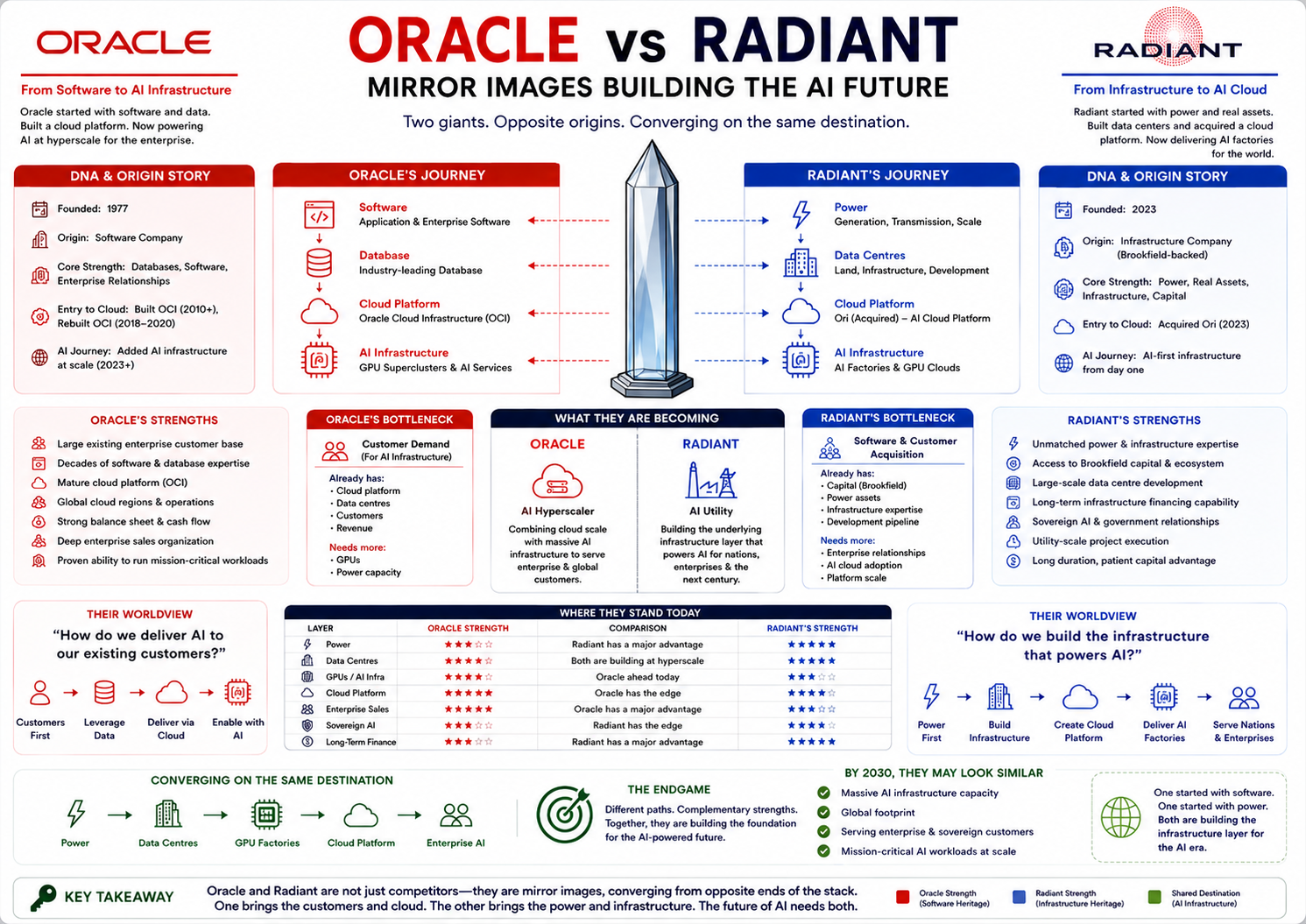
Yes, in many cases Oracle employees affected by AI-related restructuring could be strong candidates for Radiant, but it depends heavily on which part of Oracle they came from.
The interesting thing is that Oracle and Radiant are moving toward the same destination from opposite directions:
Oracle
Database
   ↓
Cloud
   ↓
AI Infrastructure

Radiant
Power
   ↓
Infrastructure
   ↓
AI Infrastructure
That creates a surprising amount of skill overlap.
Oracle Employees Radiant Should Recruit Aggressively
OCI Engineers
These are probably the highest-value hires.
Experience:
- OCI regions
- Cloud operations
- Bare metal
- Networking
- Cloud automation
Radiant needs people who know how to operate cloud infrastructure at scale.
These engineers bring exactly that.
AI Infrastructure Engineers
Oracle has been building:
- GPU superclusters
- RDMA fabrics
- RoCE networks
- AI training environments
Those skills are directly transferable to:
- Radiant AI factories
- GPU clouds
- Sovereign AI deployments
OCI SREs
Particularly valuable:
- Capacity planning
- Reliability engineering
- Infrastructure automation
- Fleet management
Radiant will need these people immediately as AI factories scale.
Data Centre Engineers
Oracle has been building data centres globally.
Skills:
- Capacity planning
- Facility operations
- Power
- Cooling
- Commissioning
These map extremely well to Radiant’s infrastructure-first strategy.
Network Engineers
Potentially the most valuable category.
Particularly if they have:
- RoCE
- RDMA
- EVPN/VXLAN
- High-performance networking
AI infrastructure is increasingly network-limited rather than GPU-limited.
Observability Engineers
This is a category many AI infrastructure companies underestimate.
Skills:
- OpenTelemetry
- Prometheus
- Grafana
- Logging platforms
- Distributed tracing
Radiant will eventually need to observe:
Power
Cooling
Networks
Storage
GPUs
Training Jobs
Cloud Platform
at enormous scale.
Oracle Employees Radiant May Need Less Of
Traditional ERP / Applications Teams
Experience in:
- E-Business Suite
- HR systems
- Legacy applications
is less directly relevant.
Radiant is building infrastructure rather than enterprise applications.
Traditional Database Administration
Still useful, but lower priority.
Radiant’s biggest bottlenecks are more likely:
- GPUs
- Networking
- Data centres
- Cloud platforms
than Oracle Database administration.
Would It Be Good For The Employees?
Potentially yes.
Oracle is becoming:
Large AI HyperscalerRadiant is becoming:
AI Infrastructure Startup
with Brookfield backing
Some engineers prefer:
Oracle
- Stability
- Massive scale
- Mature processes
- Existing customer base
Radiant
- Building from scratch
- More influence
- Faster decision making
- Potentially larger individual impact
If I Were Radiant’s CTO
The first Oracle hires I would target would be:
- OCI Principal SREs
- OCI Network Architects
- OCI GPU Platform Engineers
- OCI Capacity Engineers
- OCI Observability Platform Engineers
- OCI Data Centre Build Engineers
These people have already operated infrastructure at scales that Radiant wants to achieve.
Looking at Your Background
Based on the areas you’ve worked deeply in—observability, OpenTelemetry, Prometheus/Mimir/Loki/Tempo, Kubernetes, HPC, storage, automation, cloud platforms, and AI infrastructure—the type of role that would likely be most valuable to a company like Radiant is not a generic SRE.
It would be something closer to:
- Principal Observability Engineer
- AI Infrastructure Observability Architect
- Staff SRE (AI Platforms)
- Platform Engineering Lead
- AI Factory Telemetry Architect
because one of the hardest problems these emerging AI infrastructure companies will face is creating observability across the entire stack:
Power
  ↓
Data Centre
  ↓
Network Fabric
  ↓
GPU Cluster
  ↓
Kubernetes / Slurm
  ↓
AI Workloads
Very few engineers have practical experience spanning that many layers.
One caveat: public reporting has discussed Oracle workforce reductions in various parts of the business, but I have not seen reliable evidence supporting a single confirmed figure of “30,000 layoffs” across Oracle as a whole. When evaluating career moves, it’s better to focus on the strategic trend—Oracle investing heavily in AI infrastructure and cloud—rather than any specific layoff number unless confirmed by Oracle itself.
Where is all the Money?
The short answer is:
The money is real, but most of it is not sitting in a bank account waiting to be spent.
What you’re seeing is a combination of:
- Cash flow
- Debt financing
- Equity financing
- Project finance
- Infrastructure finance
- Customer pre-commitments
- Stock market valuations
The AI infrastructure boom is probably the largest capital deployment into technology infrastructure since the construction of the Internet and mobile networks.
Where Does The Money Actually Come From?
Imagine a company announces:
$20 Billion AI CampusMany people picture:
Bank Account
    ↓
$20 Billion
That’s almost never what happens.
Instead:
Equity
 +
Debt
 +
Customer Contracts
 +
Infrastructure Loans
 +
Future Revenue
fund the project.
CoreWeave
CoreWeave is the easiest example.
They need:
- GPUs
- Data centres
- Power
- Networking
worth billions.
They fund this through:
Equity
Investors buy shares.
Debt
Banks lend money.
GPU-backed loans
This is fascinating.
CoreWeave can buy:
100,000 H100sand lenders treat those GPUs almost like collateral.
Similar to:
Mortgage
   ↔ House

Loan
   ↔ GPU Fleet
Oracle
Oracle is different.
Oracle generates tens of billions in annual revenue.
Their funding comes primarily from:
Operating Cash Flow
Database Revenue
SaaS Revenue
Support Contracts
OCI Revenue
This is actual cash arriving every quarter.
Oracle can invest from profits.
Corporate Debt
Oracle also issues bonds.
For example:
Oracle Bond
    ↓
Investors buy it
    ↓
Oracle receives cash
This is normal corporate finance.
AWS
AWS funding is even simpler.
Amazon generates huge cash flows.
When AWS builds a data centre:
Retail Business
+
AWS Revenue
+
Debt Markets
fund it.
The money is real.
Microsoft
Microsoft is currently spending at extraordinary levels.
Funding comes from:
Windows
Office 365
Azure
GitHub
Copilot
All producing cash.
Microsoft can spend tens of billions annually because they generate enormous free cash flow.
Nscale
Nscale is much more interesting.
Nscale doesn’t have Oracle’s cash flow.
Instead funding comes from:
Equity Investors
Strategic Investors
Infrastructure Finance
Project Finance
Future Customer Contracts
Think:
Power Agreement
      +
Land
      +
Customer Demand
      ↓
Banks lend money
Crusoe
Crusoe is heavily project-finance oriented.
Example:
OpenAI
     ↓
Needs Capacity

Oracle
     ↓
Needs Capacity

Crusoe
     ↓
Build Campus
The campus may be funded by:
- Equity
- Infrastructure loans
- Project financing
- Long-term customer commitments
Similar to how airports and power stations are financed.
Radiant
Radiant may have the strongest financing model.
Why?
Because Brookfield already finances:
- Power stations
- Airports
- Ports
- Railways
- Data centres
worth hundreds of billions.
Brookfield understands:
Build Asset
      ↓
Generate Revenue
      ↓
Repay Debt
better than almost anyone.
Radiant can potentially tap into infrastructure capital that many neoclouds cannot.
Is The Money “Real”?
Yes.
But there are three different meanings.
Real Cash
Example:
Microsoft earns:
$100Customer pays.
Microsoft receives:
$100 cashReal money.
Debt
Example:
Bank lends:
$10 Billionto build AI infrastructure.
Also real money.
But must be repaid.
Market Valuation
This is where people get confused.
Example:
CoreWeave market cap:
$56 BillionThat does NOT mean:
$56 Billion cashexists.
It means:
Share Price × Shares Outstandingequals $56B.
Much of that value exists “on paper.”
The Hidden Fuel: Pension Funds
Most people don’t realize who ultimately finances much of this.
The money often comes from:
- Pension funds
- Sovereign wealth funds
- Insurance companies
- Infrastructure funds
For example:
Teacher Pension
      ↓
Infrastructure Fund
      ↓
Brookfield
      ↓
AI Data Centre
The chain can be surprisingly long.
Why Everyone Is Comfortable Lending
The reason banks are willing to lend is simple:
They believe AI demand will continue growing.
Their assumption is:
GPU Demand
      >
Debt Cost
If true:
- Loans get repaid.
- Investors make money.
- Infrastructure grows.
If false:
- Some companies will fail.
- Some campuses will be underutilized.
- Some lenders will take losses.
The Biggest Risk
The entire AI infrastructure sector is making a giant bet:
Future AI DemandIf AI demand keeps growing:
- Oracle wins.
- Microsoft wins.
- CoreWeave wins.
- Crusoe wins.
- Nscale wins.
- Radiant wins.
If demand slows dramatically:
The most leveraged companies suffer first.
That is why investors currently view:
| Company | Financial Risk |
|---|---|
| Microsoft | Low |
| Oracle | Low |
| AWS | Low |
| Low | |
| Radiant/Brookfield | Moderate |
| Crusoe | Moderate |
| Nscale | Moderate-High |
| CoreWeave | High |
The hyperscalers are largely spending from enormous existing cash flows. The neoclouds are spending mostly against future growth, future contracts, and infrastructure financing. The money is real, but much more of the neocloud funding stack depends on future demand continuing to justify today’s investments.
The 2026 AI Funding Diagram
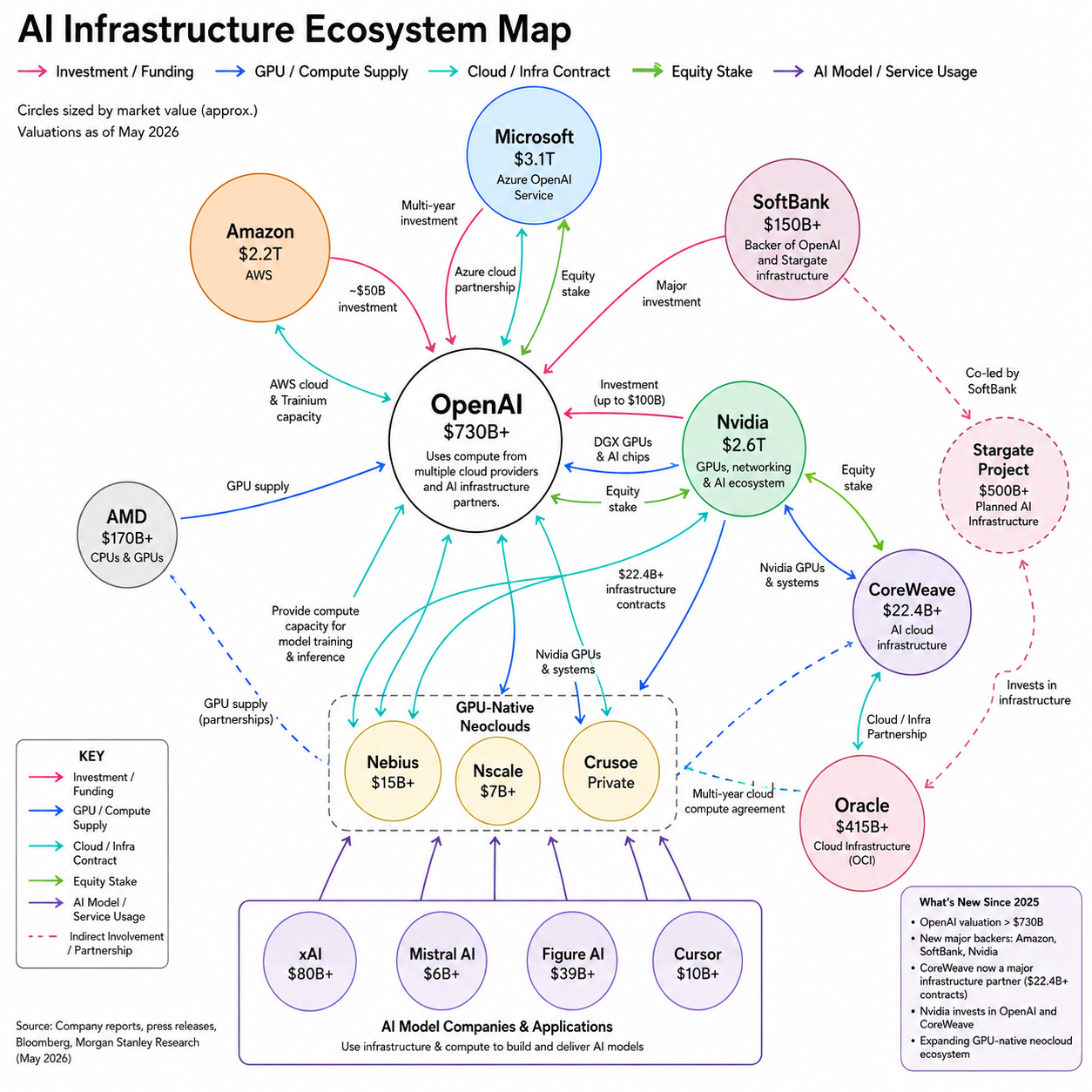
Key changes since the Bloomberg/Morgan Stanley “AI Money Machine” chart from late 2025
OpenAI
- Valuation increased from roughly $500B to over $730B–850B after its record funding rounds in 2026.
- New major funding sources:
- Amazon
- SoftBank
- Nvidia
- OpenAI is now much less dependent on Microsoft than the original chart suggests.
Amazon (missing from the original)
Amazon is arguably the biggest omission now:
- Invested approximately $50B in OpenAI.
- Expanded AWS compute commitments.
- OpenAI agreed to use AWS infrastructure and Trainium capacity.
SoftBank (missing from the original)
- Became one of OpenAI’s largest financial backers.
- Major participant in Stargate-style infrastructure funding.
CoreWeave
- OpenAI relationship expanded to about $22.4B in AI infrastructure contracts.
- Now one of OpenAI’s largest compute suppliers.
- Public company rather than private neocloud startup.
Nvidia
- Still sits at the center.
- Added direct investment into OpenAI.
- Continues investing in CoreWeave while simultaneously selling GPUs to it and buying capacity from it.
Nscale and Nebius
- The original chart correctly anticipated their importance.
- They now fit into a larger category of “GPU-native neoclouds” alongside CoreWeave.
- Their role is increasingly as infrastructure providers for AI model companies rather than model developers themselves.
If Bloomberg redrew it today
The centre would probably look like:
                    Microsoft
                         |
                         |
Amazon ----\
            \
SoftBank ----> OpenAI <---- Nvidia
            /     |  \
           /      |   \
          /       |    \
      Oracle   CoreWeave  AMD
          |        |
          |        |
       GPU Clouds (Nebius, Nscale)
          |
     Mistral / xAI / Figure / Cursor
The biggest differences
| 2025 Chart | 2026 Reality |
|---|---|
| Microsoft dominates OpenAI funding | Amazon + SoftBank now rival Microsoft |
| CoreWeave is peripheral | CoreWeave is a central infrastructure supplier |
| Amazon absent | Amazon is one of the largest players |
| SoftBank absent | SoftBank is one of the largest financiers |
| OpenAI ≈ $500B | OpenAI > $730B valuation |
| Nscale/Nebius niche | Nscale/Nebius increasingly recognized as AI infrastructure providers |
For your interests in AI infrastructure, neoclouds, and hyperscalers, a more useful 2026 version would actually be an “AI Infrastructure Ecosystem Map” showing:
- Nvidia
- AMD
- OpenAI
- Microsoft
- Amazon
- Oracle
- SoftBank
- CoreWeave
- Nebius
- Nscale
- Crusoe
- xAI
- Mistral
- Figure AI
- Stargate
with arrows for:
- Capital investment
- GPU purchases
- Cloud contracts
- Equity stakes
- AI model consumption
That would better reflect where the industry sits today than the original Bloomberg graphic.