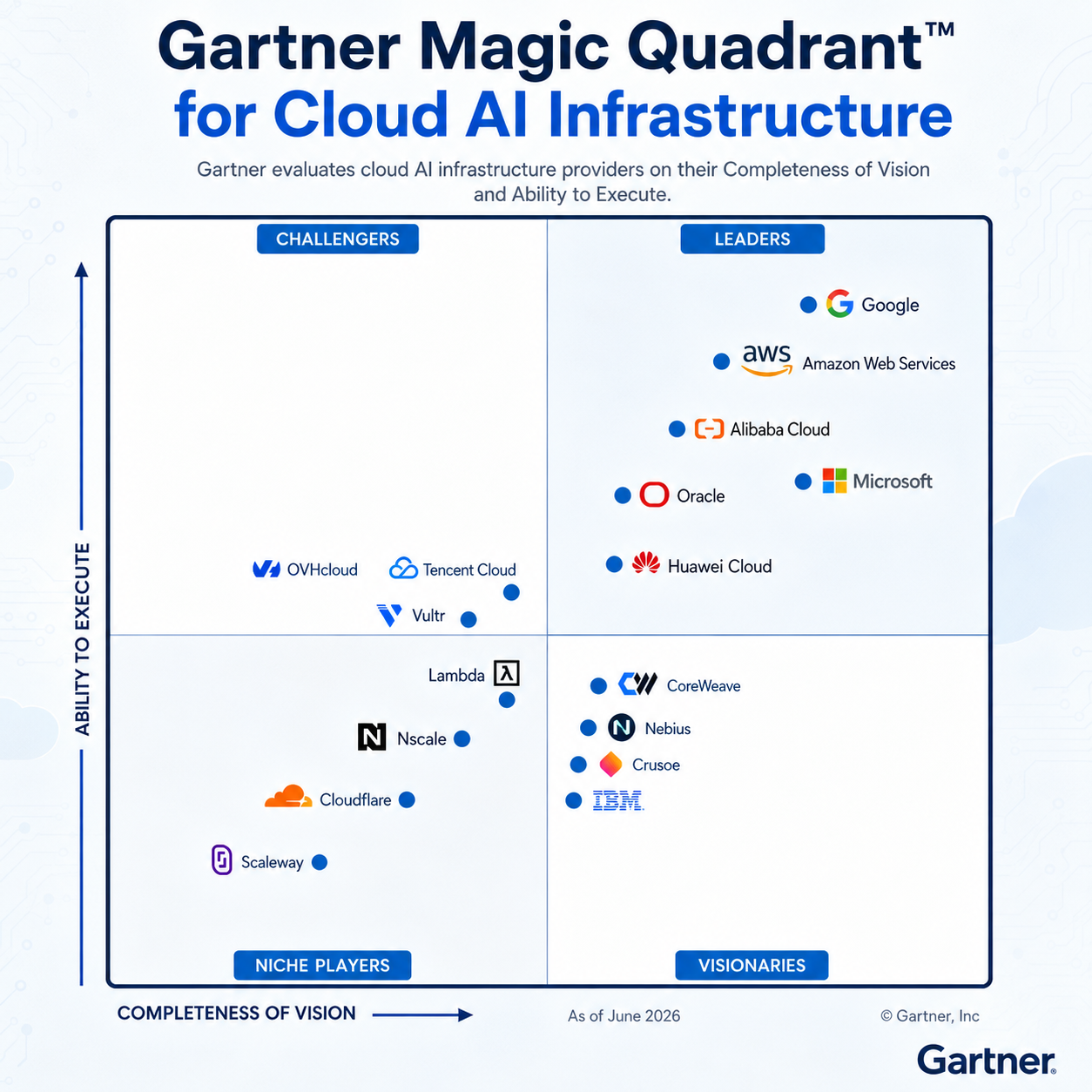
How to read the quadrant
The assessment below treats the June 2026 positions shown in your supplied image as the baseline. The 2027–28 outlook is my forward-looking assessment rather than a Gartner prediction.
The market is splitting into three strategic models:
- Hyperscalers: complete platforms spanning chips, networking, storage, models, databases and enterprise services.
- AI-native clouds or “neoclouds”: specialised GPU infrastructure optimised for training and inference.
- Sovereign, regional and edge providers: differentiated by locality, data residency, price transparency or low-latency inference.
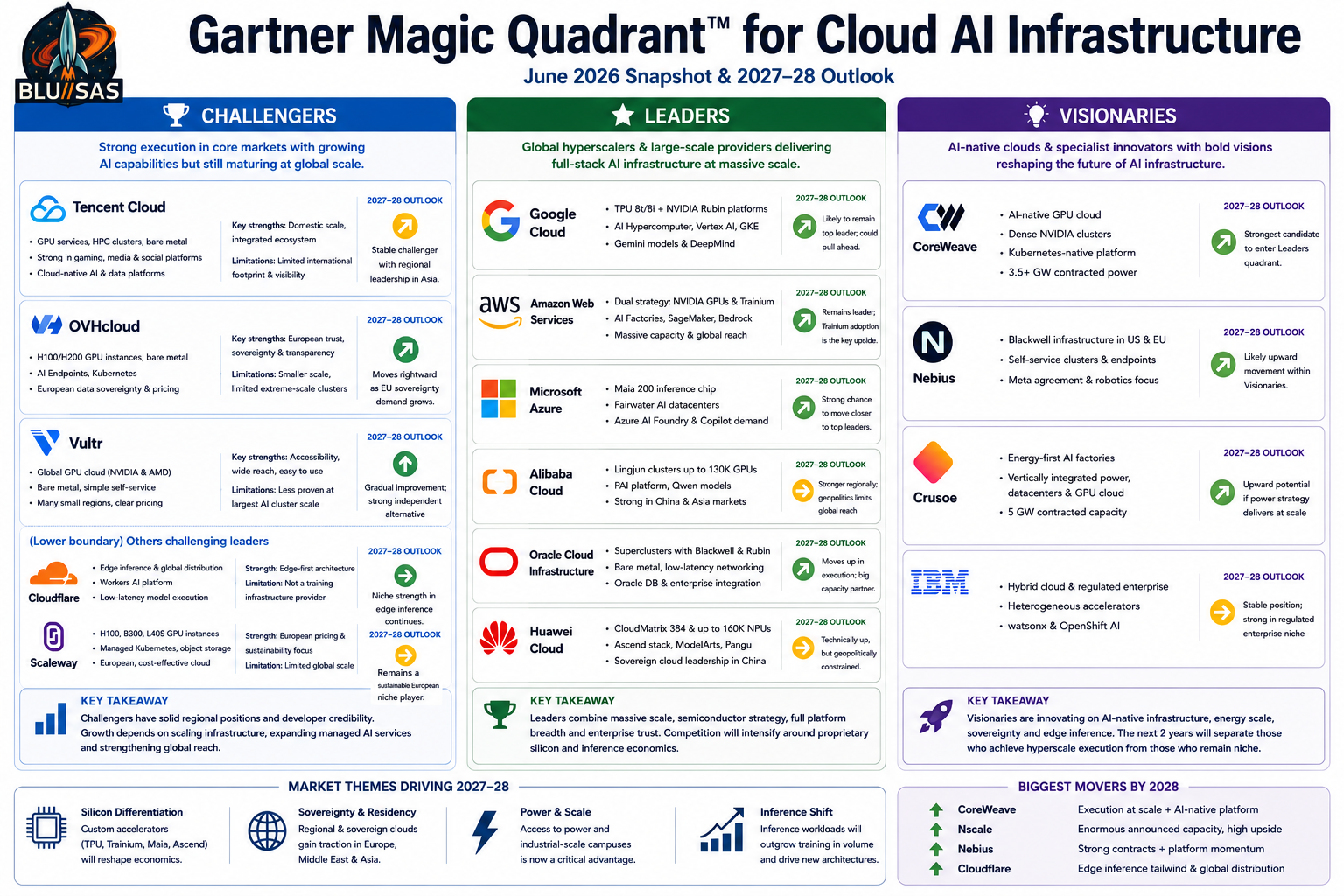
Leaders
1. Google Cloud
What Google is doing
Google has perhaps the most vertically integrated AI infrastructure stack in the market. It controls much of the chain:
- custom TPU accelerators;
- NVIDIA GPU infrastructure;
- high-performance networking;
- AI-optimised storage;
- GKE orchestration;
- JAX, TensorFlow and increasingly strong PyTorch support;
- Vertex AI;
- Gemini models and Google DeepMind workloads.
Its AI Hypercomputer strategy packages accelerators, networking, storage, cluster software and optimisation libraries into a coordinated system rather than selling isolated GPU virtual machines.
In 2026, Google expanded this strategy with eighth-generation TPU 8t and TPU 8i systems and NVIDIA Vera Rubin-based A5X infrastructure. Google says TPU 8t provides nearly three times the compute performance of the preceding generation.
Why it is at the top
Google combines:
- frontier-model experience;
- proprietary silicon;
- hyperscale engineering;
- excellent data and Kubernetes services;
- large enterprise distribution;
- genuine alternatives to NVIDIA dependence.
This gives it both high execution capability and a differentiated long-term vision.
Constraints
Google Cloud remains smaller than AWS and Azure in general-purpose enterprise cloud adoption. TPUs also introduce a degree of ecosystem friction for organisations whose software, expertise and procurement are centred entirely on CUDA.
2027–28 prospects
Direction: likely to remain a leading provider and could move further ahead.
Google’s strongest opportunity is to turn TPUs into a mainstream external platform rather than primarily an internal and specialist accelerator. Better PyTorch portability, greater TPU availability and competitive inference economics would strengthen its position substantially.
Its main risks are:
- customers preferring standard NVIDIA environments;
- excessive complexity across TPU and GPU choices;
- difficulty converting technical leadership into enterprise migration share.
Outlook: very strong.
2. Amazon Web Services
What AWS is doing
AWS is pursuing a dual-silicon strategy:
- the broadest possible catalogue of NVIDIA GPU instances;
- proprietary Trainium accelerators for training and inference economics.
Trainium2 powers Trn2 instances and UltraServers, while AWS has already moved towards Trainium3. AWS claims Trn2 can deliver materially better price-performance than comparable GPU instances. It is also activating very large clusters such as Project Rainier and offering managed “AI Factories” using Trainium and NVIDIA infrastructure.
AWS announced that it would add more than one million NVIDIA GPUs, including Blackwell and Rubin generations, starting in 2026.
Around the hardware, it has:
- EC2 UltraClusters;
- EFA networking;
- FSx for Lustre;
- S3;
- SageMaker;
- Bedrock;
- Kubernetes and container services;
- extensive security and governance facilities.
Why it is a leader
AWS has enormous execution strength:
- the largest mature cloud ecosystem;
- global capacity;
- enterprise procurement relationships;
- deep infrastructure automation;
- a broad partner and software marketplace;
- strong custom-silicon capability.
Its infrastructure is not always perceived as the easiest or cheapest, but it is highly comprehensive.
Constraints
Trainium still has to overcome CUDA’s software gravity. AWS also faces criticism around:
- product complexity;
- unpredictable cost structures;
- data-transfer charges;
- capacity availability for the newest GPUs.
2027–28 prospects
Direction: remains a leader; potential to challenge Google more closely on vision.
Trainium3 and subsequent generations are strategically important. Successful adoption would reduce AWS’s NVIDIA costs and give customers a credible alternative accelerator ecosystem.
AWS is likely to dominate organisations wanting one provider for infrastructure, platform services, data, security and model consumption. Specialist AI laboratories may still prefer neoclouds for dedicated capacity and simpler economics.
Outlook: very strong, with execution remaining its primary advantage.
3. Microsoft Azure
What Microsoft is doing
Microsoft is building AI infrastructure at extraordinary physical scale while tightening vertical integration.
Its stack includes:
- large NVIDIA GPU superclusters;
- Azure InfiniBand and high-performance storage;
- Microsoft’s Maia accelerators;
- Azure Kubernetes Service;
- Azure AI Foundry and model services;
- Microsoft 365, Dynamics and Copilot demand;
- major frontier-model workloads.
Microsoft introduced Maia 200 in 2026 as an inference-focused accelerator using 3 nm manufacturing, 216 GB of HBM3e and native low-precision processing. Microsoft says it offers 30% better performance per dollar than its previous serving systems.
Its Fairwater-style AI datacentres are purpose-built for extremely large training and inference deployments.
Why it is positioned below Google and AWS in the image
Azure has immense execution capability, but several factors may suppress its relative placement:
- infrastructure demand has at times exceeded available capacity;
- its model and infrastructure strategy is strongly associated with a small number of major partners;
- operational and commercial complexity can be substantial;
- its proprietary accelerator ecosystem is newer than Google’s TPU programme.
Constraints
Microsoft must balance:
- OpenAI-related demand;
- first-party Copilot workloads;
- external Azure customers;
- capital expenditure;
- power availability;
- the need for wider model neutrality.
2027–28 prospects
Direction: plausible upward movement toward Google and AWS.
Maia could become a major differentiator for high-volume inference, particularly where Microsoft controls the entire service path from model to application. Azure also has one of the clearest routes for converting AI infrastructure into paid enterprise software usage.
The biggest question is whether Maia becomes a broadly usable Azure platform or remains primarily an internal cost-optimisation mechanism.
Outlook: very strong, particularly for enterprise inference and agentic applications.
4. Alibaba Cloud
What Alibaba is doing
Alibaba is building a full-stack Chinese AI cloud around:
- Lingjun AI computing clusters;
- high-performance networking;
- heterogeneous accelerators;
- PAI machine-learning services;
- Qwen models;
- cloud databases, storage and data engineering;
- custom silicon and domestic supply-chain integration.
Alibaba says Lingjun can interconnect up to 130,000 GPUs in a cluster and is designed to scale towards million-accelerator deployments. It also reports high effective training time and automated failure recovery for very large MoE model training.
Why it is a leader
Within China and parts of Asia, Alibaba has:
- hyperscale infrastructure;
- deep e-commerce and model-training experience;
- an increasingly strong open-model ecosystem through Qwen;
- a large developer base;
- end-to-end platform breadth.
Its placement below the US hyperscalers reflects its weaker reach in Western enterprise markets and geopolitical constraints rather than a lack of technical capability.
Constraints
Major risks include:
- US export restrictions on advanced chips;
- fragmented international trust and compliance requirements;
- reduced access to the newest NVIDIA platforms;
- competition from Huawei, Tencent and domestic AI-cloud specialists.
2027–28 prospects
Direction: could strengthen regionally while remaining constrained globally.
Alibaba is likely to become more vertically integrated around domestic accelerators and open Qwen models. Its best route upward is to establish Lingjun and PAI as credible international platforms across Asia, the Middle East and emerging markets.
Its position will depend heavily on whether Chinese accelerator ecosystems close the software and performance gap with CUDA.
Outlook: strong in China and selected international regions; geopolitically constrained elsewhere.
5. Oracle Cloud Infrastructure
What Oracle is doing
OCI is concentrating on very large, relatively flat, high-performance GPU clusters rather than trying to match every hyperscaler service.
Its differentiation includes:
- bare-metal infrastructure;
- low-latency cluster networking;
- very large NVIDIA Superclusters;
- Oracle Database and enterprise application integration;
- multicloud deployments with other hyperscalers;
- strong partnerships with NVIDIA and frontier-model companies.
Oracle announced a next-generation Vera Rubin OCI Supercluster using Rubin GPUs, Vera CPUs, BlueField DPUs and Spectrum-X networking. OCI also describes infrastructure capable of scaling to 131,072 Blackwell GPUs.
Why it is a leader but behind the largest hyperscalers
Oracle has achieved impressive execution in high-end AI compute. However:
- its general cloud developer ecosystem is smaller;
- managed AI tooling is less influential than AWS, Azure or Google;
- regional breadth and self-service consumption remain less mature;
- much demand comes from a limited number of very large contracts.
Constraints
OCI’s capital commitments are enormous. It must ensure that long-duration GPU contracts remain profitable as:
- accelerators depreciate quickly;
- inference prices decline;
- customers demand flexibility;
- proprietary chips from hyperscalers reduce NVIDIA dependence.
2027–28 prospects
Direction: likely to remain a leader and possibly move upward in execution.
Oracle may become the preferred hyperscale “capacity partner” for organisations needing huge dedicated clusters without the service complexity of AWS or Azure.
Its challenge is turning infrastructure wins into a durable platform ecosystem rather than remaining predominantly a high-performance capacity supplier.
Outlook: strong, but financially and operationally capital-intensive.
6. Huawei Cloud
What Huawei is doing
Huawei is constructing the most complete non-US AI infrastructure stack:
- Ascend NPUs;
- Kunpeng CPUs;
- CloudMatrix supernodes;
- MatrixLink networking;
- CANN software;
- ModelArts;
- Cloud Native AI Suite;
- Pangu models;
- integrated training and inference services.
Huawei’s CloudMatrix 384 combines 384 Ascend NPUs and 192 Kunpeng CPUs into a tightly coupled system. Huawei says multiple supernodes can form clusters of up to approximately 160,000 accelerators.
Why it is in the leaders quadrant
Huawei has executed exceptionally well under hardware restrictions. Its position reflects:
- genuine system-level engineering;
- control over silicon, networking and cloud software;
- a large domestic market;
- government and telecom relationships;
- sovereign technology demand.
It is lower than the other leaders because its global addressable market is significantly restricted.
Constraints
The primary limitations are:
- international sanctions and procurement restrictions;
- software compatibility relative to CUDA;
- limited adoption in the US and several allied markets;
- uncertainty around advanced semiconductor manufacturing capacity.
2027–28 prospects
Direction: likely to rise technically but remain geographically divided.
Huawei could become the dominant AI-infrastructure platform across China and selected Global South markets. CloudMatrix may prove particularly important if it compensates for lower individual-chip performance through highly efficient system-level scaling.
It is unlikely to become a universal global leader while geopolitical restrictions remain.
Outlook: technically strong, commercially bifurcated by geopolitics.
Challengers
7. Tencent Cloud
What Tencent is doing
Tencent combines conventional cloud GPU services with infrastructure developed for its own enormous AI, gaming, media, recommendation and social-platform workloads.
Its offering includes:
- Cloud GPU Service;
- high-performance computing clusters;
- bare metal;
- data and analytics platforms;
- model and application services;
- internal experience from WeChat, gaming and advertising.
Tencent describes its HCC architecture as GPU-server clusters connected through high-speed networking.
Why it is a challenger
Tencent has substantial ability to execute, particularly in China, but its external cloud vision is less visible internationally than Alibaba’s or Huawei’s.
Its public AI-infrastructure message is also less coherent. Customers can buy GPU services and use Tencent’s AI platforms, but Tencent has not established an internationally recognisable equivalent of Google AI Hypercomputer, AWS Trainium or Huawei CloudMatrix.
2027–28 prospects
Direction: stable challenger, with potential to enter the leader quadrant regionally.
Tencent needs to:
- expose more of its internal AI infrastructure as differentiated cloud products;
- improve international documentation and availability;
- articulate a clearer accelerator and software roadmap;
- use its strength in real-time media, gaming and consumer inference.
Outlook: strong domestic potential, modest global movement unless international strategy becomes more aggressive.
8. OVHcloud
What OVHcloud is doing
OVHcloud is building a sovereign European alternative around:
- competitively priced H100 and H200 GPU instances;
- bare metal and public cloud;
- AI Endpoints;
- Kubernetes;
- European data residency;
- transparent pricing and reduced lock-in.
Its positioning is not about matching hyperscaler breadth. It is about offering accessible AI infrastructure under European jurisdiction. OVHcloud currently advertises H100-based training and inference infrastructure, although the newest GPU types remain available in a relatively limited set of regions.
Why it is near the execution threshold
OVHcloud has:
- established datacentre operations;
- a recognised European brand;
- competitive pricing;
- sovereign-cloud credibility.
However, it lacks:
- truly massive GPU clusters;
- extensive geographic GPU availability;
- a mature end-to-end model-development platform;
- the specialist orchestration of leading neoclouds.
2027–28 prospects
Direction: could move rightward if European sovereignty demand accelerates.
OVHcloud’s opportunity is the EU public sector, regulated industries and organisations uncomfortable with US jurisdiction. It is more likely to become a stronger challenger than a global leader.
Key requirements are broader Blackwell availability, high-speed multi-node clusters and improved managed AI services.
Outlook: positive in Europe, limited at frontier-model scale.
9. Vultr
What Vultr is doing
Vultr is positioning itself as an independent, globally distributed AI-first cloud with:
- NVIDIA and AMD GPU choices;
- bare metal;
- accessible self-service provisioning;
- many smaller regions;
- relatively straightforward pricing;
- partnerships around enterprise AI software.
Its expansion into Milan brought its footprint to 33 cloud regions and included GPU, bare-metal and general compute services.
Vultr is also differentiating through support for AMD Instinct accelerators rather than relying exclusively on NVIDIA.
Why it is a challenger
Vultr scores well for accessibility, geographic distribution and developer experience. It is not yet known for enormous tightly coupled GPU clusters or frontier-model training.
Its vision is broader than many regional clouds, but execution at extreme AI scale remains less proven.
2027–28 prospects
Direction: modest upward movement is plausible.
Vultr could become an important independent alternative for enterprise inference, fine-tuning and regional AI deployment. Supporting both AMD and NVIDIA may help customers manage cost and supply constraints.
It is less likely to compete directly for the largest foundation-model training runs.
Outlook: good for distributed enterprise AI; limited frontier-scale prospects.
Niche Players
10. Lambda
What Lambda is doing
Lambda evolved from selling deep-learning workstations into a specialised AI cloud and AI-factory operator.
Its offering includes:
- on-demand H100, H200 and B200 instances;
- single-tenant clusters;
- 1-Click Clusters;
- Lambda Stack software;
- managed infrastructure and co-engineering;
- high-density, liquid-cooled AI factories.
Lambda offers clusters ranging from small multi-GPU configurations to deployments exceeding 2,000 interconnected GPUs, while promoting simple pricing and no egress fees for parts of its cloud offering.
Why it is only just below the quadrant boundary
Lambda has a strong AI-native vision and deep developer credibility. Its limitations have historically been:
- smaller geographic footprint;
- constrained capacity;
- less enterprise governance;
- a narrower platform than hyperscalers;
- less proven operation of multi-gigawatt estates than larger neoclouds.
2027–28 prospects
Direction: one of the most likely niche players to move upward or rightward.
Lambda’s success depends on whether it can scale from a developer-friendly GPU cloud into a reliable enterprise and frontier-lab infrastructure provider without losing simplicity.
The company raised $480 million in 2025 to expand both infrastructure and software.
Outlook: promising, but capacity expansion and enterprise maturity are decisive.
11. Nscale
What Nscale is doing
Nscale is pursuing a highly ambitious strategy built around:
- gigawatt-class AI factories;
- sovereign AI infrastructure;
- large Microsoft contracts;
- collaboration with NVIDIA and OpenAI;
- telco-hosted and distributed GPU infrastructure;
- an “AI Grid” connecting central and regional capacity.
Its Microsoft agreement includes plans to deliver approximately 12,600 GB300 GPUs from a Portuguese site, while the Stargate UK programme has discussed initial OpenAI demand of up to 8,000 GPUs with expansion potential to 31,000.
Nscale has also achieved NVIDIA Exemplar Cloud status for GB300 NVL72 infrastructure.
Why it is currently low in the quadrant
Nscale’s vision is much larger than its current plotted position suggests. The issue is execution maturity:
- many announced deployments are still ramping;
- the software platform is less established than CoreWeave’s;
- customer concentration appears high;
- operational performance at enormous scale still needs a long track record;
- much capacity is tied to large contracts rather than broad self-service consumption.
2027–28 prospects
Direction: potentially the largest upward mover—but also one of the highest-risk.
Nscale could move into the Visionaries quadrant or near the challenger boundary if it successfully delivers its announced estates.
Its strongest differentiators are:
- European sovereignty;
- access to power and sites;
- anchor customers;
- modern NVIDIA architecture;
- telco and regional distribution.
Risks include construction delays, financing requirements, power-grid constraints, hardware delivery and dependence on a small number of large customers.
Outlook: high upside, high execution risk.
12. Cloudflare
What Cloudflare is doing
Cloudflare is not attempting to become a conventional training cloud. Its strategy is distributed inference at the edge.
Workers AI provides:
- serverless GPU inference;
- one API across Cloudflare’s global network;
- pay-per-inference pricing;
- a catalogue of open models;
- integration with Workers, R2, Vectorize and AI Gateway;
- low-latency execution close to users.
Cloudflare says Workers AI operates models across more than 200 cities, and it has developed the Omni platform to run multiple models efficiently on shared GPUs.
In 2026 it began supporting larger open models, indicating an effort to move beyond small edge inference workloads.
Why it is a niche player
Cloudflare has an unusually strong vision, but it does not currently offer the complete training, storage and high-performance cluster environment expected from a cloud AI infrastructure provider.
Its low vertical placement reflects limited ability to execute large training jobs—not weakness in edge infrastructure.
2027–28 prospects
Direction: likely to move rightward rather than substantially upward.
As inference becomes a larger share of AI expenditure, Cloudflare’s architecture becomes increasingly relevant. It could dominate:
- distributed agent execution;
- low-latency model calls;
- AI gateways;
- model routing;
- privacy-sensitive regional inference.
It probably will not compete with CoreWeave or AWS for giant training clusters.
Outlook: excellent for inference and agentic edge workloads; structurally specialised.
13. Scaleway
What Scaleway is doing
Scaleway offers a European AI cloud centred on:
- H100, B300, L40S and L4 GPU instances;
- managed Kubernetes;
- object storage;
- transparent pricing;
- limited or no data-transfer penalties on selected services;
- sustainability reporting;
- European data sovereignty.
Its products cover both low-cost inference and higher-performance training, with multi-GPU instances and Kubernetes integration.
Why it is near the bottom
Scaleway has a coherent European developer proposition but remains small in:
- geographic reach;
- GPU inventory;
- multi-node supercluster scale;
- enterprise adoption;
- managed MLOps breadth.
Its position reflects scale more than technical inadequacy.
2027–28 prospects
Direction: gradual improvement, probably remaining a niche provider.
Scaleway can succeed as a cost-conscious European platform for startups, inference and moderate training workloads. Moving significantly upward would require:
- much larger accelerator estates;
- more regions;
- stronger enterprise support;
- proven high-performance multi-node networking.
Outlook: sustainable European niche, unlikely global leader.
Visionaries
14. CoreWeave
What CoreWeave is doing
CoreWeave is the clearest example of an AI-native cloud built specifically for GPU workloads.
Its differentiation includes:
- dense NVIDIA clusters;
- bare-metal-style performance;
- Kubernetes-native orchestration;
- InfiniBand and high-speed Ethernet;
- direct-to-chip liquid cooling;
- fast adoption of new NVIDIA platforms;
- specialised cluster lifecycle and observability software;
- strong relationships with frontier-model providers.
By March 2026, CoreWeave reported 49 datacentres, more than 1 GW of active power and over 3.5 GW of contracted power. It also stated that nine of the ten leading foundation-model providers used its infrastructure.
Why it leads the Visionaries
CoreWeave has moved beyond simply renting GPUs. It now operates industrial-scale AI infrastructure with specialised software and a significant global footprint.
It is below the leaders because it still lacks:
- hyperscaler service breadth;
- equivalent global region coverage;
- a large general enterprise base;
- proprietary accelerators;
- diversified revenue on the scale of AWS or Google.
2027–28 prospects
Direction: strongest candidate to enter the Leaders quadrant.
CoreWeave’s movement depends on whether it can:
- maintain reliability during rapid expansion;
- diversify its customer base;
- control debt and capital intensity;
- build a richer inference and managed-services layer;
- avoid excessive NVIDIA dependency.
The transition from training to inference is strategically important. CoreWeave is already repositioning around production inference rather than only large training clusters.
Outlook: very strong, with financial concentration and execution as the main risks.
15. Nebius
What Nebius is doing
Nebius is building a vertically integrated AI cloud across the US and Europe with:
- NVIDIA Blackwell infrastructure;
- high-performance storage and networking;
- managed Kubernetes;
- self-service GPU clusters;
- serverless jobs and endpoints;
- specialist engineering support;
- physical-AI and robotics offerings.
It has made B200 infrastructure available through self-service clusters and has expanded into robotics and physical AI in collaboration with NVIDIA.
Nebius also announced a long-term infrastructure supply agreement with Meta in March 2026, which provides an important anchor customer.
Why it is below CoreWeave
Nebius has a credible platform vision, experienced infrastructure engineers and substantial capital. However:
- it is earlier in its international build-out;
- its datacentre footprint is smaller;
- large-scale operational evidence is newer;
- brand recognition remains limited;
- anchor-customer concentration is a risk.
2027–28 prospects
Direction: likely upward movement within Visionaries.
Nebius may become Europe’s strongest independent AI cloud if it executes well. Its opportunity is to combine hyperscale contracts with accessible self-service products for startups and enterprises.
Physical AI, robotics and multimodal workloads may give it a more differentiated application focus than pure GPU-capacity providers.
Outlook: strong, with credible potential to approach CoreWeave.
16. Crusoe
What Crusoe is doing
Crusoe differentiates through an energy-first, vertically integrated AI-factory model.
It is involved in:
- energy procurement and generation;
- datacentre design and construction;
- modular and edge datacentres;
- GPU cloud services;
- managed AI infrastructure;
- large long-term capacity agreements.
Crusoe reported contracted AI infrastructure capacity approaching 5 GW in 2026. Its strategy is to address the fundamental AI bottleneck—power—rather than treating the datacentre as a commodity input.
It is also launching smaller modular “Spark Factory” and edge deployments alongside giant central facilities.
Why it is a visionary
Crusoe’s vision is highly differentiated. It recognises that by 2027–28, power availability, grid interconnection and cooling may matter as much as GPU procurement.
Its execution score is lower because its public cloud platform and software ecosystem are less mature than CoreWeave’s, while much of its strategy involves long construction and infrastructure cycles.
2027–28 prospects
Direction: potentially significant upward movement.
Crusoe could become one of the most strategically important AI-infrastructure operators if power remains the industry’s critical constraint.
To move higher, it must show:
- reliable delivery of large campuses;
- stronger self-service and managed-cloud tooling;
- diversified customers;
- efficient capital deployment;
- competitive inference services.
Outlook: high potential, with physical construction and financing risk.
17. IBM
What IBM is doing
IBM’s strategy is different from the neoclouds. It is focused on regulated enterprise and hybrid-cloud AI rather than frontier-model training.
Its stack includes:
- IBM Cloud GPU and accelerator services;
- NVIDIA B300 and L40S;
- AMD MI300X;
- Intel Gaudi;
- Red Hat OpenShift;
- watsonx;
- hybrid and private-cloud deployment;
- governance, security and consulting.
IBM explicitly supports a heterogeneous accelerator architecture rather than an NVIDIA-only platform.
Why it is low in Visionaries
IBM has clear enterprise credibility and a strong hybrid-cloud philosophy. However, it lacks:
- frontier-scale public GPU capacity;
- a high-growth developer AI cloud;
- major foundation-model training customers;
- the aggressive datacentre expansion of CoreWeave, Nebius or Crusoe.
It appears in Visionaries because its hybrid, governed and heterogeneous approach is strategically differentiated.
2027–28 prospects
Direction: likely stable unless IBM materially increases infrastructure investment.
IBM can prosper in:
- banks;
- government;
- healthcare;
- mainframe-connected AI;
- private and sovereign deployments;
- regulated model governance.
It is unlikely to become a leading general-purpose training cloud. Its movement will depend more on enterprise adoption of watsonx and OpenShift AI than on raw GPU count.
Outlook: defensible enterprise niche, limited frontier-cloud expansion.
Likely movement by 2028
| Provider | Most plausible movement | Assessment |
|---|---|---|
| Remains top leader | Proprietary silicon and complete AI stack | |
| AWS | Remains leader, potentially moves right | Trainium adoption is the key variable |
| Microsoft | Moves upward | Maia and enterprise inference could narrow the gap |
| Oracle | Moves upward in execution | Strong superclusters, but high capital exposure |
| Alibaba | Stronger regionally | Restricted by geopolitics and chip access |
| Huawei | Technically upward, geographically constrained | CloudMatrix is strategically important |
| Tencent | Modest movement | Needs clearer external AI-cloud differentiation |
| OVHcloud | Moves rightward | Sovereignty strengthens vision more than scale |
| Vultr | Gradual improvement | Strong independent distributed cloud |
| Lambda | Could cross into Visionaries | Requires successful capacity and software scaling |
| Nscale | Potentially large upward/rightward jump | Announced capacity must become operational reality |
| Cloudflare | Moves strongly right | Inference and edge AI favour its architecture |
| Scaleway | Remains niche | Valuable European role, insufficient global scale |
| CoreWeave | Most likely new Leader | Must manage debt, concentration and rapid growth |
| Nebius | Moves upward within Visionaries | Strong anchor contracts and platform development |
| Crusoe | Moves upward if power strategy delivers | Energy integration could become decisive |
| IBM | Remains a lower Visionary | Strong regulated-enterprise niche |
Overall judgement
The companies most likely to improve their relative position by 2028 are:
CoreWeave, because it is closest to proving hyperscale execution with an AI-native architecture.
Nscale, because its contracted and announced expansion is far ahead of its current operational maturity—but this also gives it the greatest delivery risk.
Nebius, because it is combining anchor customers, self-service cloud capabilities and European/US infrastructure.
Cloudflare, because industry expenditure is shifting from periodic model training toward continuous, globally distributed inference.
Microsoft, because Maia gives it a route to reduce inference costs across Azure and its enormous Copilot estate.
The providers under the most pressure are smaller general-purpose GPU clouds that do not possess one of four defensible advantages: proprietary silicon, massive power capacity, sovereign jurisdiction or globally distributed inference.
The Niche Players – Nscale not N scaling
The Niche Players quadrant does not necessarily mean “bad technology.” It usually means that a provider has either:
- a narrower addressable market;
- an incomplete platform;
- limited geographic or operational scale;
- weaker execution evidence;
- or a strategy that has not yet translated into repeatable customer delivery.
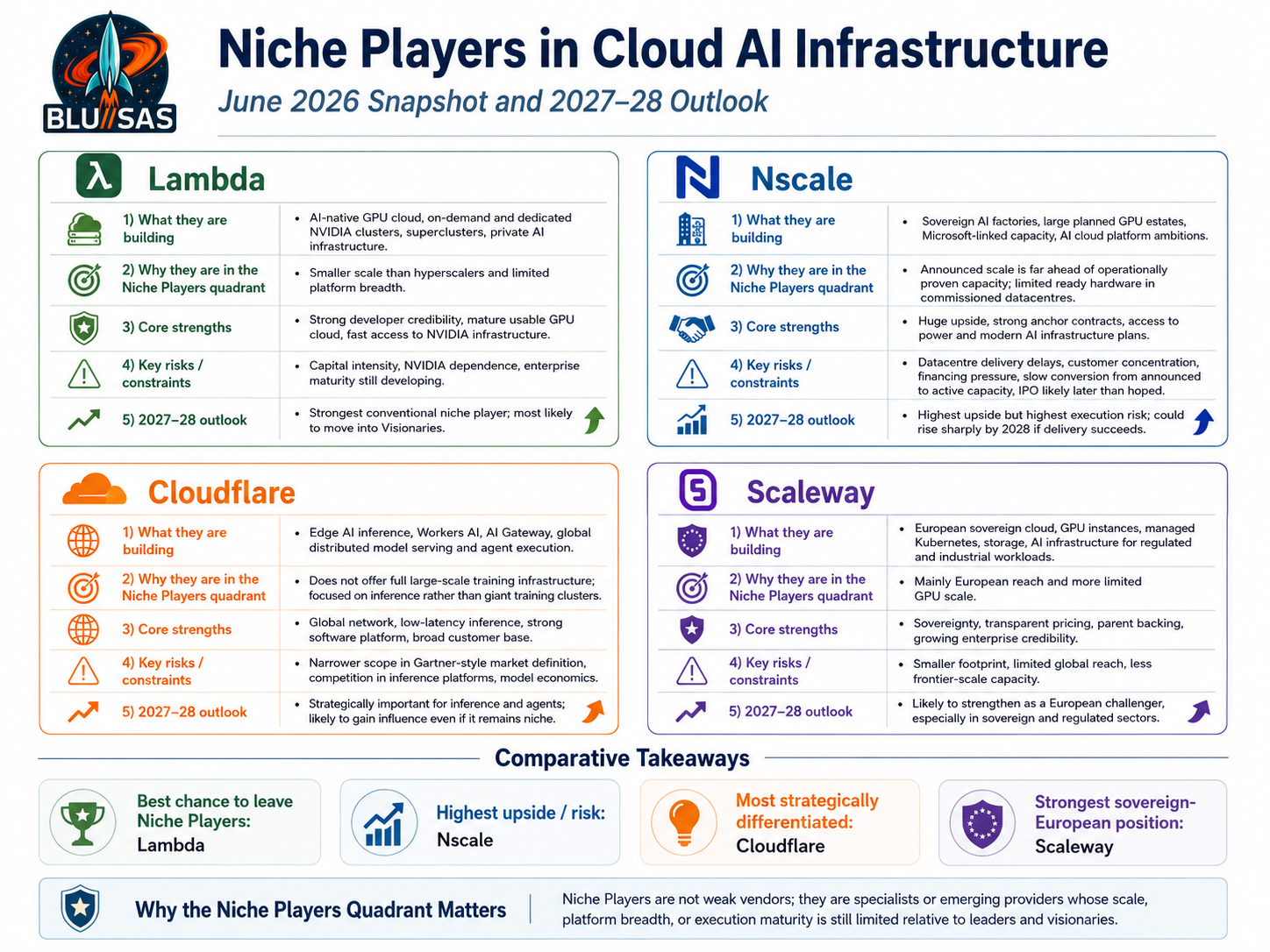
For Nscale, the decisive word is yet. Its announcements, capital raised and contracted ambitions look much larger than its demonstrated operating footprint. That mismatch—between projected scale and operationally proven scale—is the most credible explanation for its low position.
1. Nscale’s fundamental problem: it is valued on tomorrow’s capacity
Nscale is being presented as a vertically integrated AI-infrastructure company that will own or control:
- data-centre sites;
- power capacity;
- GPU clusters;
- networking;
- orchestration software;
- cloud services;
- and long-term customer contracts.
That is strategically attractive. It avoids being merely a GPU reseller and potentially gives Nscale control over the entire infrastructure cost stack.
However, most of Nscale’s differentiation currently resides in contracts, sites, financing arrangements and construction pipelines, not in a large mature global cloud already delivering at the advertised future scale.
The company was only founded in its present form in 2024, yet by March 2026 it had raised a $2 billion Series C at a $14.6 billion valuation. It has also hired senior banks to prepare for a possible flotation.
That creates a sharp execution test:
Nscale must convert a venture-stage organisation into a hyperscale infrastructure operator within only a few years.
Google, AWS, Microsoft, Oracle and even CoreWeave can point to large installed fleets, operational customers, production telemetry and repeatable deployment processes. Nscale is still proving that its announced estate can become commissioned, energised, networked and revenue-generating infrastructure.
That is why it can simultaneously have:
- an enormous valuation;
- major partners;
- multi-billion-dollar contracts;
- and a low Magic Quadrant position.
The valuation measures anticipated opportunity. The quadrant measures, among other things, demonstrated ability to execute.
2. Its announcements are ahead of physical delivery
Nscale has announced some exceptionally large programmes.
These include:
- capacity agreements involving Microsoft across Norway, Portugal, Texas and the UK;
- a proposed Texas campus capable of hosting around 104,000 GPUs;
- a West Virginia deployment scheduled to begin in tranches from late 2027;
- UK programmes involving Microsoft, NVIDIA and potentially OpenAI;
- expansion in Norway;
- plans for hundreds of thousands of GPUs globally.
The West Virginia project, for example, is not scheduled to begin delivery until late 2027.
The original Microsoft programme reported by the Financial Times involved approximately 116,600 NVIDIA GPUs across Portugal and Texas, with delivery expected over a 12–18-month period.
This matters because there is an enormous difference between:
- announcing a potential 1.2 GW campus;
- securing land and power options;
- obtaining planning consent;
- financing construction;
- completing the shell;
- energising the site;
- installing cooling and electrical distribution;
- receiving GPUs;
- building the network fabric;
- passing acceptance testing;
- and achieving billable utilisation.
Magic Quadrant execution scoring is much more likely to reward stages 8–11 than stages 1–4.
Nscale is still disproportionately represented in the earlier stages.
3. Why “no hardware in ready datacentres” is so damaging
For an AI cloud, a data centre without commissioned accelerators is not really productive capacity. It is an infrastructure option.
The commercially valuable unit is not simply a megawatt or a building. It is:
a usable, interconnected, supported and contractually available accelerator-hour.
A ready AI facility requires much more than empty space:
- stable power;
- transformers and switchgear;
- backup systems;
- liquid-cooling loops;
- high-density racks;
- InfiniBand or equivalent fabrics;
- optical networking;
- storage;
- cluster management;
- scheduler integration;
- security controls;
- performance testing;
- fault management;
- spare hardware;
- support engineers;
- and an active customer workload.
If Nscale has power reservations and future GPU allocations but limited broadly available production clusters, it cannot yet demonstrate the utilisation, reliability and customer diversity expected from a higher-quadrant provider.
The contrast with CoreWeave is instructive. By 2026, CoreWeave was reporting dozens of datacentres, more than 1 GW of active power and extensive use by leading model developers. Nscale’s headline capacity is potentially vast, but a significant proportion is still future capacity. This difference between active capacity and contracted or planned capacity is probably one of the largest contributors to the gap between them.
4. Greenfield construction is much slower than the AI news cycle
Nscale’s strategy depends heavily on new-build or substantially upgraded AI factories. That creates a structural timing problem.
AI hardware generations move on roughly 12–24-month commercial cycles, but large data-centre projects can take several years from site selection to production.
During that period, several things can change:
- the selected GPU generation;
- rack density;
- cooling requirements;
- network architecture;
- customer demand;
- financing costs;
- planning requirements;
- energy prices;
- and inference economics.
A facility designed around one generation may need redesign before it opens.
For example, Nscale’s West Virginia announcement is based on NVIDIA Vera Rubin NVL72 systems and begins delivery only from late 2027. That is strategically forward-looking, but it also means that the capacity cannot support 2026 revenue or prove 2026 execution.
A hyperscaler can bridge this gap using existing regions and datacentres. A younger neocloud must often wait for new infrastructure to be built.
This is likely one reason Nscale appears to be scaling slowly despite announcing rapid expansion.
5. Power is not the same as available power
AI infrastructure announcements frequently quote megawatts or gigawatts. Those figures can refer to very different things:
- power requested;
- power reserved;
- grid connection agreed;
- power under development;
- energised power;
- or power currently serving IT equipment.
Only the last two create near-term operational capacity.
Nscale’s Norwegian expansion illustrates this tension. It has reportedly secured substantial financing and existing power capacity, while also seeking additional capacity in a region where new grid reservations have been paused because of constraints.
The US is even more difficult because large projects compete for:
- grid interconnections;
- transformers;
- generation;
- substations;
- transmission capacity;
- construction labour;
- water or alternative cooling capacity;
- and suitable land close to fibre routes.
Research published in 2026 argued that the physically feasible US hyperscale envelope is much smaller than simple land-availability calculations suggest once grid, climate, environmental and infrastructure constraints are considered.
Therefore, Nscale’s US problem is not merely buying GPUs. It is synchronising five scarce resources:
- land;
- power;
- buildings;
- accelerators;
- customers.
A delay in any one delays the entire revenue stream.
6. Its US expansion starts from a weak installed base
Nscale’s US ambitions are huge, but its current competitive position there is weak relative to:
- AWS;
- Google;
- Microsoft;
- Oracle;
- CoreWeave;
- Crusoe;
- and established colocation operators.
Those companies already possess combinations of:
- energised campuses;
- construction teams;
- utility relationships;
- procurement scale;
- enterprise sales organisations;
- cloud regions;
- operational support;
- and established customers.
Nscale must build all of these while simultaneously commissioning its first truly large American estates.
The Texas programme reportedly contemplates a campus that could eventually reach 1.2 GW, but construction and deployment are phased.
The West Virginia programme begins delivery only in late 2027.
This means that a material Nscale US operating footprint may not become visible until after the period in which it originally hoped to establish an IPO narrative.
The company’s US story is therefore currently more credible as a development pipeline than as a mature cloud presence.
7. The Loughton project exposed the announcement-to-delivery gap
Nscale’s proposed AI facility in Loughton, Essex, became a particularly damaging example because it received substantial political and media attention before visible construction had advanced.
A Guardian investigation reported that the site was still operating as a scaffolding yard in early 2026 and that planning permission had only recently been submitted. Nscale later said that it had purchased the site and aimed to deliver the datacentre in 2027.
The project may ultimately be delivered, but the episode illustrates a reputational problem:
- government and corporate announcements implied imminent strategic infrastructure;
- the physical site looked much earlier in its development cycle;
- observers therefore questioned whether Nscale’s presentation was ahead of reality.
For a Magic Quadrant assessment, this affects perceived execution in several ways:
- delivery credibility;
- transparency;
- construction maturity;
- timetable confidence;
- and the distinction between announced and operational infrastructure.
It also potentially makes public-market investors more sceptical.
8. OpenAI-related uncertainty weakens part of the demand story
Nscale’s UK narrative was strengthened by the proposed Stargate UK relationship involving OpenAI and NVIDIA.
Nscale’s announcement said OpenAI would explore taking up to 8,000 GPUs initially, with potential expansion to 31,000. The wording is important: explore offtake is not necessarily the same as an unconditional long-term take-or-pay contract.
In April 2026, Reuters reported that OpenAI had paused its principal UK datacentre project because of regulation and energy costs.
That does not invalidate Nscale’s broader business, particularly because Microsoft appears to be a more concrete anchor customer. But it demonstrates why announced AI-factory demand can be less certain than it appears.
Customers may:
- defer projects;
- move workloads to another region;
- change hardware generations;
- renegotiate commitments;
- lease instead of own;
- or transfer capacity to another major buyer.
This is particularly important when a provider’s development pipeline is concentrated around a few giant customers.
9. Customer concentration is both an advantage and a risk
Microsoft is one of the strongest possible anchor customers. Its contracts can help Nscale:
- finance construction;
- secure debt;
- negotiate with suppliers;
- obtain NVIDIA support;
- demonstrate future utilisation;
- and improve investor confidence.
However, high dependence on Microsoft creates concentration risk.
A provider heavily reliant on one customer is exposed to:
- renegotiation;
- delayed acceptance;
- changes in deployment timing;
- changes in hardware specification;
- regional demand shifts;
- and reduced bargaining power.
It also raises a strategic question:
Is Nscale developing a broadly diversified AI cloud, or primarily building dedicated infrastructure for a few hyperscale tenants?
Both can be viable businesses, but the second is closer to a specialised infrastructure lessor than a complete cloud platform.
That distinction may reduce Nscale’s completeness of vision score, even if the underlying contracts are large.
10. Its cloud platform is less proven than its infrastructure narrative
Nscale promotes a full-stack cloud platform with:
- inference endpoints;
- fine-tuning;
- orchestration;
- managed GPU clusters;
- sovereign deployment;
- and workload management.
However, it has not yet demonstrated the same visible ecosystem depth as:
- AWS SageMaker and Bedrock;
- Azure AI Foundry;
- Google Vertex AI;
- CoreWeave’s mature Kubernetes and cluster estate;
- or Cloudflare’s globally distributed inference platform.
Important questions remain:
- How many independent customers use Nscale’s public cloud?
- How much revenue comes from platform services rather than dedicated infrastructure?
- What is the active GPU utilisation rate?
- How reliable are large multi-node training jobs?
- How mature are its storage and data services?
- How quickly can ordinary customers provision capacity?
- How many regions provide immediate self-service access?
- What service-level history can it demonstrate?
- How much software differentiation exists beyond infrastructure management?
Until those answers become visible, Gartner would reasonably score Nscale below providers with mature, production-proven platforms.
11. Corporate history adds credibility and governance questions
Nscale emerged from the ecosystem around Australian bitcoin miner Arkon Energy. That is not inherently problematic—CoreWeave also emerged from cryptocurrency infrastructure—but the transition is extremely rapid.
Financial Times reporting highlighted:
- historical loan defaults at the predecessor business;
- expensive financing;
- warrant structures;
- complex ownership changes;
- and substantial infrastructure obligations.
These issues do not prove that Nscale is financially unsound. The company has subsequently attracted major investors, raised large equity rounds and obtained significant debt facilities.
However, they increase the burden of proof for an IPO.
Public investors would expect clarity on:
- group structure;
- related-party transactions;
- predecessor liabilities;
- lease guarantees;
- customer concentration;
- GPU-backed borrowing;
- infrastructure ownership;
- and the division between contracted revenue and conditional future demand.
That is a much more demanding disclosure standard than private funding rounds require.
12. Nscale’s financing model is highly capital intensive
Nscale has raised very large amounts:
- $1.1 billion Series B;
- $2 billion Series C;
- a $1.4 billion delayed-draw term loan backed by GPUs;
- and project-specific debt and partner support.
This gives it the capital needed to expand, but the financing itself introduces risk.
GPU-cloud economics depend on:Revenue−energy−facility costs−networking−operations−interest−hardware depreciation
The hardware depreciates economically very quickly. A cluster can remain functional for years while losing pricing power because a newer accelerator generation offers better performance per watt and per dollar.
Nscale therefore needs:
- high utilisation;
- long contracts;
- disciplined hardware purchasing;
- reliable delivery;
- and sufficient margins to service debt.
If deployment is delayed, interest and development expenditure may begin before corresponding revenue.
This produces negative carry: the company spends and borrows today for capacity that may not earn revenue until 2027 or later.
13. The valuation may make an early IPO harder, not easier
The March 2026 Series C valued Nscale at $14.6 billion.
That valuation creates a difficult public-market threshold.
An IPO would normally need to:
- validate or exceed the private valuation;
- offer sufficient upside to new investors;
- provide credible revenue visibility;
- and avoid a sharp post-listing decline.
At a $14.6 billion private valuation, public investors would expect more than a promising construction pipeline. They would want evidence of:
- substantial recognised revenue;
- improving gross margins;
- operational capacity;
- secured hardware;
- utilisation;
- contracted backlog quality;
- disciplined capital expenditure;
- and a credible route to positive cash flow.
A lower valuation might make an IPO easier, but it could trigger:
- down-round optics;
- investor dilution;
- employee-option problems;
- and negative comparisons with the latest private round.
Consequently, the Series C may have provided necessary expansion capital while simultaneously reducing the urgency and attractiveness of a 2026 flotation.
14. Why a 2026 IPO now appears difficult
There are several practical reasons.
Insufficient operating history
Nscale is exceptionally young. Public investors would be asked to value a company whose current shape has only a short audited operating record.
Too much capacity remains future capacity
Major US and European installations extend into 2027 and beyond. A 2026 IPO would require investors to underwrite construction risk rather than evaluate a completed estate.
Financial reporting complexity
The company has to consolidate:
- development entities;
- leases;
- GPU financing;
- debt;
- customer contracts;
- site ownership;
- potential guarantees;
- and predecessor arrangements.
Revenue-recognition questions
Large contract values do not equal current revenue. Investors would need to know:
- minimum committed spend;
- delivery milestones;
- termination rights;
- take-or-pay provisions;
- revenue-recognition timing;
- and dependency on hardware acceptance.
Public peer volatility
The public market can now compare neoclouds with listed infrastructure and technology companies. It will scrutinise debt, capex, concentration and utilisation more aggressively than private investors might.
No confirmed public timetable
Reuters reported in February that banks had been hired but that the timetable had not been set. In March, it again reported no confirmed timeline.
Taken together, a 2026 IPO is still theoretically possible, but operationally and financially it appears increasingly ambitious.
15. A realistic IPO timetable
My assessment is:
Late 2026: low probability
A flotation would require rapid preparation, audited disclosure, greater operational evidence and favourable equity markets. It would probably sell a future-capacity story rather than a mature operating-company story.
2027: plausible but demanding
A 2027 IPO becomes credible if Nscale can demonstrate:
- commissioned Microsoft capacity;
- material recurring revenue;
- successful European deployments;
- visible US construction progress;
- reliable GPU delivery;
- and clearer profitability economics.
The ideal window would probably follow several quarters of measurable production revenue.
2028: operationally more credible
By 2028, Nscale could potentially show:
- a meaningful US installed base;
- operational West Virginia tranches;
- mature Norway and Portugal capacity;
- customer diversification;
- public-cloud platform adoption;
- and a more defensible earnings trajectory.
The disadvantage is that waiting also exposes Nscale to:
- additional funding needs;
- hardware depreciation;
- competition;
- and changing AI economics.
Therefore, 2028 may be the more credible readiness date, but not automatically the more attractive market date.
16. Comparison with the other Niche Players
Lambda
Lambda has the clearest near-term opportunity to leave the quadrant because it has a longer visible history of selling usable GPU compute and systems directly to developers.
Its constraints are scale, geographic coverage and enterprise maturity—not the same degree of greenfield delivery uncertainty.
Relative to Nscale:
- Lambda has stronger product and developer credibility;
- Nscale has larger infrastructure ambitions and anchor contracts;
- Lambda’s risk is scaling too slowly;
- Nscale’s risk is promising much faster than it can physically deliver.
Cloudflare
Cloudflare is a niche player because it does not attempt to provide giant training clusters. Its niche status is architectural and intentional.
Its strength is:
- edge inference;
- AI gateways;
- serverless execution;
- global distribution;
- and developer integration.
Cloudflare already has a global production network. Its problem is not execution credibility; it is that its product scope covers only part of the AI-infrastructure market.
Relative to Nscale, Cloudflare has much lower construction risk but a narrower infrastructure proposition.
Scaleway
Scaleway is a regional European cloud with a modest GPU footprint. Its low placement reflects limited scale and global reach.
However, Scaleway has a relatively understandable business:
- operating cloud regions;
- accessible GPU instances;
- European jurisdiction;
- straightforward customer proposition.
Its ambition is smaller than Nscale’s, but so is the gap between claim and delivery.
Nscale offers far greater upside, but also materially higher financing, construction and execution risk.
17. Why Nscale is below Lambda despite larger announcements
This is probably the most important comparison.
Nscale may have:
- larger contracts;
- more planned GPUs;
- a higher valuation;
- and stronger political visibility.
Yet Lambda may still rank higher because Gartner is likely to place more weight on:
- currently consumable infrastructure;
- product maturity;
- customer experience;
- operational history;
- platform accessibility;
- and repeatable execution.
In other words:
Lambda is selling an existing specialist cloud that must become much larger. Nscale is constructing a much larger cloud that must first become fully existing.
That distinction explains much of the relative positioning.
18. What Nscale must achieve to move out of Niche Players
Demonstrate operational rather than announced capacity
Nscale must report clearly:
- energised megawatts;
- installed GPU counts;
- customer-available GPUs;
- active regions;
- utilisation;
- cluster size;
- and production reliability.
Planned and contracted figures should be separated from operational figures.
Deliver the first major Microsoft milestones
Microsoft deployments are Nscale’s strongest validation opportunity. On-time delivery would materially improve its execution credibility.
Establish a real US production footprint
The US strategy needs more than campuses under development. Nscale needs operational clusters, local support and repeatable customer onboarding.
Diversify beyond Microsoft and OpenAI-linked projects
A stronger customer mix would reduce concentration risk and demonstrate that its platform has independent market demand.
Prove the software layer
Nscale needs visible evidence that it offers more than buildings and GPUs:
- orchestration;
- managed Kubernetes;
- inference;
- observability;
- scheduling;
- storage;
- model services;
- and developer tooling.
Improve transparency
Regular reporting of operational capacity and delivery progress would reduce scepticism created by highly promotional announcements.
Show sustainable unit economics
Investors and analysts need evidence that contracts produce attractive returns after:
- financing;
- energy;
- depreciation;
- cooling;
- networking;
- staffing;
- and datacentre costs.
Final assessment
Nscale is low in the quadrant not because its ambitions are small, but because they are too large relative to what it has yet demonstrated.
Its strengths are real:
- Microsoft contracts;
- NVIDIA support;
- substantial private capital;
- European sovereign-cloud positioning;
- access to Nordic energy;
- major planned US facilities;
- and a potentially integrated infrastructure stack.
Its weaknesses are equally material:
- a very short operating history;
- limited currently visible installed capacity;
- dependence on unfinished datacentres;
- slow conversion of announced sites into active GPU infrastructure;
- concentration around a few large customers;
- high capital and debt requirements;
- unproven global operational maturity;
- and uncertain readiness for public-market scrutiny.
The central Nscale issue can be summarised as:
It has scaled commitments much faster than it has scaled commissioned infrastructure.
My expected trajectory is:
- 2026: remains a lower Niche Player while concentrating on funding and construction.
- 2027: could move significantly upward if Microsoft capacity becomes operational and US delivery begins.
- 2028: could enter Visionaries or potentially approach Challengers if it proves both hyperscale execution and a genuine cloud software platform.
- Failure case: persistent site delays, customer changes or financing pressure leave it as a highly valued infrastructure developer rather than a leading AI cloud.
An IPO in 2026 is not impossible, but it would be unusually dependent on forecasts. A 2027 flotation is plausible; 2028 is more consistent with the company having enough operational evidence to support its valuation.
I can monitor Nscale’s datacentre commissioning, GPU deployments and IPO filings and alert you when its position materially changes.
Other Niches
Excluding Nscale, the supplied quadrant contains three materially different companies:
- Lambda — a specialist, NVIDIA-centric AI cloud.
- Cloudflare — a global edge-inference and AI-control platform.
- Scaleway — a European sovereign cloud with a growing AI infrastructure portfolio.
They occupy the same quadrant for different reasons. Lambda is constrained mainly by scale and concentration; Cloudflare by the narrow definition of its AI-infrastructure role; Scaleway by geographic and physical scale.
1. Lambda: the strongest conventional AI cloud in the quadrant
What Lambda is building
Lambda is the closest of the three to CoreWeave’s neocloud model. It offers:
- on-demand NVIDIA GPU instances;
- dedicated single-tenant clusters;
- 1-Click Clusters ranging from 16 to more than 2,000 interconnected GPUs;
- B200, B300 and GB300-class systems;
- InfiniBand-connected superclusters;
- workstation and server hardware;
- managed private-cloud deployments.
Lambda now markets itself as a “Superintelligence Cloud”, emphasising large dedicated systems rather than merely inexpensive GPU virtual machines. Its current product range includes GB300 NVL72 and B300 systems alongside B200 and H100 infrastructure.
It has also raised substantial capital:
- $480 million Series D in February 2025;
- more than $1.5 billion Series E in November 2025;
- a $1 billion senior secured credit facility announced in May 2026.
The latest credit facility is intended specifically to expand datacentre capacity and deploy newer NVIDIA infrastructure.
Why Lambda is still a Niche Player
It remains much smaller than CoreWeave
Lambda can operate serious production clusters, but its publicly visible estate remains far smaller than the multi-gigawatt footprint associated with CoreWeave.
This affects:
- the number of very large customers it can serve simultaneously;
- capacity availability during periods of peak demand;
- geographic redundancy;
- the ability to reserve hardware generations years in advance;
- purchasing power with NVIDIA and datacentre suppliers.
Lambda has proven that it can run clusters. It has not yet demonstrated hyperscale breadth.
Its portfolio is heavily NVIDIA-dependent
Lambda’s engineering and customer appeal are closely tied to NVIDIA hardware and CUDA. This creates a strong near-term product because customers want NVIDIA compatibility, but it also leaves Lambda exposed to:
- NVIDIA pricing;
- hardware allocation;
- generation changes;
- supply constraints;
- lower gross margins than providers with proprietary silicon.
AWS, Google and Microsoft can offset NVIDIA costs through Trainium, TPU and Maia. Lambda cannot presently do this.
It has limited horizontal cloud breadth
Lambda is substantially narrower than a hyperscaler. It does not offer an equivalent portfolio of:
- enterprise databases;
- globally distributed object and block storage;
- security and identity ecosystems;
- analytics platforms;
- integration services;
- application hosting;
- enterprise SaaS.
That can be an advantage for customers wanting a straightforward GPU cloud, but it limits Lambda’s completeness of vision as a general Cloud AI Infrastructure provider.
Enterprise maturity is still developing
Lambda has strong technical credibility with AI engineers, but large regulated organisations also require:
- extensive compliance coverage;
- private networking;
- fine-grained governance;
- procurement frameworks;
- service-level history;
- regional disaster recovery;
- mature support operations.
Lambda is progressing in these areas, but it does not yet have hyperscaler-level institutional trust.
Lambda’s scaling difficulty
Lambda’s scaling problem is less severe than Nscale’s because it already has operational hardware and consumable clusters. Its challenge is expanding rapidly enough without destroying its economics.
The company must continuously finance:
- GPUs;
- datacentre leases;
- network fabrics;
- cooling systems;
- power commitments;
- spare capacity.
This produces the same capital-intensity problem as other neoclouds: hardware must be installed quickly and maintained at high utilisation before a newer generation reduces its pricing power.
The $1 billion credit facility indicates both confidence and necessity. Lambda has demand, but it needs external financing to convert demand into installed infrastructure.
Lambda compared with Nscale
| Dimension | Lambda | Nscale |
|---|---|---|
| Current product maturity | Stronger | Less proven |
| Immediately available GPU cloud | More established | More limited |
| Planned physical scale | Smaller | Much larger |
| Developer reputation | Strong | Developing |
| Anchor hyperscale contracts | Less prominent | Stronger |
| Greenfield construction risk | Moderate | High |
| Execution history | Longer | Very short |
| Strategic upside | High | Very high |
| Delivery risk | Material | Very high |
Lambda’s story is:
“We operate a credible AI cloud and need to expand it.”
Nscale’s story is:
“We have contracted an enormous future infrastructure estate and need to complete it.”
That is why Lambda is reasonably positioned above Nscale.
IPO prospects
Lambda has reportedly explored a 2026 listing, but there was no public filing or confirmed IPO date visible by mid-2026. Reports described a potential second-half 2026 flotation and pre-IPO financing, but these remain reported plans rather than a formal timetable.
Lambda is arguably more IPO-ready than Nscale because it has:
- a longer operating history;
- established products;
- recognisable customer usage;
- existing revenue-generating hardware;
- a clearer public-cloud identity.
However, investors would still scrutinise:
- debt;
- hardware depreciation;
- customer concentration;
- utilisation;
- gross margin;
- NVIDIA dependence;
- capital expenditure;
- expansion commitments.
2027–28 prospects
Lambda is the Niche Player most likely to move into Visionaries, provided that it can show:
- multi-region growth;
- larger operational clusters;
- stronger enterprise controls;
- sustained utilisation;
- a richer software platform.
It could also become an acquisition target for a telecommunications, colocation, semiconductor or enterprise technology company seeking an established AI cloud.
Assessment: strongest conventional provider in the quadrant; good upward prospects, but financially constrained by the economics of rapid GPU expansion.
2. Cloudflare: a niche player because it is playing a different game
What Cloudflare is building
Cloudflare is not trying to replicate AWS, CoreWeave or Lambda. Its strategy is to become the global AI inference, routing, security and agent-execution layer.
Its AI portfolio now includes:
- Workers AI for serverless GPU inference;
- AI Gateway for observing, routing, caching and controlling model traffic;
- Vectorize for vector storage;
- R2 object storage;
- Durable Objects and Workflows for stateful agents;
- AI Search;
- model access through an OpenAI-compatible interface;
- edge execution across Cloudflare’s global network.
Workers AI advertises more than 50 models across over 200 cities, accessed through one API without customers managing GPUs or capacity.
Cloudflare expanded Workers AI in March 2026 to support larger frontier-class open models, initially including Kimi K2.5 with long context, vision and tool-calling support. In April it described the broader platform as a unified inference layer spanning Cloudflare-hosted and external models.
Its acquisition of Replicate also strengthened the model-serving and developer-platform proposition.
Why Cloudflare is a Niche Player
It is not a large-scale training cloud
Cloudflare does not primarily offer:
- giant dedicated GPU superclusters;
- bare-metal AI factories;
- multi-thousand-GPU training reservations;
- high-performance parallel filesystems;
- InfiniBand training fabrics;
- foundation-model training campuses.
If Gartner’s market definition rewards full lifecycle infrastructure—from training through fine-tuning to inference—Cloudflare is structurally disadvantaged.
Its low position therefore should not be read as evidence that Cloudflare is failing. It means its AI offering covers a narrower part of the market.
Its GPU estate is optimised for distribution, not concentration
Training benefits from thousands of accelerators tightly connected in one location. Cloudflare distributes smaller pools of compute across many cities.
That architecture is excellent for:
- low latency;
- geographic proximity;
- resilience;
- request routing;
- lightweight and medium inference;
- data-residency control.
It is poor for synchronous frontier-model training.
Cloudflare cannot convert its global network into a CoreWeave-style supercluster merely by adding GPUs. The workload architecture is fundamentally different.
The AI business is integrated into a broader platform
Cloudflare does not disclose Workers AI as an independent infrastructure business with a separate GPU estate, revenue profile and utilisation rate.
Customers therefore have less visibility into:
- dedicated AI capacity;
- accelerator count;
- model-level profitability;
- GPU utilisation;
- AI-specific revenue;
- hardware expansion plans.
That makes it harder to assess as a standalone AI-infrastructure operator.
Cloudflare’s true strategic strengths
Global network
Cloudflare already has a production network across hundreds of locations. It does not need to build an entirely new geographic footprint before delivering globally distributed AI services.
Existing traffic position
Cloudflare sits in the request path for a large volume of Internet applications. It can combine inference with:
- caching;
- security;
- identity;
- bot detection;
- data localisation;
- observability;
- traffic steering.
This is a stronger position than a GPU provider that only receives a request after an application has already selected its model and endpoint.
AI Gateway as a control plane
The potentially most defensible part of Cloudflare’s strategy is not GPU inference itself. It is controlling how applications consume models from multiple providers.
AI Gateway can potentially become the layer that decides:
- which model receives a request;
- where it is executed;
- whether a result is cached;
- whether sensitive data is removed;
- how failures are retried;
- how usage is logged;
- how costs are controlled.
That can be valuable even when the underlying inference runs on another cloud.
Agentic workloads
Agents generate many short, geographically distributed calls to models, APIs, storage and state services. That pattern fits Cloudflare’s architecture better than traditional batch training does.
Cloudflare’s main website now explicitly positions the platform around building, deploying and governing AI agents on its network.
Risks and weaknesses
Model economics
Distributed inference is not automatically cheap. Cloudflare must achieve sufficient demand in each region to justify GPU deployment while avoiding large pools of idle hardware.
Hardware fragmentation
Different models require different:
- memory capacities;
- accelerator types;
- quantisation formats;
- runtimes;
- batch sizes.
Supporting many models in many cities can create difficult fleet-management and scheduling problems.
Competition
Cloudflare competes with several layers simultaneously:
- hyperscaler inference endpoints;
- model vendors;
- serverless inference companies;
- API-routing platforms;
- CDN and edge competitors;
- observability and AI-governance providers.
Organisational restructuring
Cloudflare reported strong Q1 2026 revenue growth but announced a major workforce reduction associated with an AI-first operating redesign. The restructuring shows financial strength but also introduces execution risk during an important platform transition.
Cloudflare compared with Nscale
| Dimension | Cloudflare | Nscale |
|---|---|---|
| Existing global infrastructure | Very strong | Early |
| Large training capability | Weak | Planned strength |
| Edge inference | Major strength | Limited differentiation |
| Construction risk | Low relative to neoclouds | Very high |
| Software platform maturity | Strong | Developing |
| GPU concentration | Low | Planned high concentration |
| Customer diversity | Broad | Concentrated |
| Capital intensity of AI expansion | Moderate | Extremely high |
Cloudflare is below the quadrant boundary because of scope, whereas Nscale is low because of execution maturity.
Cloudflare does not need to become Nscale to succeed. Its best route is to redefine the commercially important layer of AI infrastructure around inference and agents.
2027–28 prospects
Cloudflare may move strongly to the right on completeness of vision if inference and agent traffic become the dominant operational AI workload.
It is unlikely to move far upward if the Magic Quadrant continues to emphasise large-scale model training. It could nevertheless build a highly valuable AI business while remaining a Niche Player.
Assessment: strategically differentiated and operationally credible; quadrant position understates its potential importance to distributed inference.
3. Scaleway: the sovereign-European infrastructure contender
What Scaleway is building
Scaleway is a subsidiary of the Iliad telecommunications group and offers a wider conventional cloud portfolio than Lambda or Nscale.
Its AI infrastructure includes:
- NVIDIA GPU instances;
- H100, L40S, L4 and other accelerator options;
- instances with up to eight GPUs;
- dedicated custom GPU clusters;
- managed Kubernetes;
- object storage;
- managed inference;
- hosted generative-model APIs;
- AI supercomputers;
- environmental-footprint measurement.
Scaleway emphasises transparent pricing, reduced data-transfer penalties and European hosting.
Iliad announced a €3 billion AI investment programme and stated that Scaleway was making almost 5,000 high-end GPUs commercially available.
In 2026, Scaleway continued expanding its European footprint, including a new Italian region and participation in a proposed French AI-gigafactory consortium.
A significant recent validation is Airbus’s selection of Scaleway for sensitive AI, industrial and defence workloads. Airbus reportedly plans to migrate approximately 70 critical applications by 2028, with a substantially larger potential scope later.
Why Scaleway is still low in the quadrant
Physical scale remains modest
Five thousand GPUs is significant in the European market, but it is small compared with:
- hyperscaler fleets;
- CoreWeave’s estate;
- Nscale’s announced capacity;
- large sovereign-AI programmes;
- frontier-model training requirements.
Scaleway can serve enterprise inference, development and moderate training. It has less ability to allocate tens of thousands of tightly interconnected accelerators to one customer.
Geographic scope is largely European
Scaleway’s sovereignty proposition is strengthened by remaining under European control, but this also limits its global reach.
Multinational enterprises commonly require:
- North American regions;
- Asia-Pacific regions;
- global private connectivity;
- consistent global service catalogues;
- follow-the-sun support.
Scaleway is not positioned to match the worldwide infrastructure of AWS, Azure, Google or Cloudflare.
Newest hardware availability is limited
Scaleway offers useful accelerator options, but the newest hardware is not necessarily available:
- in every region;
- at large scale;
- immediately;
- through both self-service and dedicated clusters.
A catalogue entry does not establish that thousands of identical accelerators can be provisioned together.
Platform depth is improving but still behind hyperscalers
Scaleway has the essential components of an AI cloud, but not equivalent depth in:
- MLOps;
- model governance;
- enterprise data platforms;
- managed databases;
- AI-agent tooling;
- foundation-model services;
- ecosystem integrations.
It is balancing two identities
Scaleway is simultaneously:
- a general European cloud;
- a sovereign cloud;
- an AI infrastructure provider;
- an HPC provider;
- a developer cloud.
This breadth is useful, but it can make its AI strategy appear less specialised than Lambda’s or CoreWeave’s.
Scaleway’s strongest differentiator: jurisdiction
For certain customers, European ownership and legal control are not secondary preferences. They are procurement requirements.
This is particularly important for:
- defence;
- aerospace;
- government;
- healthcare;
- critical national infrastructure;
- regulated research;
- sensitive industrial intellectual property.
The Airbus agreement illustrates that sovereignty can translate into material enterprise demand rather than remaining a marketing slogan.
Scaleway therefore does not need to defeat AWS globally. It needs to become the credible default for European workloads that cannot—or should not—depend entirely on US-controlled infrastructure.
Scaleway’s scaling model
Scaleway has a different financial position from Lambda and Nscale because it is backed by Iliad.
Advantages include:
- group-level capital;
- European telecom infrastructure;
- datacentre experience;
- connectivity assets;
- a longer planning horizon;
- less immediate need for an IPO.
This can allow Scaleway to expand more conservatively without relying on highly leveraged GPU-backed financing.
The disadvantage is that Iliad must allocate capital among telecoms, cloud, datacentres and other priorities. Scaleway may not receive the same level of aggressive financing as a pure-play neocloud.
Scaleway compared with Nscale
| Dimension | Scaleway | Nscale |
|---|---|---|
| Existing European cloud | Mature | Early-stage |
| Current GPU capacity | Moderate but operational | Smaller visible base, large pipeline |
| Planned scale | Moderate-to-large | Enormous |
| Sovereignty proposition | Strong and established | Strong but developing |
| Parent backing | Iliad | Private investors and debt |
| US ambitions | Limited | Very large |
| Platform breadth | Broader | More AI-focused |
| Customer concentration | Lower | Higher |
| Execution risk | Moderate | Very high |
Scaleway is less likely to leap dramatically up the quadrant, but its business is also less dependent on speculative delivery.
2027–28 prospects
Scaleway could move upward if it successfully converts European industrial policy into operational capacity.
Key catalysts include:
- European AI-gigafactory funding;
- additional government and defence contracts;
- larger dedicated clusters;
- new-generation accelerators;
- expanded regions;
- stronger managed inference;
- adoption of European-designed AI accelerators.
Its June 2026 announcement included plans to integrate VSORA accelerator technology alongside GPU services, suggesting a longer-term attempt to reduce dependency on a single foreign hardware ecosystem.
Scaleway is unlikely to become a global Leader by 2028. It could, however, become a significantly stronger Challenger or a regionally important sovereign AI platform.
Assessment: constrained by scale but increasingly protected by European sovereignty demand and parent-company backing.
Comparative assessment
| Provider | Why it is niche | Core strength | Main weakness | Likely 2028 outcome |
|---|---|---|---|---|
| Lambda | Insufficient scale and platform breadth | AI-native NVIDIA cloud | Capital intensity and hardware dependence | Most likely to enter Visionaries |
| Cloudflare | Does not provide full training infrastructure | Global inference and agent platform | Limited concentrated GPU training | Strategic influence rises; may remain niche |
| Scaleway | Regional and relatively small | European sovereignty and full cloud stack | GPU scale and geographic reach | Stronger regional Challenger |
| Nscale | Future estate exceeds proven execution | Massive planned AI factories | Construction, financing and delivery | High upside but highest risk |
Who is actually in the best position?
Best current execution: Cloudflare
Cloudflare already operates a global production platform, has a broad customer base and does not depend on unfinished megacampuses. Its limitation is market scope rather than operational maturity.
Best chance of changing quadrant: Lambda
Lambda most closely resembles an emerging Visionary. Its existing cloud and cluster products give it a more credible path upward than a provider relying predominantly on future capacity.
Best protected regional strategy: Scaleway
Scaleway benefits from a structural market requirement—European sovereignty—that AWS or CoreWeave cannot completely neutralise through pricing or technology.
Highest upside and risk: Nscale
Nscale may ultimately become much larger than any of the other three, but it must still convert its financial, political and contractual momentum into installed, reliable and profitable infrastructure.
Overall conclusion
The Niche Players quadrant contains two different types of company:
- Companies that are credible but deliberately specialised, particularly Cloudflare and Scaleway.
- Companies trying to become major AI-compute operators but not yet at sufficient scale, particularly Lambda and Nscale.
Lambda’s constraint is that it needs more of what it already operates.
Cloudflare’s constraint is that it does not address the entire AI infrastructure lifecycle.
Scaleway’s constraint is that its commercial and geographic universe remains mostly European.
Nscale’s constraint is more fundamental: much of what defines its prospective market position still has to be physically delivered.
By 2028, I would expect Lambda to have the strongest chance of leaving Niche Players, Scaleway to strengthen materially within Europe, and Cloudflare to become strategically more important without necessarily fitting the Gartner category any better.
Potential new entrants to Cloud AI Infrastructure
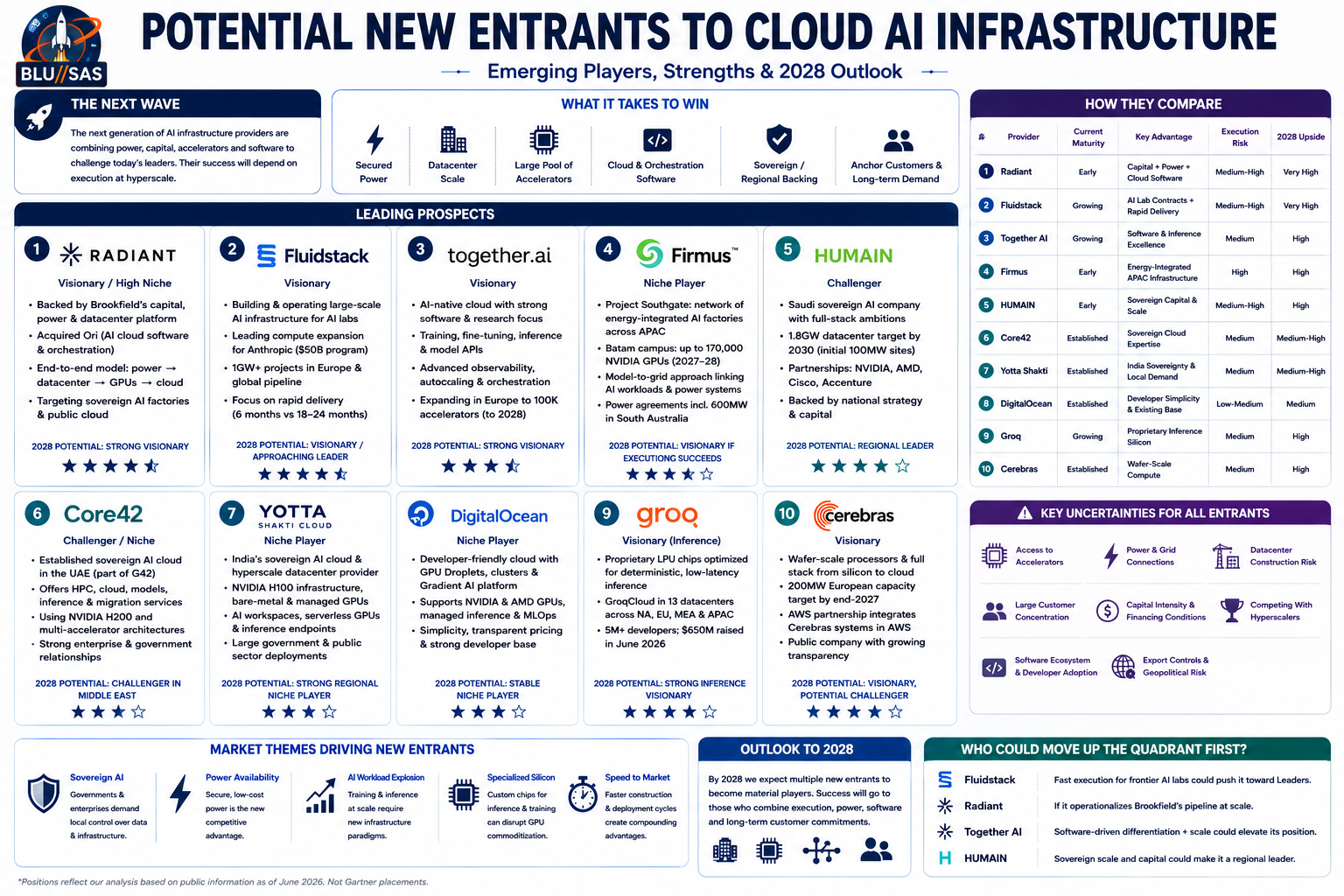
The next wave is unlikely to consist only of more GPU-rental companies. The strongest prospective entrants combine at least two of these assets:
- secured power and datacentre development;
- large pools of accelerators;
- infrastructure orchestration software;
- sovereign or regional backing;
- custom inference silicon;
- anchor customers with long-term commitments.
Against the market structure in the supplied quadrant, I see ten credible prospective entrants, although they are at very different levels of maturity.
Most likely entrants by 2028
| Provider | Probable initial position | Principal advantage | 2028 potential |
|---|---|---|---|
| Radiant | Visionary or high Niche Player | Brookfield capital, energy and Ori software | Strong Visionary |
| Fluidstack | Visionary | Large AI-lab contracts and rapid datacentre delivery | Visionary approaching Leader |
| Together AI | Visionary | Research-led inference and full-stack AI cloud | Strong Visionary |
| Firmus | Niche Player | Grid-integrated APAC AI factories | Visionary if construction succeeds |
| HUMAIN | Challenger | Saudi sovereign capital, power and full-stack ambition | Regional Leader |
| Core42 | Challenger or Niche Player | Established sovereign AI cloud | Regional Challenger |
| Yotta Shakti Cloud | Niche Player | Indian sovereignty and operational infrastructure | Strong regional Niche Player |
| DigitalOcean | Niche Player | Developer accessibility and existing cloud base | Stable Niche Player |
| Groq | Visionary | Purpose-built inference silicon and cloud | Strong inference Visionary |
| Cerebras | Visionary | Wafer-scale processors and differentiated cloud | Visionary, potentially Challenger |
These are my forecasts, not Gartner placements.
1. Radiant: the most strategically complete new entrant
What Radiant is
Radiant was launched in February 2026 through the combination of:
- Brookfield’s AI infrastructure initiative;
- UK AI-cloud operator Ori Industries;
- datacentre and powered-land development;
- institutional infrastructure capital;
- an AI-cloud software and orchestration platform.
Its model is intended to integrate the complete chain:
power → powered land → datacentre → accelerators → cloud software → customer workload
PwC describes Radiant as the first deployment vehicle for Brookfield’s AI Infrastructure Fund, with access to a pipeline associated with a potential $100 billion investment programme. Ori contributes the software-enabled AI-cloud layer that Brookfield would otherwise have had to build or acquire separately.
Reuters reported that Radiant was valued at approximately $1.3 billion following the Ori transaction. NVIDIA is participating through technology and investment support, while Brookfield contributes infrastructure financing and development capability.
Radiant’s principal strengths
1. Brookfield solves the capital problem
The greatest weakness of most neoclouds is their dependence on repeated equity rounds and GPU-secured debt. Brookfield already understands:
- utility-scale power;
- renewable generation;
- datacentres;
- real estate;
- long-duration infrastructure financing;
- project development;
- institutional investment.
This could allow Radiant to match infrastructure financing periods more closely to datacentre asset lives rather than funding everything as a high-risk technology start-up.
2. Ori supplies an existing software platform
Pure infrastructure investors often underestimate the cloud-control layer. Customers need:
- provisioning;
- Kubernetes integration;
- workload scheduling;
- multitenancy;
- observability;
- access control;
- billing;
- storage and networking integration;
- model deployment.
The Ori acquisition means Radiant does not start as an empty building-and-power company. It inherits an operating AI-cloud software platform and customer experience.
3. It can pursue sovereign AI factories
Radiant’s model is particularly suitable for governments, telecommunications companies and regulated enterprises that want:
- local infrastructure;
- operational sovereignty;
- dedicated capacity;
- predictable long-term economics;
- less dependence on US hyperscaler public regions.
This overlaps with Nscale’s strategy, but Radiant begins with a much stronger infrastructure-capital parent.
4. It is not restricted to one deployment model
Radiant could potentially offer:
- public GPU cloud through Ori;
- dedicated enterprise clusters;
- sovereign national AI factories;
- capacity leasing;
- managed infrastructure;
- joint ventures with utilities or telecom operators.
That breadth is strategically stronger than a provider selling only hourly GPU instances.
Radiant’s weaknesses and execution risks
Radiant is still very new as an integrated company. It must demonstrate that Brookfield’s physical-infrastructure culture and Ori’s software-company culture can operate as one organisation.
Its principal uncertainties are:
- how much accelerator capacity is currently operational;
- how much of the Brookfield pipeline will actually be allocated to Radiant;
- whether it can secure large anchor customers;
- whether its software scales to very large clusters;
- whether it becomes a genuine cloud or principally an infrastructure-financing vehicle;
- whether customers see differentiation beyond access to capital.
A $100 billion associated investment programme is not the same as $100 billion committed directly to Radiant. The company must distinguish available group-level investment capacity from approved Radiant projects.
Radiant compared with Nscale
| Dimension | Radiant | Nscale |
|---|---|---|
| Infrastructure capital | Exceptional Brookfield access | Large but dependent on fundraising and debt |
| Cloud software | Ori platform already acquired | Developing Nscale platform |
| Datacentre development | Brookfield ecosystem | Direct and partner-led development |
| Anchor customers | Still needs stronger disclosure | Major Microsoft-linked commitments |
| Operational history | Ori supplies some history | Very short in current form |
| Announced scale | Less publicly quantified | Exceptionally large |
| Delivery risk | High | Very high |
| Financing risk | Lower | Higher |
| Near-term market credibility | Potentially stronger platform | Stronger headline customer pipeline |
Radiant may scale more deliberately than Nscale, but it could have a more credible route to financing each project.
Predicted position
2026–27: not enough integrated operating evidence for a high placement.
2028: credible Visionary, potentially above Nscale if it demonstrates operational AI factories and retains Ori’s software differentiation.
Longer term: possible Challenger or Leader, but only if it becomes a broad repeatable cloud platform rather than an asset-by-asset infrastructure developer.
Prospect rating: very strong.
2. Fluidstack: the strongest prospective execution challenger
What it is doing
Fluidstack has evolved from a distributed GPU marketplace into a developer and operator of large dedicated AI infrastructure.
It now describes its role as acquiring power, designing and building datacentres, and operating the resulting compute infrastructure. The company says it is leading infrastructure delivery for Anthropic’s planned $50 billion compute expansion and claims a design objective of delivering gigawatt-scale capacity in approximately six months rather than conventional 18–24-month cycles.
Fluidstack has also signed an agreement with the French government concerning a proposed 1 GW AI supercomputer and has arranged GPU financing with Macquarie for European deployments.
Strengths
Fluidstack’s greatest advantage is an apparent ability to combine:
- major AI-laboratory demand;
- power acquisition;
- rapid facility design;
- hardware procurement;
- cluster operations;
- specialist customer support.
It is closer to CoreWeave’s trajectory than most emerging providers. Its customers are technically demanding organisations rather than only ordinary enterprise tenants, which can force operational maturity to develop quickly.
Weaknesses
Its biggest risks are:
- concentration around a small number of frontier AI customers;
- aggressive construction timescales;
- huge working-capital requirements;
- dependence on NVIDIA supply;
- the difficulty of turning bespoke clusters into a standardised cloud;
- limited evidence of a broad self-service enterprise platform.
An infrastructure company serving two or three enormous laboratories can become financially large without becoming a broadly complete cloud provider.
Predicted position
Most likely initial placement: Visionary.
Fluidstack could approach the Leaders quadrant by 2028 if the Anthropic-associated build-out becomes operational and it demonstrates reliability across multiple gigawatt-scale projects.
Prospect rating: exceptionally strong, with concentration risk.
3. Together AI: the software-led AI-native cloud
What it is doing
Together AI combines:
- GPU clusters;
- managed inference;
- fine-tuning;
- model APIs;
- dedicated endpoints;
- research into kernels and model efficiency;
- enterprise cluster orchestration.
Its clusters support H100, H200, B200 and GB200 systems with InfiniBand and managed orchestration. In 2026 it added autoscaling, role-based access control, full-stack observability, active health checks and self-service repair.
Together has also announced a European programme involving up to 100,000 accelerators and as much as 2 GW of supporting capacity through infrastructure partners, with deployments running through 2028.
Strengths
Together’s distinctive advantage is that it understands the workload above the GPU.
It is strong in:
- high-performance inference;
- open-model deployment;
- kernel optimisation;
- fine-tuning;
- generative media;
- research-led performance improvement;
- developer APIs.
That gives it a more credible completeness-of-vision story than providers whose differentiation is predominantly hardware availability.
Its published customer examples include training, inference, voice AI, generative media and GB200 deployments, indicating broader workload diversity than a pure capacity lessor.
Weaknesses
Together does not directly own the entire power-to-datacentre chain. Its large European expansion depends on infrastructure partners, introducing:
- delivery dependencies;
- split operational responsibility;
- potentially weaker physical-asset control;
- competition for hardware;
- margin sharing.
It also competes with model API companies, inference platforms, GPU clouds and hyperscaler AI platforms simultaneously.
Predicted position
Most likely initial placement: Visionary.
Together could become one of the strongest Visionaries because its software and research vision is more differentiated than many neoclouds. Moving into Leaders would require much greater physical scale and global enterprise execution.
Prospect rating: very strong.
4. Firmus: an APAC AI-factory contender
What it is doing
Australian company Firmus is developing Project Southgate, a network of energy-integrated AI factories across Australia and the wider Asia-Pacific region.
In June 2026, Firmus announced a Batam, Indonesia, AI-factory campus covering as many as 170,000 NVIDIA accelerators across Grace Blackwell, Vera Rubin and Vera generations, scheduled across 2027–28. It said expected committed offtake could generate $25–30 billion over the first six years.
Its broader strategy explicitly couples:
- model behaviour;
- computing;
- thermals;
- energy supply;
- grid operation;
- datacentre architecture.
The company is also securing large power arrangements, including a reported 600 MW South Australian agreement associated with renewable generation and battery storage.
Strengths
Firmus could become the leading AI-native infrastructure platform in Australia and parts of Southeast Asia because it has:
- a regional first-mover advantage;
- proximity to renewable resources;
- NVIDIA alignment;
- grid-aware datacentre engineering;
- access to markets underserved by US and European neoclouds;
- a sovereign-AI narrative.
Its “model-to-grid” approach is strategically sound because future AI-cloud competitiveness will increasingly depend on power scheduling and thermal efficiency, not just GPU count.
Weaknesses
Firmus exhibits many of the same risks as Nscale:
- enormous announced future capacity;
- relatively limited currently proven scale;
- dependence on datacentre construction;
- power and transmission risk;
- major financing requirements;
- dependence on accelerator delivery;
- possible customer concentration.
The Batam project is extremely ambitious. Its credibility will depend on how much capacity becomes operational rather than merely reserved or announced.
Predicted position
Initial placement: Niche Player.
Successful delivery of even a substantial fraction of Southgate could move Firmus into Visionaries by 2028.
Prospect rating: high upside and high execution risk.
5. HUMAIN: the sovereign-capital heavyweight
What it is doing
HUMAIN is Saudi Arabia’s state-backed full-stack AI company. Its remit spans:
- datacentres;
- AI cloud infrastructure;
- accelerators;
- models;
- applications;
- national AI capability.
Saudi plans have referenced a 1.8 GW datacentre target by 2030. Initial Riyadh and Dammam sites were expected to begin with as much as 100 MW each.
HUMAIN has also formed an infrastructure initiative with AMD and Cisco whose first phase is intended to deploy 100 MW using AMD Instinct MI450 accelerators and Cisco infrastructure.
Its partnership with Accenture illustrates that HUMAIN is pursuing the application and enterprise-transformation layers as well as physical compute.
Strengths
HUMAIN has assets few start-ups can match:
- sovereign financial backing;
- national strategic priority;
- available land;
- potentially competitive energy economics;
- access to government and national-enterprise demand;
- partnerships with NVIDIA, AMD, Cisco and service integrators;
- a route into Middle Eastern, African and Asian markets.
It can fund infrastructure through national industrial policy rather than depending entirely on short-term cloud margins.
Weaknesses
Its major uncertainties include:
- execution by a newly assembled organisation;
- availability of US accelerator exports;
- attracting international cloud customers;
- building a genuine developer ecosystem;
- balancing national objectives with commercial efficiency;
- extreme climate and cooling requirements;
- possible overdependence on government-directed demand.
State-backed scale can secure assets, but it does not automatically produce a successful cloud platform.
Predicted position
HUMAIN could enter directly as a Challenger because of its scale and resources. By 2028 it may be viewed as a regional Leader if operational capacity and customer adoption develop as planned.
It is less likely to become a global Leader quickly because software ecosystems, trust and worldwide regions take longer to build than datacentres.
Prospect rating: very strong regionally.
6. Core42: an established provider that could become more visible
What it is doing
Core42, part of the UAE’s G42 ecosystem, already operates:
- sovereign AI cloud;
- high-performance compute;
- heterogeneous accelerators;
- enterprise migration services;
- model and inference infrastructure;
- regulated-cloud environments.
It positions its platform around sovereign control, compliance and migration from conventional enterprise systems into AI infrastructure.
Core42 has continued expanding its NVIDIA-based cloud capacity, including plans for H200 systems.
Strengths
Core42 is more mature than many supposed newcomers. It has:
- existing datacentre operations;
- enterprise and government customers;
- sovereign-cloud expertise;
- G42 ecosystem relationships;
- access to UAE capital;
- strategic connections across the Middle East, Europe and the US;
- experience with multiple accelerator types.
Weaknesses
Its challenges are:
- lower global brand recognition;
- geographic concentration;
- geopolitical and export-control scrutiny;
- limited public transparency around available accelerator capacity;
- a smaller independent developer ecosystem;
- strong association with government and large-enterprise projects rather than open self-service cloud.
Predicted position
Likely placement: Niche Player or Challenger.
Core42 could rank above newly formed sovereign providers because it has a more established operating platform. It may become the Middle East’s most credible cross-border sovereign cloud, although HUMAIN could exceed it in physical scale.
Prospect rating: strong and comparatively mature.
7. Yotta Shakti Cloud: India’s strongest sovereign candidate
What it is doing
Yotta operates hyperscale datacentres in Navi Mumbai and Greater Noida and offers Shakti Cloud as an Indian sovereign AI and HPC platform.
The service includes:
- NVIDIA H100 infrastructure;
- bare-metal GPU compute;
- Kubernetes GPU resources;
- AI workspaces;
- serverless GPUs;
- inference endpoints;
- NIM integration;
- government-community-cloud deployment.
Yotta describes Shakti Cloud as a full-stack platform covering training, fine-tuning, deployment and sovereign compliance. It has also deployed India’s BHASHINI language-AI environment across its government and AI-cloud infrastructure.
Strengths
Yotta benefits from:
- India’s vast domestic market;
- in-country data-sovereignty requirements;
- existing operational datacentres;
- government-supported AI demand;
- comparatively lower operating costs;
- local language and public-service workloads;
- a complete infrastructure-to-platform proposition.
Unlike several greenfield projects, Yotta already has facilities and services that customers can consume.
Weaknesses
Its limitations include:
- modest global reach;
- concentration in India;
- less frontier-scale cluster evidence;
- dependence on imported accelerators;
- limited international enterprise recognition;
- a software ecosystem smaller than those of global clouds.
Predicted position
Likely placement: Niche Player, with a strong vertical position inside India.
Yotta could eventually become a Challenger if India’s sovereign-AI programme produces large, repeatable government and enterprise deployments.
Prospect rating: strong regional contender.
8. DigitalOcean: the established developer-cloud entrant
What it is doing
DigitalOcean has assembled an increasingly complete AI-native cloud around:
- Paperspace;
- GPU Droplets;
- eight-GPU bare-metal servers;
- multi-node clusters;
- serverless and dedicated inference;
- model deployment;
- Gradient workflows and deployments;
- AMD MI300X and NVIDIA options.
Its documentation now presents these components as one DigitalOcean AI-Native Cloud rather than a loosely connected GPU acquisition.
Strengths
DigitalOcean’s advantages are:
- a large existing developer and small-business audience;
- simple APIs and pricing;
- an established cloud-control plane;
- global infrastructure experience;
- Paperspace’s machine-learning tooling;
- a more approachable platform than the hyperscalers.
It can bring AI infrastructure to customers who find AWS, Azure and Google unnecessarily complex.
Weaknesses
It is unlikely to compete for frontier-scale training because it lacks:
- multi-gigawatt AI campuses;
- enormous tightly coupled GPU clusters;
- hyperscaler procurement leverage;
- extensive sovereign and government positioning;
- proprietary accelerators.
DigitalOcean is more suited to development, fine-tuning, inference and medium-scale production.
Predicted position
Likely placement: Niche Player.
It could become a durable, profitable AI cloud without ever becoming a Leader. Its role would be the accessible AI platform for developers and mid-market enterprises.
Prospect rating: solid, but deliberately below hyperscale.
9. Groq: the leading inference-specific entrant
What it is doing
Groq has designed its own Language Processing Unit, or LPU, specifically for deterministic, low-latency inference.
GroqCloud now operates across 13 datacentres in North America, Europe, the Middle East and Asia-Pacific. Groq says it serves more than five million developers and raised another $650 million in June 2026 to expand its inference-cloud business.
Its strategy is not to train frontier models. It is to execute already-trained models with:
- very low latency;
- predictable token generation;
- high throughput;
- an integrated compiler and runtime;
- lower dependence on NVIDIA.
Strengths
Groq has one of the clearest technical differentiators in the market:
- proprietary inference silicon;
- deterministic execution;
- vertically integrated hardware and compiler;
- global cloud deployment;
- strong developer adoption;
- lower exposure to NVIDIA supply and pricing.
As inference becomes the dominant volume workload, Groq’s specialist architecture becomes more strategically important.
Weaknesses
Groq is limited by:
- no comparable frontier-training platform;
- fewer supported workload types than general GPUs;
- dependence on model compilation and optimisation;
- the capital required to manufacture proprietary chips;
- competition from NVIDIA inference systems, TPUs, Trainium and custom hyperscaler accelerators.
Its quadrant position would depend heavily on whether “Cloud AI Infrastructure” values specialised inference as highly as general-purpose training.
Predicted position
Likely placement: Visionary.
Groq could become the Cloudflare of concentrated high-performance inference: strategically influential, commercially successful and still outside the traditional full-stack cloud model.
Prospect rating: very strong for inference.
10. Cerebras: the most credible alternative-compute cloud
What it is doing
Cerebras offers wafer-scale AI processors through both systems and cloud services. Unlike a conventional GPU cloud, it controls:
- processor architecture;
- system design;
- interconnect;
- compiler;
- model runtime;
- cloud delivery.
In July 2026, Cerebras announced plans to reach 200 MW of European AI-compute capacity by the end of 2027. It also has an AWS collaboration that integrates Cerebras systems into AWS’s infrastructure and security environment.
Cerebras is now publicly traded, and its own risk disclosures acknowledge the early stage of its cloud business, the need for datacentre capacity and capital, and dependence on a limited number of major customers.
Strengths
Cerebras provides genuine differentiation:
- extremely large on-chip memory and compute architecture;
- reduced complexity for distributing models across many separate GPUs;
- very high inference performance for suitable models;
- control of the hardware-to-cloud stack;
- independence from CUDA at the infrastructure level;
- on-premises and cloud options.
Its public listing also provides greater financial transparency than privately held neoclouds.
Weaknesses
Its challenges are:
- a much smaller ecosystem than CUDA;
- customer concentration;
- workload portability;
- manufacturing and supply-chain dependence;
- the need to educate customers around a non-standard architecture;
- competition from rapidly improving GPU and custom-accelerator systems.
Predicted position
Likely placement: Visionary.
Cerebras could move toward Challenger if it proves that the cloud model can scale commercially beyond a limited number of very large customers.
Prospect rating: strong, technologically differentiated.
Secondary candidates
Several additional providers could appear at the lower edge of a future assessment:
GMI Cloud
A growing NVIDIA-focused GPU cloud offering H100, H200 and Blackwell systems, with straightforward pricing and dedicated inference. Its prospects depend on graduating from a cost-focused GPU supplier into an enterprise-grade platform with large operational clusters.
RunPod
Strong developer adoption and serverless GPU accessibility could make it relevant for inference and smaller training workloads. It remains below Magic Quadrant scale in enterprise governance, owned infrastructure and large-cluster execution.
Voltage Park
Possesses substantial GPU infrastructure and straightforward bare-metal access, but needs a broader managed platform and larger international presence.
Vast.ai and decentralised GPU markets
These can aggregate inexpensive capacity, but heterogeneous hardware, networking, security, reliability and support make them unlikely near-term Magic Quadrant contenders for enterprise Cloud AI Infrastructure.
Who has the strongest prospects?
Most complete new challenger: Radiant
Radiant has the best structural combination of infrastructure capital, power expertise, datacentre development and acquired cloud software. Its weakness is the lack of large-scale integrated operational proof.
Strongest execution candidate: Fluidstack
Fluidstack has the clearest route to becoming another CoreWeave if its major AI-laboratory infrastructure projects are delivered on schedule.
Strongest software platform: Together AI
Together has the best chance of differentiating above commodity GPU capacity through research, inference optimisation and model-lifecycle tooling.
Strongest sovereign entrant: HUMAIN
No other new provider combines equivalent national backing, energy access, procurement scale and full-stack ambition. Its key question is commercial and operational execution.
Strongest regional entrants: Firmus, Core42 and Yotta
Each has a credible home market:
- Firmus: Australia and Asia-Pacific;
- Core42: UAE and international sovereign deployments;
- Yotta: India.
Strongest alternative-silicon providers: Groq and Cerebras
They can escape direct commodity competition with NVIDIA-based neoclouds, but only by proving that customers will accept a more specialised ecosystem.
Expected 2028 market impact
My estimated likelihood of becoming a material Magic Quadrant participant by 2028 is:
| Rank | Provider | Entry probability | Likely trajectory |
|---|---|---|---|
| 1 | Fluidstack | Very high | Visionary, potentially approaching Leader |
| 2 | Radiant | Very high | Visionary |
| 3 | Together AI | Very high | Strong Visionary |
| 4 | HUMAIN | High | Challenger or regional Leader |
| 5 | Core42 | High | Challenger/Niche boundary |
| 6 | Groq | High | Inference-focused Visionary |
| 7 | Cerebras | High | Alternative-silicon Visionary |
| 8 | Firmus | Medium-high | Niche initially; major upside |
| 9 | Yotta | Medium-high | Strong regional Niche Player |
| 10 | DigitalOcean | Medium | Durable developer-focused Niche Player |
Overall conclusion
The most dangerous new competitors to the existing quadrant are not ordinary GPU clouds.
They are providers that possess a defensible control point:
- Radiant: institutional capital and the complete physical-to-software chain;
- Fluidstack: rapid delivery for frontier laboratories;
- Together AI: model and inference software;
- HUMAIN: sovereign capital and energy;
- Firmus: grid-integrated APAC infrastructure;
- Core42 and Yotta: regional sovereignty;
- Groq and Cerebras: proprietary silicon.
Radiant is particularly important because it directly addresses the weakness affecting Nscale and many neoclouds: the mismatch between short-duration technology financing and long-duration physical infrastructure. Brookfield can finance power and datacentres as infrastructure assets, while Ori supplies the software layer.
That does not guarantee execution. But if Radiant converts Brookfield’s capital and asset pipeline into commissioned NVIDIA AI factories while preserving Ori’s cloud platform, it has a credible path to becoming a top-tier Visionary by 2028—and potentially a more financially resilient competitor than Nscale.