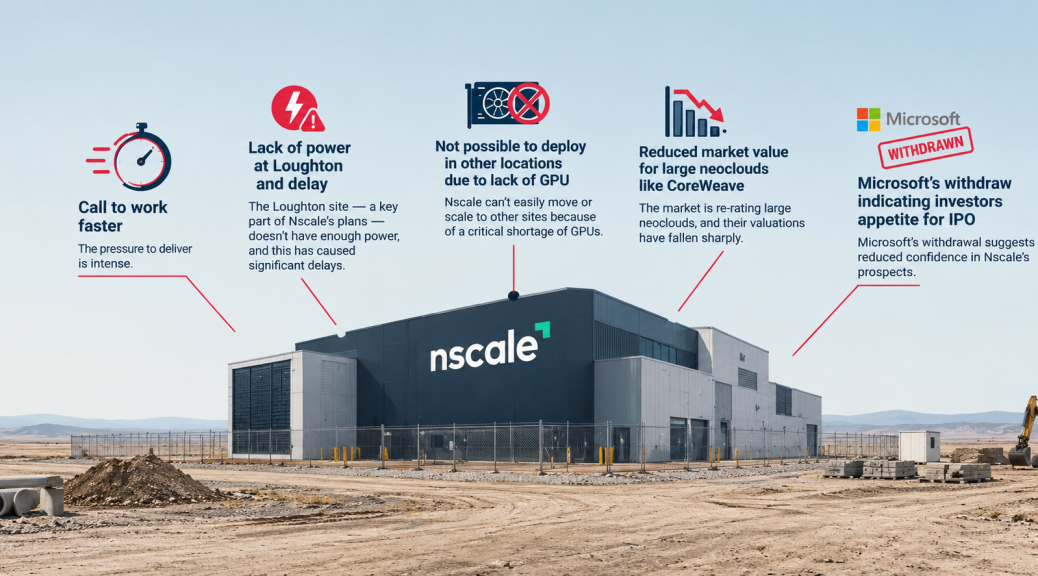
Claiming to break every record for moving fast and attaining huge amount of funding as a start-up is a huge potential to fail..
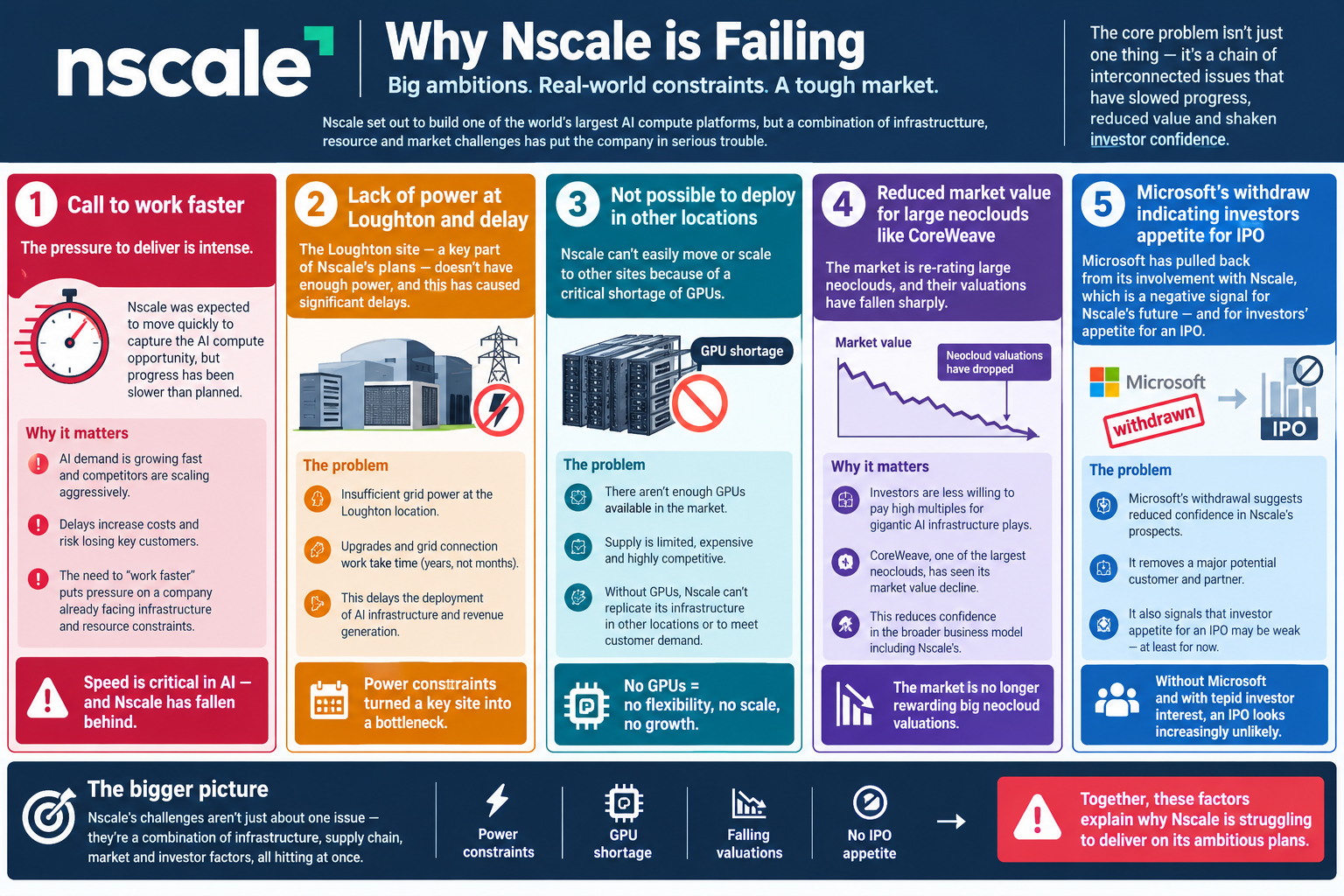
I was set-up to fail working at Nscale and now Nscale have been set-up to fail as a Neocloud…
Tell me how hard it is for Nscale to satisfy request to move faster: https://news.google.com/s/CBIwtYqon-oB?sceid=GB:en&r=0&oc=1
How hard is it for Nscale to “move faster”?
My assessment: very difficult — roughly 8/10 for accelerating delivery of fully operational AI data-centre capacity. The problem is that Nscale cannot solve every delay simply by asking its engineers to work harder.
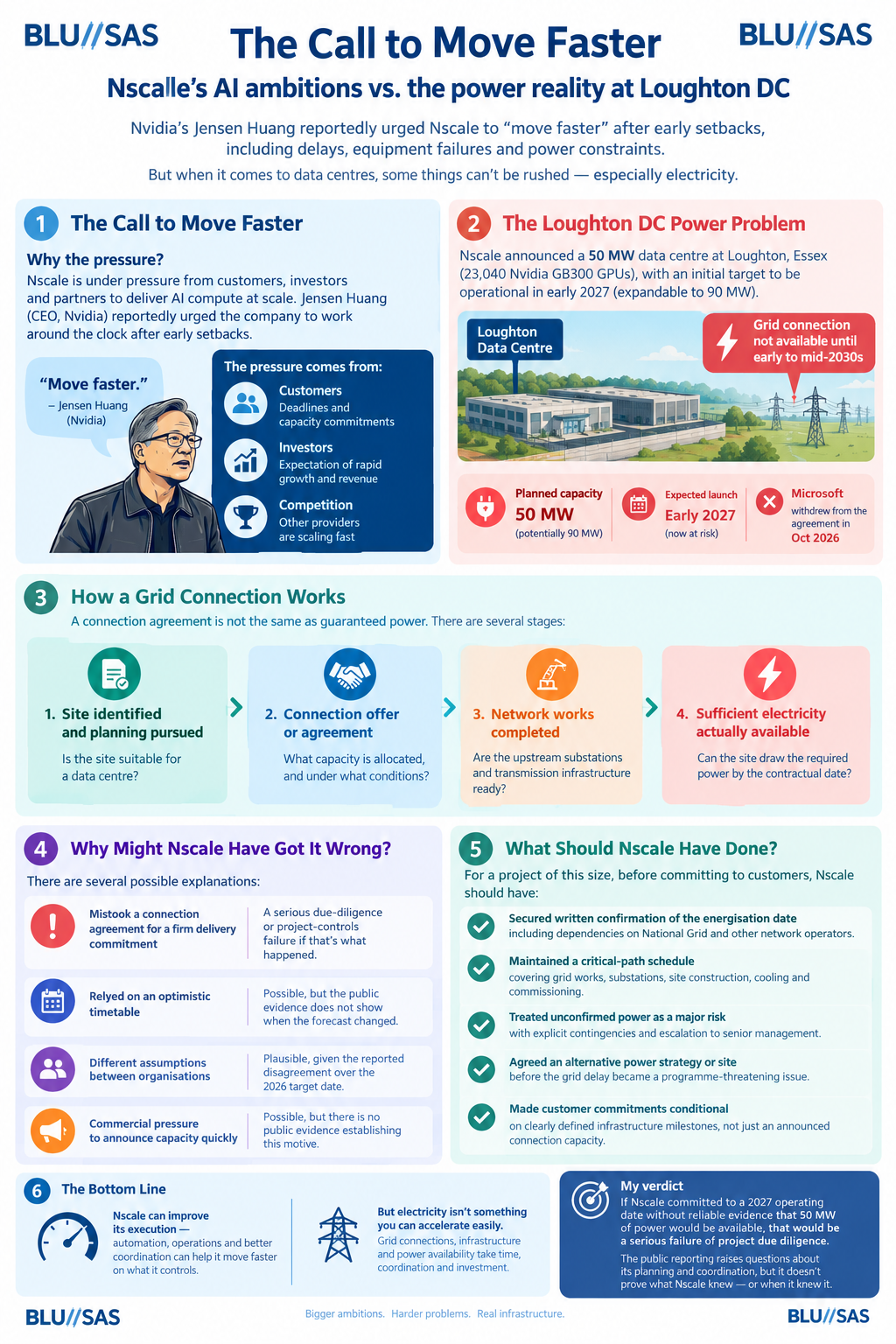
The Bloomberg report published on 22 October 2026, Nvidia’s Huang Urged Nscale to Move Faster After Early Setbacks, says Jensen Huang urged Nscale to work around the clock following setbacks involving data-centre delivery. These included delays, equipment failures and power constraints.
Bloomberg
The crucial distinction is between working faster on things Nscale controls and making infrastructure available sooner when external constraints prevent it.
1. The main obstacles
1. Electricity and grid connections
Very difficult
The Loughton, Essex, project was intended to provide 50 MW of capacity from 23,040 Nvidia GB300 GPUs. Grid connection delays pushed the expected power supply into the 2030s, prompting Microsoft to withdraw from that site’s agreement. No amount of overtime can fix a grid connection that is years away. Alternative power generation might help, but it brings engineering, planning, cost and safety challenges.
Reuters
2. Hardware deployment and commissioning
Very difficult
GPU servers, networking, power distribution, cooling and storage must all work together. Equipment failures and integration problems can block commissioning. Engineers can improve installation automation, testing and fault diagnosis, but defective equipment and supplier lead times impose hard limits.
3. Scaling the operating platform
Difficult
It is one thing to build a functioning cluster; it is another to deliver repeatable, reliable GPU capacity across multiple sites. Provisioning, network configuration, observability, capacity management, failure recovery and customer onboarding all need to scale together.
4. People, processes and coordination
Difficult
Rapid expansion increases the number of teams, suppliers, contractors and dependencies. More staff and longer hours can increase throughput, but they can also increase coordination overhead, operational mistakes and rework if the delivery process is immature.
2. Why the scale of the challenge matters
The gap between Nscale’s contracted business and its operating infrastructure is particularly important.
Reported position as of late August 2026
$103bn+
Total contracted value
$2.6bn
Value associated with active capacity
These figures are not directly comparable measures of delivered capacity: one represents contracted value over time, while the other relates to already-active capacity. Nevertheless, the difference illustrates the challenge of converting a huge pipeline of commitments into operating infrastructure.
Reuters
The Financial Times also reported that fulfilling Nscale’s future commitments would require deploying approximately 461,000 GPUs, nearly 20 times its then-current capacity. That is a major industrial-scale deployment programme, not simply a software delivery project.
Financial Times
3. What can Nscale actually accelerate?
| Area | Potential to move faster | Why |
|---|---|---|
| Infrastructure automation | High | Reduce manual deployment and configuration |
| Software and platform engineering | High | Improve testing, provisioning and release cycles |
| Fault diagnosis and recovery | High | Reduce downtime and commissioning delays |
| Hardware procurement | Moderate | Depends on supplier capacity and availability |
| Data-centre construction | Moderate to low | Depends on contractors, equipment and site readiness |
| Electricity availability | Low where the grid is constrained | Depends on network capacity, connections or alternative generation |
| End-to-end delivery | Variable | Determined by the slowest critical dependency |
These are engineering assessments rather than reported measurements of Nscale’s internal performance.
The most effective approach is to identify the critical path for each site and remove its actual bottlenecks. Adding engineers to a team whose deployment process is slow can help. Adding engineers to a project waiting for electrical power cannot solve the principal problem.
4. What does Jensen Huang’s demand mean for the company?
There are three distinct interpretations.
- A genuine execution problem: Nscale may need tighter delivery management, better commissioning procedures and more predictable deployment.
- A mismatch between commercial ambition and physical delivery: signing large contracts is not the same as bringing the promised computing capacity online.
- Pressure from customers and investors: delays become especially costly when customers have deadlines and investors expect rapid conversion of contracts into revenue. Reuters’ reporting on the Microsoft withdrawal illustrates the commercial consequences of a missed infrastructure deadline.
Reuters+1
Huang’s instruction to work around the clock is therefore a demand for urgency, not evidence that the underlying problems can all be solved by working longer hours.
My conclusion
Nscale’s challenge is not that every part of its business is inherently slow; it is that several complex delivery processes must succeed simultaneously at enormous scale.
I would distinguish two targets:
- Accelerating engineering and operational execution: achievable over weeks or months if there are genuine process and automation bottlenecks.
- Accelerating the delivery of hundreds of thousands of GPUs across data centres: much harder, potentially taking years, because power, construction, procurement, commissioning and financing all interact.
The key question is whether Nscale’s delays are predominantly caused by fixable execution weaknesses or by external infrastructure constraints. If they are mostly the former, Huang’s pressure could produce substantial improvements. If they are mostly the latter, the company can improve its execution considerably and still miss some delivery dates.
The public reporting establishes that Nscale faces both types of challenge, but does not reveal enough of its internal project data to quantify their relative contribution.
Loughton DC power issue
https://www.theguardian.com/technology/2026/sep/24/construction-largest-supercomputer-delayed
Why didn’t Nscale know about the power issues especially relating to the Houghton DC?
The short answer: Nscale may have known about the risk, but failed to secure a dependable power-delivery date.
The reporting on the Loughton data centre in Essex raises a serious question about project due diligence. However, there is an important difference between knowing that a grid connection is planned and having confirmation that sufficient electricity will actually be available by the required date.
The project was announced in 2025, with an intended opening in early 2027 and a planned initial capacity of 50 MW, potentially expanding to 90 MW. UK Power Networks subsequently indicated that sufficient grid power might not be available until the early to mid-2030s. Microsoft then withdrew from its agreement for that site in October 2026.
The Guardian
That is a potential gap of several years between the commercial delivery plan and the physical infrastructure needed to operate it.
1. The most revealing detail: Nscale reportedly had a 90 MW connection arrangement
This is where the story becomes more interesting.
According to City AM, Nscale had secured planning permission and a 90 MW grid connection arrangement, but the actual supply was expected much later than originally anticipated.
City AM
According to Data Center Dynamics, the original late-2026 completion target had been agreed with UK Power Networks, but National Grid said it had not agreed to that target date.
DCD
That points to a potentially significant misunderstanding or failure of coordination between the parties.
A grid connection is not a single yes-or-no decision. There are several stages:
1. Site identified and planning pursued
Is the site suitable for a data centre?
2. Connection offer or agreement
What capacity is allocated, and under what conditions?
3. Network works completed
Are the upstream substations and transmission infrastructure ready?
4. Sufficient electricity actually available
Can the site draw the required power by the contractual date?
A project can progress through the first two stages without the last two being ready.
One important qualification: the public reports do not establish the exact legal terms of Nscale’s connection agreement or precisely when each party learned that the timetable was unachievable.
2. So why might Nscale have got it wrong?
I see four plausible explanations.
| Possible explanation | My assessment |
|---|---|
| It mistook a connection agreement for a firm delivery commitment. | A serious due-diligence or project-controls failure if that is what happened. |
| It relied on an optimistic timetable that later deteriorated. | Possible, but the public evidence does not establish when the forecast changed. |
| Different organisations had different assumptions about who would deliver the upstream network works. | Plausible given the reported disagreement over the 2026 target date. |
| It accepted the risk because of commercial pressure to announce capacity quickly. | Possible, particularly given the rapid expansion plans, but there is no public evidence establishing that motive. |
The distinction between the first two explanations matters. A project team can make a reasonable forecast that subsequently proves wrong. It is much harder to defend committing to a customer delivery date without sufficiently robust evidence that the required power will be available.
3. What should Nscale have done?
For a project requiring 50–90 MW, I would expect the following before making a firm customer commitment:
- Obtain written confirmation of the energisation date, including any dependencies on National Grid and other network operators.
- Maintain a documented critical-path schedule covering grid works, substations, site construction, cooling and commissioning.
- Treat unconfirmed power availability as a major delivery risk, with explicit contingencies and escalation to senior management.
- Agree a credible alternative power strategy or alternative site before the grid delay becomes a programme-threatening issue.
- Make customer commitments conditional on clearly defined infrastructure milestones, rather than assuming that an announced connection capacity guarantees delivery.
These are standard principles of major infrastructure programme management, not claims about Nscale’s actual internal procedures.
4. My verdict
If Nscale committed to a 2027 operating date without reliable evidence that 50 MW of power would be available, that would be a serious failure of project due diligence.
The public reporting makes it reasonable to question the quality of its planning and coordination. It does not, however, prove that Nscale was unaware of the risk, that it deliberately misled Microsoft, or that management ignored a warning.
The decisive evidence would be the original connection offer, the correspondence about the 2026 energisation target, the subsequent revised forecasts, and the date on which Nscale informed Microsoft of the risk.
Those documents would tell us whether this was an unforeseeable deterioration, poor coordination between infrastructure providers, or a failure by Nscale to distinguish a planned connection from deliverable electrical capacity.
My suspicion is that the more fundamental issue was not that Nscale failed to understand how much electricity its data centre needed, but that its commercial delivery plan may have advanced further than its certainty about when that electricity could be supplied. That is the question its board and investors should be asking.
Nscale’s Compute Power
Is there any evidence the Nscale have over 23,000 GB300 GPU to go into the Loughton’s DC?
What the evidence actually shows
There is strong evidence that Nscale planned to deploy 23,040 Nvidia GB300 GPUs at Loughton. There is not, in the public sources I’ve found, equivalent evidence that Nscale had already acquired or physically held all 23,040 GPUs for that site.
Nscale’s own announcement on 16 September 2025 explicitly stated that the Loughton facility would initially house 23,040 GB300 GPUs, with delivery planned for Q1 2027. That establishes a published deployment commitment, not proof of completed procurement or delivery.
Nscale
Evidence by category
| Evidence | What it establishes |
|---|---|
| Nscale’s official announcement | Confirmed plan: 23,040 GB300 GPUs for Loughton, targeted for Q1 2027. |
| Nscale’s expanded Microsoft GPU agreement | Broader procurement commitment: approximately 200,000 GB300 GPUs across several sites and countries, including about 104,000 for Texas. It does not prove those GPUs were physically available for Loughton. Nscale |
| IT Pro’s October 2026 report | Delivery uncertainty: the site faced major power delays, and Microsoft withdrew from its agreement for this facility. IT Pro |
My conclusion
I would not conclude that Nscale had 23,040 GB300 GPUs sitting in a warehouse waiting for electricity. Equally, the public evidence does not establish that it had failed to procure them.
The key distinction is between contracted GPUs, ordered GPUs, delivered GPUs and installed GPUs. The public announcements establish the intended deployment and broader supply commitments, but not the status of the specific Loughton allocation.
To establish that, we would need a supplier delivery schedule, an Nscale statement confirming the allocation, or physical evidence of the equipment arriving at the site. I haven’t found reliable public evidence confirming any of those for all 23,040 GPUs.
Loughton DC was a building site in April 2026
Yes — and the evidence is stronger than just an empty yard in April.
The key investigation is the Guardian article published on 9 March 2026, titled From press release … to scrap metal site: the Essex ‘supercomputer’ that’s still a scaffolding yard. Reporters visited the site in February 2026 and found it still operating as a scaffolding depot, with scrap metal and lorries rather than an AI data-centre construction project. The article said planning permission was filed in late February, after the newspaper began making enquiries.
The Guardian
The timeline is particularly revealing
Jan 2025
Project announced
The government publicised plans for a major UK AI supercomputer, with an ambitious delivery timetable.
Feb 2026
Still a scaffolding yard
The Guardian’s site visit found no visible data-centre construction underway.
Late Feb 2026
Planning application filed
The application followed the Guardian’s enquiries, according to its investigation.
Oct 2026
Microsoft withdraws
Microsoft pulled out of its Loughton agreement after power-supply problems emerged. Nscale said it remained committed to the project.
The Guardian
What does this tell us about the 23,040 GPUs?
It makes the question about GPU procurement more pressing.
If the site was still a scaffolding yard in February and construction had not begun, then there was no completed facility at Loughton ready to receive and operate those GPUs. That does not prove that the chips had not been purchased, allocated or stored elsewhere.
It does, however, raise a reasonable question: why was the project publicly presented with such an ambitious delivery timetable before the site was visibly progressing through construction and planning?
The strongest evidence here is about the maturity of the physical project, not the precise number of GPUs Nscale had bought.
One qualification: the Guardian’s visit was in February, not April. I have not verified a separate April photograph or site visit, so I would not claim that the March reporting independently establishes the site’s exact condition throughout April.
My assessment: the scaffolding-yard investigation is meaningful early evidence that Loughton was far behind the public image of a rapidly materialising AI supercomputer. Combined with the later power constraints, it suggests that the project’s delivery risk extended beyond electricity alone.
No evidence of over 20,000 GB300 available for the Loughton DC
The most important point is that Nscale had other sites in its Microsoft deployment programme that were intended to host far more GPUs than Loughton. Portugal and Texas are therefore the obvious places to investigate as potential destinations for any Loughton allocation that had actually been procured.
Nscale’s 15 October 2025 announcement gives us a useful starting point:
Nscale
1. Nscale’s announced Microsoft GPU deployments
Texas, USA
104,000 GPUs
Approximately 240 MW initially; phased delivery planned from Q3 2026.
Largest announced deployment in the programme.
Nscale
Sines, Portugal
12,600 GPUs
GB300 deployment planned from Q1 2026 at Start Campus.
A separate facility with a much smaller initial GB300 allocation than Texas.
Nscale
Narvik, Norway
52,000 GPUs
GB300 deployment announced through the Nscale–Aker joint venture.
A major deployment, but actual operating capacity needs to be distinguished from announced capacity.
Nscale
Loughton, UK
23,040 GPUs
50 MW planned, with an original deployment target of Q1 2027.
Microsoft subsequently withdrew from its agreement for this site following power-supply delays.
Nscale
+1
These four announced allocations total approximately 191,600 GPUs, consistent with the broader agreement for approximately 200,000 GPUs once the rounded figures and other programme details are taken into account.
2. How much compute does Nscale actually have?
There is a particularly useful update from Nscale itself. On 1 October 2026, it stated that it had deployed more than 50,000 GPUs powering production workloads across six active data centres in five countries. It said it had deployed 24,000 GPUs in the preceding month alone.
Nscale
Nscale’s reported operational position — 1 October 2026
50,000+
GPUs deployed in production
6
Active data centres
5
Countries
24,000
GPUs deployed in the previous month
Source: Nscale’s own operational update. These are company-reported figures, not an independent audit.
Nscale
That is evidence that Nscale had meaningful live compute capacity. It does not establish that all its announced deployments had been completed or that all 50,000 GPUs were GB300s.
3. Could the 23,040 Loughton GPUs have gone elsewhere?
Potentially, yes — but there is an important timing issue.
| Alternative site | Announced GB300 allocation | Potential to absorb additional GPUs |
|---|---|---|
| Texas | 104,000 | The largest candidate, subject to installed power, cooling, rack capacity and delivery schedules |
| Portugal | 12,600 | A possible candidate if additional space and power were available |
| Norway | 52,000 | Another potential candidate, subject to actual commissioning progress |
| Loughton | 23,040 | The original allocation; power constraints threatened the planned timetable |
The allocations and intended deployment schedules were published by Nscale in October 2025.
Nscale
However, the Loughton GPUs were originally scheduled to arrive from Q1 2027. So we cannot assume that 23,040 GPUs had already been delivered to Nscale and were sitting idle when Microsoft withdrew in October 2026.
There are two different scenarios:
- If the GPUs had not yet been delivered: Nscale could potentially redirect future shipments to Texas, Portugal or Norway, subject to revised agreements and available infrastructure.
- If the GPUs had already been delivered or assembled: relocating them would be more complicated. It would require suitable powered racks, cooling, networking, commissioning capacity and potentially contractual changes.
Portugal is particularly interesting because its original 12,600-GPU allocation is smaller than Loughton’s planned 23,040 GPUs. Absorbing the entire Loughton allocation there would require substantially more capacity than the original deployment plan.
4. The bigger question
Nscale’s October update shows that it was deploying compute at considerable speed. But the gap between 50,000 operational GPUs and roughly 200,000 GPUs announced under its Microsoft programme is still substantial.
That gap is not automatically evidence of failure: these are phased deployments with different delivery dates.
The key questions I would want answered are:
- How many of the 23,040 Loughton GPUs had actually been ordered, manufactured, delivered or allocated by October 2026?
- How many of the 104,000 Texas GPUs and 12,600 Portugal GPUs were installed and available for customer workloads, rather than merely contracted?
- Did Nscale have spare powered capacity at any of its existing sites to accommodate additional GPUs?
My conclusion: Nscale had a credible alternative deployment footprint, especially in Texas. But the public evidence does not establish that it possessed 23,040 surplus GPUs or had enough spare capacity elsewhere to deploy them immediately. The most revealing evidence would be its site-by-site GPU deployment figures and delivery schedule, rather than its aggregate contracted GPU count.
Is there going to a successful Nscale IPO this year?
https://fortune.com/2026/09/24/nscale-wants-a-35-billion-valuation-nvidia-is-helping-foot-the-bill
Nscale vs CoreWeave: would Nscale’s IPO succeed?
My assessment, as of 25 October 2026, is that Nscale could complete an IPO, but achieving its reported $35 billion target valuation looks considerably harder following Microsoft’s withdrawal from Loughton. I would expect investors to scrutinise its operational capacity, financing requirements and customer concentration much more closely than they would have a few months ago.
The comparison with CoreWeave is instructive. CoreWeave has demonstrated that investors will fund a specialist AI cloud provider at enormous scale. Its recent share-price weakness also shows that investors are becoming more demanding about how that growth is financed and delivered.
1. Comparing their compute capacity
Figures are from company announcements and recent reporting; contracted capacity is not the same as operational capacity.
CoreWeave
4.2 GW
Contracted power, August 2026
CoreWeave reported approximately 4.2 GW of contracted power and more than $25 billion in additional customer commitments during early Q3 2026. It is an established, publicly traded AI cloud provider with a substantial operating business.
CoreWeave Investors
Nscale
55 MW
Combined capacity across five active data centres, according to its IPO prospectus
Nscale’s September prospectus reported five active data centres with 55 MW of combined capacity and 12 more at various stages of development. Its subsequent October update reported more than 50,000 GPUs in production across six active data centres in five countries.
DCD
+1
The power figures alone illustrate the difference in scale:
Reported or contracted power capacity
CoreWeave contracted power versus Nscale’s reported active-site capacity; these are different measures and are not a like-for-like comparison.
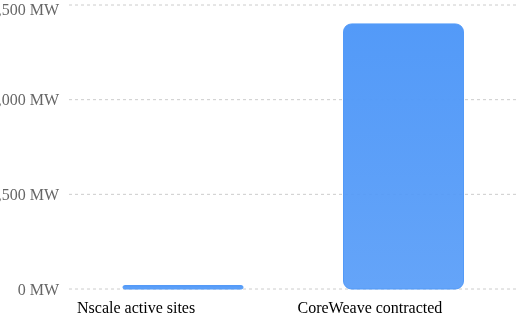
CoreWeave’s contracted power is approximately 76 times Nscale’s prospectus-reported active-site capacity. That is not a claim that CoreWeave has 76 times as much usable compute today: one figure is contracted power and the other is reported active-site capacity.
The GPU counts are also not directly comparable. Nscale has publicly reported more than 50,000 GPUs in production, but the figures cited here do not establish a matching, current CoreWeave GPU count on the same basis. Power capacity, GPU generation, utilisation and customer workloads all matter.
2. CoreWeave’s share-price decline: what is the market telling us?
Recent market developments, October 2026
CoreWeave
AI cloud provider
−15.1%
14–15 October sell-off period
Reuters reported that CoreWeave shares fell sharply as concerns grew over its debt burden, rising borrowing costs and the profitability of AI infrastructure investment. Its bonds also sold off, with yields reaching approximately 15%.
Investing.com
The decline is a warning, but not necessarily evidence that customers no longer want AI compute.
Investors are increasingly distinguishing three things:
- Demand: Do customers want GPU capacity?
- Delivery: Can the provider bring the contracted capacity online on time?
- Returns: Will the resulting revenue cover equipment costs, electricity, financing, depreciation and operating expenses?
CoreWeave has demonstrated substantial demand and operating scale. Nevertheless, its debt and capital expenditure have made investors question whether growth will produce attractive returns.
Nscale faces the same questions, but with an additional disadvantage: it has a much smaller operational footprint and a greater proportion of its valuation depends on infrastructure that is still being developed.
3. Why Nscale’s $35 billion IPO valuation is vulnerable
The most concerning figures in Nscale’s IPO reporting are its revenue, losses and concentration of future contracts.
Nscale, first half of 2026
$140.6m
Revenue
$1.02bn
Net loss
$103bn
Reported total contract value
~85%
Of contract commitments attributed to Microsoft and Anthropic combined in September reporting
Sources: Nscale’s IPO reporting and TechCrunch’s analysis. Total contract value is not recognised revenue, cash received or guaranteed profit.
The Information
This is the central valuation problem: a large contract backlog looks attractive only if Nscale can finance, build and operate the capacity needed to fulfil it.
The Information reported on 29 September that Nscale’s $35 billion valuation target looked too high given the proportion of contracts dependent on unbuilt data centres. It suggested a valuation of less than half that figure might be more appropriate.
The Information
The Microsoft withdrawal does not erase the entire $103 billion backlog. Reports indicate that the Loughton project represented only a small part of that total, and Nscale has said its other Microsoft contracts remain in place. But it damages confidence in execution.
There is another important complication: the IPO process itself. On 23 October, Quartz reported that Nscale’s IPO marketing remained on hold while it addressed SEC feedback, amid investor resistance to the proposed valuation. The same report noted that CoreWeave had lost approximately a quarter of its share value during October.
Quartz
4. My IPO forecast
These are my subjective scenario estimates, not market-implied probabilities or investment advice.
Bull case
20%
$25–35bn valuation
Nscale secures alternative power for Loughton, delivers major projects on schedule, maintains customer contracts and convinces investors that its backlog will translate into revenue.
Base case
50%
$15–25bn valuation
The IPO proceeds, but at a materially lower valuation or with less favourable terms. Investors recognise the opportunity while pricing in construction, funding and customer-concentration risks.
Bear case
30%
Below $15bn, or a delayed IPO
Financing becomes more expensive, construction delays spread, customers reconsider commitments, or public-market investors refuse to underwrite the proposed growth rate.
Scenario ranges are analytical estimates based on information available on 25 October 2026. They are not independently established fair values. Probabilities sum to 100% and describe the valuation/outcome scenarios, not the probability of Nscale ultimately becoming a successful business.
My central estimate would therefore be a valuation of approximately $15–25 billion if Nscale successfully completes an IPO in the current environment. I would be sceptical of $35 billion without strong evidence of funded construction, reliable energisation dates and a credible path to profitability.
5. What would change my mind?
The following evidence would materially improve my assessment:
- Operational capacity: independently verifiable figures for installed GPUs, billable compute and utilisation by site.
- Power certainty: binding, credible power-delivery schedules for major sites, especially Norway and Portugal.
- Funding: sufficient committed capital to complete the build programme without excessive dilution or punitive debt.
- Customer resilience: evidence that Microsoft and Anthropic commitments are firm, financeable and deliverable, with manageable termination conditions.
- Unit economics: gross margins and cash generation that improve as new facilities become operational.
The converse is also true. Further missed delivery milestones, expensive emergency financing or additional customer withdrawals would make a valuation below $15 billion—or a postponement—more plausible.
Final verdict
CoreWeave’s share-price decline is a useful warning about the market’s appetite for capital-intensive AI infrastructure companies. But it is not a simple referendum on AI demand: investors are increasingly penalising debt, execution risk and the gap between promised capacity and profitable operating compute.
Nscale’s risk is more acute because it is asking public investors to value a much smaller operating business partly on the basis of an enormous future contract backlog. Microsoft’s Loughton withdrawal reinforces precisely the concern that investors already had: a contract is not the same as a working data centre, and a working data centre is not automatically a profitable one.
I would expect Nscale to face pressure to reduce its valuation expectations substantially. A successful IPO remains possible, but a $35 billion flotation now looks like the optimistic case rather than the most likely outcome.