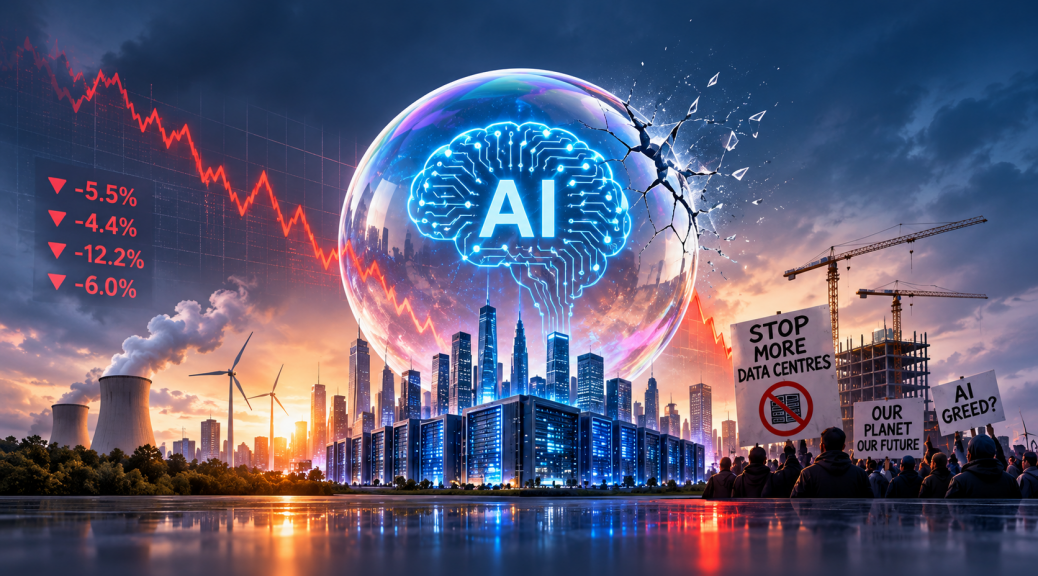
The probability of an AI bubble bursting: November 2026
Global markets • AI infrastructure • Data-centre investment • Social opposition • Industrial transformation
My assessment: 60%
Elevated risk of a major correction
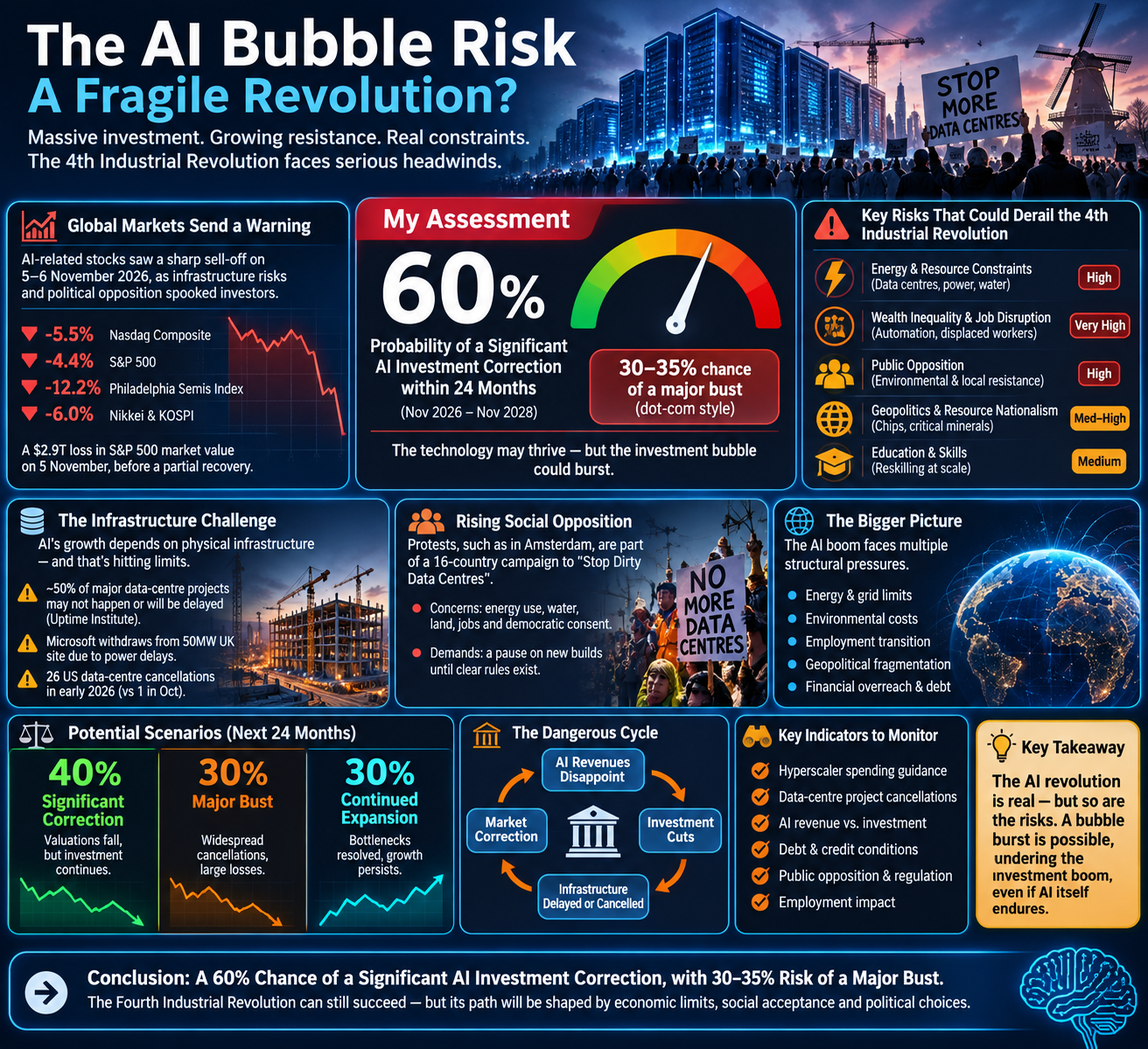
My assessment is that there is approximately a 60% probability of a significant AI investment and valuation correction within the next 24 months, running from November 2026 to November 2028.
I would put the probability of a more severe, dot-com-style AI bubble burst, involving widespread infrastructure cancellations, company failures and substantial losses for investors, at approximately 30–35%.
These are my analytical estimates, not market-implied probabilities or statistically calibrated forecasts.
The important distinction is that I do not believe AI itself is a bubble. I believe there is a credible possibility that the financial markets, infrastructure developers and technology companies have collectively overestimated:
- How quickly AI will become commercially profitable.
- How much computing infrastructure will actually be required.
- How quickly electricity and grid infrastructure can be delivered.
- How much society will tolerate the environmental and economic costs.
- How quickly organisations can reorganise their workforces around AI.
In other words, the technology could succeed while a substantial proportion of the investment built around it fails.
That is precisely what happened during the dot-com crash: the internet transformed the world, but many of the businesses and infrastructure investments made in anticipation of that transformation were economically unsustainable.
1. What global stock markets are telling us
There has been a particularly important development over the last few days.
The global markets have experienced a sharp AI-related sell-off, followed by a partial recovery.
The November 5–6, 2026 market shock
-5.5%
Nasdaq Composite, November 5
-4.4%
S&P 500, November 5
-12.2%
Philadelphia Semiconductor Index, November 5
-6%
Japan’s Nikkei and South Korea’s KOSPI, November 6
The S&P 500 subsequently lost approximately $2.9 trillion in market value on November 5. On November 6, the S&P 500 and Nasdaq recovered 0.31% and 1.1%, respectively. Sources: Reuters and Euronews.Investing.com+2
What makes this particularly interesting is the trigger.
Investors are increasingly concerned that political opposition to data-centre expansion could translate into tighter regulation and reduced infrastructure spending.
The US midterm election results have introduced another dimension to the investment risk: the possibility that local, state and federal governments will become less accommodating towards AI infrastructure.
Reuters reported that the sell-off affected semiconductor companies, hyperscalers and other businesses associated with the AI infrastructure economy. Reuters+1
This is significant because markets are no longer just questioning whether AI companies can make money.
They are beginning to question whether the physical infrastructure required to support the projected growth can actually be built.
My interpretation: This is an early warning signal, not proof that the bubble has burst. The speed of the recovery also shows that investors are still willing to buy the AI story.
2. Data-centre construction: the physical bottleneck
This is arguably the strongest part of your argument.
The AI industry is making enormous assumptions about the availability of physical infrastructure. Those assumptions are increasingly being challenged.
There are three particularly important pieces of evidence.
A. A significant proportion of proposed projects may never happen
A July 2026 investigation by The Guardian, titled Stymied datacentre projects threaten global AI revolution, reported that the Uptime Institute had identified 250 global data-centre projects exceeding 100MW, announced between 2021 and 2024.
Approximately half were expected either not to happen or to experience delays.
The reasons included:
- Electricity availability.
- Construction costs.
- Insufficiently committed customers.
- Water consumption.
- Supply-chain limitations.
- GPU availability.
- Local planning objections.
This is particularly important because announced investment is not the same as completed infrastructure, and completed infrastructure is not the same as profitable infrastructure. The Guardian
B. Microsoft has already demonstrated the problem in Britain
On 19 October 2026, Microsoft withdrew from an agreement to anchor a 50MW data centre in Loughton, Essex, being developed by Nscale.
The problem was electricity.
The anticipated grid connection had been pushed into the 2030s, making the original project timetable commercially unattractive.
The site had been expected to provide 23,040 Nvidia GB300 GPUs.
Microsoft stressed that the decision related to this particular site, rather than its wider relationship with Nscale.
Nevertheless, this is an important example of the gap between announced AI investment and deliverable infrastructure. Investing.com+1
C. Cancellations are becoming more widespread
A February 2026 Guardian investigation reported that MacroEdge had identified 26 US data-centre cancellations through January, compared with just one in October.
The cancellations and delays reflected a combination of energy shortages, supply-chain problems, tariffs, local opposition and growing investor concerns.
This is particularly worrying because data-centre construction has become an important contributor to US economic growth. The Guardian
The implications
The AI investment model depends on a chain of events:
Hyperscaler investment commitments
Data-centre construction
Electricity, cooling and network capacity
GPU deployment and AI computing capacity
AI revenue and investment returns
A failure or delay at any stage can undermine the economics of the entire investment.
This creates a potentially dangerous feedback loop.
If projects are delayed, GPU orders may be postponed. If GPU orders are postponed, semiconductor manufacturers face lower expected growth. If semiconductor valuations fall, investors become less willing to finance infrastructure developers. If financing becomes more expensive, more projects are cancelled.
The problem is that these companies are not independent. They are financially and commercially connected.
3. Amsterdam: the social opposition is becoming organised
An important escalation
The Amsterdam developments are particularly relevant to your thesis.
On 6 November 2026, more than 100 activists entered a Microsoft AI data-centre construction site in Amsterdam.
According to Reuters, protesters climbed cranes, occupied parts of the site and staged demonstrations.
This was not simply an isolated local protest.
It formed part of two days of coordinated demonstrations planned across 16 countries by the Stop Dirty Data Centres coalition.
NETHERLANDS-PROTEST-MICROSOFT-DATACENTRE-RALLY-SPEAKER-STAGE
NETHERLANDS-PROTEST-MICROSOFT-DATACENTRE-LINKED-ARMS-RIOT-POLICE
The campaigners’ objections included:
- Electricity consumption and pressure on national grids.
- Water consumption and environmental damage.
- Competition for land and other resources.
- The effects of AI on employment.
- Concentration of economic and technological power.
- Insufficient public consultation and accountability.
The campaign’s position is particularly interesting: it is not necessarily calling for existing data centres to close. It is demanding a pause in major new construction until governments establish clearer rules.
That is a much more politically achievable position than demanding an end to AI. Reuters
Amsterdam already has a regulatory problem
Amsterdam introduced restrictions on new data-centre developments and extensions until at least 2030, following its earlier moratorium.
In August 2026, DutchNews reported that more than 500 people had joined a campaign against a proposed large facility in Amsterdam-Zuidoost.
Campaigners argued that the development would provide little benefit to the local community.
The protests also included activity by Geef Tegengas and Extinction Rebellion against a Microsoft project in Amsterdam-Sloterdijk. DutchNews.nl+1
This matters because Amsterdam is not an obscure location.
It is one of Europe’s established data-centre markets, with significant digital infrastructure and connectivity.
If opposition becomes sufficiently widespread, the consequences could extend well beyond the Netherlands.
Why this matters to the AI bubble
There is an important distinction between public opposition to AI applications and public opposition to the infrastructure itself.
The latter is potentially more damaging to the investment cycle.
An AI application can be developed, modified or relocated relatively quickly.
A data-centre campus requires:
- Land acquisition.
- Planning permission.
- Grid connections.
- Power-generation capacity.
- Water and cooling infrastructure.
- Significant capital investment.
- Long-term commercial commitments.
If communities and governments begin to resist these developments, infrastructure investment becomes less predictable.
This increases the cost of capital and makes speculative projects less attractive.
My assessment: The Amsterdam protests are an early indication of a wider political legitimacy problem. They are not yet evidence of a coordinated international movement capable of stopping the AI industry, but the organised 16-country campaign makes them more significant than an isolated local demonstration.
4. Analysing your article: what could derail the industrial revolution?
I have read your article, AI DC Buildouts, Changing Jobs & Roles of the 4th Industrial Revolution.
I think its most important argument is not actually about data-centre engineering or employment.
It is the recognition that AI infrastructure is competing for finite resources while society is still trying to work out how the economic benefits and costs should be distributed.
Your article identifies several structural threats:
- Climate change and energy transition.
- Water shortages.
- Resource nationalism.
- Demographics.
- Education.
- Public trust.
- Wealth inequality.
- Employment transition.
- Geopolitics.
I would group these into five major risks.
Risk 1: Energy and resource constraints
AI is not an intangible technology.
It requires physical infrastructure on an industrial scale.
Your article highlights the IEA projection that data-centre electricity consumption could reach approximately 945 TWh annually by 2030.
This is a substantial increase.
The difficulty is that electricity infrastructure cannot be deployed at the same speed as software.
A new AI model can be developed in months. A new transmission network, power station or major grid connection can take years.
This creates a mismatch between technological expectations and physical reality.
There are also three competing demands:
- Household electricity consumption.
- Industrial electrification and decarbonisation.
- AI infrastructure.
If AI data centres contribute to higher household electricity bills, public support could deteriorate rapidly.
This is particularly dangerous politically because consumers may see AI as something that benefits large technology companies while increasing their own living costs.
Bubble risk: High.
Risk 2: Wealth inequality and employment disruption
This is potentially the most significant long-term social risk.
Your article correctly identifies that AI does not simply replace jobs. It compresses tasks and changes the structure of employment.
However, there is a potential timing problem.
Consider two simultaneous developments:
- AI reduces the need for certain categories of administrative, professional and technical labour.
- The new AI infrastructure economy creates different jobs, but requires different skills and is geographically concentrated.
These jobs are not automatically interchangeable.
A displaced customer-service worker cannot immediately become a GPU infrastructure engineer.
Nor can an administrative worker automatically transition into a high-voltage electrical engineering role.
The potential consequences are:
- Rising employment insecurity.
- Reduced household purchasing power.
- Increased political pressure for regulation.
- Resistance to automation.
- A growing divide between owners of AI infrastructure and those whose labour is being displaced.
There is an economic feedback loop here that I think deserves particular attention.
If AI adoption reduces employment or wages faster than productivity gains translate into broader prosperity, consumer demand could weaken.
That could undermine the very revenues that justify enormous AI investment.
Your article identifies this issue in its discussion of employment transition, but I would elevate it to one of the principal threats to the entire AI investment thesis. BLU // SAS
Bubble risk: Very high over the medium to long term.
Risk 3: Public trust and social legitimacy
Nationwide Walkouts To Freeze AI – San Francisco
Your article identifies surveillance, privacy, bias, deepfakes, autonomous weapons and job displacement as threats to public trust.
I would add one more:
The perception that AI is being imposed on society without democratic consent.
Amsterdam is a practical example.
When local communities feel that their electricity, land and water are being committed to private technology infrastructure without meaningful local benefit, opposition becomes more likely.
This could lead to:
- Planning restrictions.
- Construction moratoriums.
- Higher environmental requirements.
- Additional taxation.
- Mandatory community-benefit agreements.
- Restrictions on water and electricity use.
The danger is that individual restrictions accumulate.
One municipality restricting construction is manageable.
Hundreds of municipalities, regions and national governments doing so could fundamentally alter the projected growth rate of the industry.
Bubble risk: High.
Risk 4: Geopolitics and resource nationalism
Your article correctly identifies compute as an increasingly strategic resource.
This is particularly important because the AI industry is dependent on concentrated supply chains.
The dependencies include:
- Advanced semiconductor manufacturing.
- GPU architectures.
- High-bandwidth memory.
- Semiconductor fabrication equipment.
- Copper and other electrical materials.
- Rare earth elements.
- Energy supplies.
- International technology partnerships.
Governments may increasingly prioritise national security over commercial efficiency.
This could create separate AI ecosystems across the United States, China, Europe, India and the Middle East.
That would mean duplicated infrastructure, competing standards and less efficient capital allocation.
It could also create situations where data-centre capacity exists but cannot be used economically because of restrictions on technology transfers, chips or software.
Bubble risk: Medium to high.
Risk 5: Education and the employment transition
This is the risk that could make the social problems self-reinforcing.
AI development is moving faster than many education systems and labour-market institutions can adapt.
If businesses automate before workers can retrain, the economic benefits may become concentrated among a relatively small group of companies and investors.
That creates a political problem.
Governments will face increasing pressure to intervene in the labour market, regulate AI deployment and redistribute some of its economic benefits.
The critical question is whether AI productivity improvements will create sufficient new economic activity to offset the jobs and income displaced.
We do not yet have a convincing answer.
Bubble risk: High, particularly if productivity gains are not broadly distributed.
5. The financial weakness: who is actually paying for the AI revolution?
This is where I think the greatest immediate financial danger lies.
The investment figures are enormous.
According to J.P. Morgan’s October 2026 research:
- Global AI capital expenditure could reach approximately $900 billion in 2026.
- Cumulative AI capital expenditure could reach $5.5 trillion by 2030.
- The five major American hyperscalers are committing unprecedented sums to AI infrastructure.
However, there is a growing dependence on external financing.
The Bank of England’s July 2026 Financial Stability Report highlighted several concerning developments:
- AI companies are increasingly using debt to finance infrastructure.
- Hyperscaler debt issuance has increased substantially.
- Private credit and structured finance are becoming more involved.
- Off-balance-sheet financing arrangements are making the financial relationships more complicated.
- Declining free cash flow increases dependence on future financing conditions.
The Bank specifically warned that a sufficiently large adverse shock could affect wider financial conditions and the UK real economy. the UK’s central bank+1
The Financial Times also published an important investigation on 4 November 2026, titled Are we ready for an AI bust?.
It highlights the increasing gap between technology companies’ investment commitments and their operating cash flows, alongside increasingly complex financing arrangements.
This is particularly relevant because data-centre investment is becoming interconnected through leases, guarantees, private credit and infrastructure funds. Financial Times
The dangerous financial feedback loop
Consider this hypothetical sequence:
- AI revenues disappointCompanies discover that AI services are not generating the expected returns.
- Hyperscalers reduce capital expenditureThey postpone or cancel data-centre expansion.
- Infrastructure companies lose customersGPU rental businesses, data-centre developers and power suppliers face lower demand.
- Financing becomes more expensiveInvestors reassess the value of infrastructure assets and the ability of borrowers to repay debt.
- Asset values fallData centres, GPUs and associated infrastructure become worth less than originally anticipated.
- Further cancellations followInvestors withdraw capital, creating a wider contraction across the AI ecosystem.
This is how an investment correction can become a systemic financial event.
The important point is that the financial system does not need AI to fail technologically.
It only needs the expected returns to fall below the cost of capital.
6. My probability assessment
I would distinguish between three different outcomes.
These probabilities are my subjective estimates for the period November 2026–November 2028.
Probability of an AI investment correction or bubble burst
Significant AI market correction
40%
AI-related equities and infrastructure valuations fall substantially, but investment continues.
Major AI investment bust
30%
Widespread project cancellations, major valuation losses, infrastructure company failures and significant reductions in capital expenditure.
Continued expansion without a major bust
30%
AI revenues and productivity gains broadly justify investment, with bottlenecks resolved through technological and political adaptation.
Combined probability of correction or bust
70%
The broader probability of a substantial valuation correction or worse. My central estimate of a significant correction alone is 60%.
There is a distinction here: a 30% probability of a major bust is not the same as a 30% probability of AI technology failing.
I would actually expect AI to continue advancing even if the investment market experiences a severe correction.
What would a major bust look like?
| Indicator | Potential outcome |
|---|---|
| Nvidia and semiconductor valuations | Major repricing |
| AI infrastructure companies | Consolidation and failures |
| Data-centre construction | Large-scale cancellations |
| Hyperscaler investment | Significant reductions |
| Private credit | Rising defaults and refinancing problems |
| AI start-ups | Funding difficulties and acquisitions |
| Employment | Further disruption, particularly in technology |
| Global markets | Wider technology-led correction |
The dot-com comparison is useful here.
The internet survived the dot-com crash. The infrastructure and business models that survived ultimately became the foundations of the modern digital economy.
AI could follow a similar trajectory.
7. Which factors could actually derail the Fourth Industrial Revolution?
I would rank the threats differently depending on whether we are considering the technology itself or the investment boom.
| Threat | Risk to AI investment | Risk to long-term AI adoption |
|---|---|---|
| Electricity and grid limitations | Very high | Medium |
| Poor commercial returns | Very high | High |
| Excessive infrastructure investment | Very high | Low |
| Public opposition | High | Medium |
| Wealth inequality | High | High |
| Employment displacement | High | Medium–high |
| Geopolitical fragmentation | High | High |
| Water and climate pressures | Medium–high | Medium |
| Education and skills shortages | Medium | Medium |
| Loss of public trust | High | High |
I would identify three particularly dangerous combinations.
Combination A: Commercial failure + infrastructure oversupply
This is the most direct route to an AI bubble burst.
Companies build infrastructure based on projected demand, but actual usage and revenues fail to justify the investment.
Combination B: Social opposition + political intervention
This is the Amsterdam scenario becoming international.
Communities object to electricity consumption, water use, land allocation and job displacement. Politicians respond with restrictions, taxation and construction moratoriums.
Combination C: Employment disruption + inequality + declining consumer demand
This is potentially the most damaging long-term scenario.
AI increases productivity, but the economic benefits are concentrated. Employment and wages weaken in affected sectors, consumer demand suffers and businesses discover that the market for their AI services is smaller than anticipated.
The technology becomes more capable, but the economic model supporting it becomes less sustainable.
8. The indicators I would monitor over the next 12 months
These are the signals I believe would provide the earliest indication that the AI investment cycle is deteriorating.
| Indicator | What I would watch |
|---|---|
| Hyperscaler capex | Announced spending cuts or deferred projects |
| Nvidia and AMD | Falling orders and slowing data-centre revenue |
| CoreWeave and neoclouds | Financing costs, utilisation and customer concentration |
| Microsoft, Google, Amazon and Meta | AI revenue growth relative to infrastructure spending |
| Data-centre projects | Increasing cancellations and construction delays |
| Electricity markets | Rising connection delays and regional price pressure |
| Private credit | Deteriorating data-centre loan performance |
| Public opposition | More moratoriums and coordinated protests |
| AI employment | Displacement outpacing new job creation |
| AI regulation | Restrictions that materially reduce deployment economics |
I would pay particular attention to the relationship between AI capital expenditure and AI-generated revenue.
Spending more money is not evidence of a successful investment.
The critical question is whether the incremental investment produces sufficient incremental revenue and productivity.
The three most important developments to watch
1
Hyperscaler spending guidance
If Microsoft, Amazon, Google or Meta begin reducing projected infrastructure expenditure, I would significantly increase my estimate of a bubble burst.
2
Data-centre project cancellations
If cancellations become widespread among projects with committed customers and financing, rather than speculative proposals, the risk becomes considerably more serious.
3
Debt and credit deterioration
If data-centre financing begins experiencing defaults, refinancing difficulties or falling collateral values, the correction could spread beyond technology equities.
9. My overall conclusion
I think your article identifies an important weakness in the prevailing AI investment narrative.
The industry tends to discuss AI adoption as though the primary constraints are technological.
But the constraints are increasingly economic, political, environmental and sociological.
There is an assumption that because AI is transformative, society will automatically accommodate the infrastructure needed to support it.
I don’t think that assumption is safe.
Consider the historical parallels:
- Railways transformed transportation, but speculative railway investment caused enormous financial losses.
- Electrification transformed industry, but required decades of infrastructure investment.
- The internet transformed the economy, but the dot-com bubble destroyed enormous amounts of capital.
- AI could transform knowledge work, manufacturing, scientific research and services, but its infrastructure investment cycle could still be badly mispriced.
The critical difference is that AI is competing for resources that are already under pressure.
Electricity, water, land, skilled labour, copper, semiconductor capacity and public-sector investment are not unlimited.
And unlike software, the physical infrastructure cannot simply be scaled up at the push of a button.
My central thesis
The technology is not necessarily the bubble. The expectations surrounding its commercial deployment may be.
I believe the greatest risk is that the AI industry is attempting to construct the infrastructure for a future economy before that economy has demonstrated that it can generate sufficient returns, social acceptance and political legitimacy.
The Amsterdam protests, the Microsoft/Nscale withdrawal in Britain, the increasing number of delayed projects and the growing reliance on debt are all warning signs.
They are not independent problems. They can reinforce each other.
My final assessment:
- 60% probability: Significant AI valuation correction within 24 months.
- 30–35% probability: Severe, dot-com-style AI infrastructure and investment bust.
- 30% probability: Continued expansion without a major bust.
- High confidence: AI will remain an important technology even if the investment cycle collapses.
I would not interpret a correction as the end of the industrial transformation. I would interpret it as a possible repricing of how quickly, how profitably and under what social conditions that transformation can happen.
10. One further area I think deserves investigation
I would take your argument one step further.
There is a possibility of a particularly damaging sequence:
- AI infrastructure investment creates expectations of enormous productivity gains.
- Companies automate jobs in anticipation of those gains.
- Employment and wage disruption generate public resistance.
- Governments respond with tighter regulation and restrictions on infrastructure.
- AI companies face both weaker demand and higher infrastructure costs.
- Investors begin questioning the valuations of the companies that were supposed to lead the Fourth Industrial Revolution.
This is a potential AI investment and social acceptance paradox.
The technology succeeds at automating work, but the economic and political consequences undermine the market conditions needed to finance its expansion.
I think this deserves a separate, more detailed investigation.
The question I would ultimately try to answer is: Can AI generate productivity gains quickly enough, and distribute them widely enough, to sustain the economic system that is financing AI’s development?
That, in my view, is potentially the most important question behind the probability of an AI bubble bursting.
Research note: This is a scenario-based macroeconomic assessment, not personalised investment advice. Market movements and the cited reporting are current to 8 November 2026. Probability estimates are judgement-based, not derived from a formal forecasting model.